



Indian export subsidy hurting American firms: US complains at WTO

Agencies
March 15, 2018

Washington, Mar 15: The US on Wednesday challenged Indian export subsidy schemes at the World Trade Organisation, saying these programmes harm American workers by creating an "uneven" playing field, officials said.

The US Trade Representative (USTR) argued that at least half a dozen Indian programmes provide financial benefits to Indian exporters, which allow them to sell their goods more cheaply to the detriment of American workers and manufacturers.

These programs are: the Merchandise Exports from India Scheme; Export Oriented Units Scheme and sector specific schemes, including Electronics Hardware Technology Parks Scheme, Special Economic Zones, Export Promotion Capital Goods Scheme and Duty Free Imports for Exporters Programme.

"These export subsidy programmes harm American workers by creating an uneven playing field on which they must compete," said Lighthizer.

"USTR will continue to hold our trading partners accountable by vigorously enforcing US rights under our trade agreements and by promoting fair and reciprocal trade through all available tools, including the WTO," Lighthizer said.

The announcement from Lighthizer came while Indian Foreign Secretary Vijay Gokhale was on his maiden visit to the US. He was scheduled to hold meetings with the USTR.

In a statement, the USTR alleged that through these programmes, India is given exemption from certain duties, taxes, and fees which benefits numerous Indian exporters, including producers of steel products, pharmaceuticals, chemicals, information technology products, textiles, and apparel.

According to the Indian government documents, thousands of Indian companies are receiving benefits totaling to over $7 billion annually from these programs.

The USTR said export subsidies provide an unfair competitive advantage to recipients.

A limited exception to this rule is for specified developing countries that may continue to provide export subsidies temporarily until they reach a defined economic benchmark.

India was initially within this group, but it surpassed the benchmark in 2015. India's exemption has expired, but India has not withdrawn its export subsidies, USTR alleged.

"In fact, India has increased the size and scope of these programs," USTR charged.

For example, India introduced the Merchandise Exports from India Scheme in 2015, which has rapidly expanded to include more than 8,000 eligible products, nearly double the number of products covered at its inception, it alleged.

Exports from Special Economic Zones increased over 6,000 per cent from 2000 to 2017, and in 2016, exports from Special Economic Zones accounted for over $82 billion in exports, or 30 per cent of India's export volume.

Exports from the Export Oriented Units Scheme and sector specific schemes, including Electronics Hardware Technology Parks Scheme, increased by over 160 per cent from 2000 to 2016, it asserted.

Noting that consultations are the first step in the WTO dispute settlement process, The USTR said if the US and India are not able to reach a mutually agreed solution through consultations, it may request the establishment of a WTO dispute settlement panel to review the matter.

The House Ways and Means Committee Chairman Kevin Brady applauded the USTR's decision to challenge through the WTO.

"The Administration's decision to challenge India's USD7 billion worth of prohibited subsidies is a plain and unmistakable signal that we will not tolerate any failure by our trading partners to live up to their commitments at the expense of US manufacturers, service providers, farmers, and ranchers," Brady said.

"Today's action highlights the value of ensuring that our trade agreements are fully enforceable through binding dispute settlement. We must continue to hold our trading partners accountable and ensure a level playing field for American workers and businesses," he said.

"In responding to India's prohibited subsidisation of its steel industry in this manner, we prove the significance of the WTO dispute settlement process as a powerful, valuable, and appropriate tool in the administration's toolbox to address unfair practices that hurt our steel workers and companies. I join the Administration in calling on India to end its unfair trading immediately," Brady said.

Comments

Add new comment

  • Coastaldigest.com reserves the right to delete or block any comments.
  • Coastaldigset.com is not responsible for its readers’ comments.
  • Comments that are abusive, incendiary or irrelevant are strictly prohibited.
  • Please use a genuine email ID and provide your name to avoid reject.
News Network
January 23,2026

modIKERALA.jpg

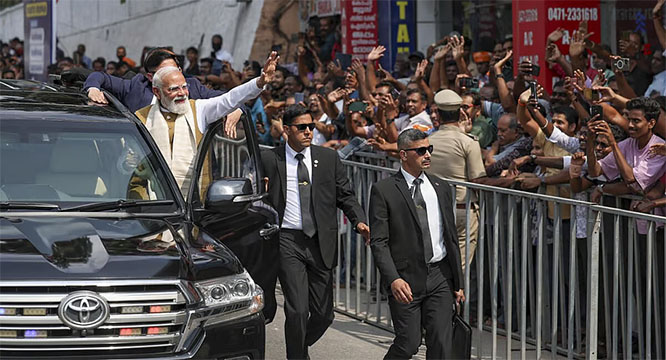
Prime Minister Narendra Modi, during his visit to Thiruvananthapuram on Friday, January 23, indicated that the Bharatiya Janata Party (BJP) is aiming to expand its political footprint in Kerala ahead of the Assembly elections scheduled in the coming months.

Speaking at a BJP-organised public meeting, Modi drew parallels between the party’s early electoral gains in Gujarat and its recent victory in the Thiruvananthapuram Municipal Corporation. The civic body win, which ended decades of Left control, was cited by the Prime Minister as a possible starting point for the party’s broader ambitions in the state.

Recalling BJP’s political trajectory in Gujarat, Modi said the party was largely insignificant before 1987 and received little media attention. He pointed out that the BJP’s first major breakthrough came with its victory in the Ahmedabad Municipal Corporation that year.

“Just as our journey in Gujarat began with one city, Kerala’s journey has also started with a single city,” Modi said, suggesting that the party’s municipal-level success could translate into wider electoral acceptance.

The Prime Minister alleged that successive governments led by the Left Democratic Front (LDF) and the United Democratic Front (UDF) had failed to adequately develop Thiruvananthapuram. He accused both fronts of corruption and neglect, claiming that basic infrastructure and facilities were denied to the capital city for decades.

According to Modi, the BJP’s control of the civic body represents a shift driven by public dissatisfaction with the existing political alternatives. He asserted that the BJP administration in Thiruvananthapuram had begun working towards development, though no specific details or timelines were outlined.

Addressing the gathering at Putharikandam Maidan, Modi said the BJP intended to project Thiruvananthapuram as a “model city,” reiterating his party’s commitment to governance-led change.

The Prime Minister’s visit to Kerala also included the inauguration of several development projects and the flagging off of new train services, as the BJP intensifies its political outreach in the poll-bound state.

Comments

Add new comment

  • Coastaldigest.com reserves the right to delete or block any comments.
  • Coastaldigset.com is not responsible for its readers’ comments.
  • Comments that are abusive, incendiary or irrelevant are strictly prohibited.
  • Please use a genuine email ID and provide your name to avoid reject.
News Network
January 23,2026

Mangaluru: The Karnataka Government Polytechnic (KPT), Mangaluru, has achieved autonomous status from the All India Council for Technical Education (AICTE), becoming the first government polytechnic in the country to receive such recognition in its 78-year history. The status was granted by AICTE, New Delhi, and subsequently approved by the Karnataka Board of Technical Education in October last year.

Officials said the autonomy was conferred a few months ago. Until recently, AICTE extended autonomous status only to engineering colleges, excluding diploma institutions. However, with a renewed national focus on skill development, several government polytechnics across India have now been granted autonomy.

KPT, the second-largest polytechnic in Karnataka, was established in 1946 with four branches and has since expanded to offer eight diploma programmes, including computer science and polymer technology. The institution is spread across a 19-acre campus.

Ravindra M Keni, the first dean of the institution, told The Times of India that AICTE had proposed autonomous status for polytechnic institutions that are over 25 years old. “Many colleges applied. In the first round, 100 institutions were shortlisted, which was further narrowed down to 15 in the second round. We have already completed one semester after becoming an autonomous institution,” he said. He added that nearly 500 students are admitted annually across eight three-year diploma courses.

Explaining the factors that helped KPT secure autonomy, Keni said the institution has consistently recorded 100 per cent admissions and placements for its graduates. He also noted its strong performance in sports, with the college emerging champions for 12 consecutive years, along with active student participation in NCC and NSS activities.

Autonomous status allows KPT to design industry-oriented curricula, conduct examinations, prepare question papers, and manage academic documentation independently. The institution can also directly collaborate with industries and receive priority funding from AICTE or the Ministry of Education. While academic autonomy has been granted, financial control will continue to rest with the state government.

“There will be separate committees for examinations, question paper setting, boards of studies, and boards of examiners. The institution will now have the freedom to conduct admissions without government notifications and issue its own marks cards,” Keni said, adding that new academic initiatives would be planned after a year of functioning under the autonomous framework.

Comments

Add new comment

  • Coastaldigest.com reserves the right to delete or block any comments.
  • Coastaldigset.com is not responsible for its readers’ comments.
  • Comments that are abusive, incendiary or irrelevant are strictly prohibited.
  • Please use a genuine email ID and provide your name to avoid reject.
News Network
February 1,2026

US President Donald Trump on Saturday claimed that the government of India led by Prime Minister Narendra Modi has made a deal to buy Venezuelan oil, as opposed to purchasing it from Iran.

"We've already made that deal, the concept of the deal," he told reporters on Air Force One.

Trump had imposed 25% tariffs on countries buying Venezuelan oil, including India, in March 2025. He had also hit India with tariffs for buying Russian oil, saying it was "funding" President Vladimir Putin's war against Ukraine.

Trump has said that the US has taken control of the oil-rich Venezuela after capturing former President Nicolas Maduro in January.

A fleet of 18 ships loaded with crude oil bound for refineries in Texas, Louisiana, and Mississippi in January, the most since December 2024, according to a report by the news agency Bloomberg.

Combined crude deliveries to the US will reach about 2,75,000 barrels a day, more than doubling volumes seen in December last year. Shipments to China, which averaged 4,00,000 barrels a day last year, fell to zero in January.

PM Modi, Venezuelan President Agree To Expand Ties

Prime Minister Narendra Modi and Venezuela's acting President Delcy Rodriguez spoke on Friday and agreed to take the bilateral relations to "new heights" in the years ahead.

It was the first phone call between the two leaders since the capture of Maduro and his wife by the US on January 3.

"Spoke with Acting President of Venezuela, Ms. Delcy Rodriguez. We agreed to further deepen and expand our bilateral partnership in all areas, with a shared vision of taking India-Venezuela relations to new heights in the years ahead," PM Modi said in a post on X.

A statement from Prime Minister Modi's office said the two leaders agreed to further expand and deepen the India-Venezuela partnership in all areas, including trade and investment, energy, digital technology, health, agriculture, and people-to-people ties.

They exchanged views on various regional and global issues of mutual interest and underscored the importance of their close cooperation for the Global South, the statement said.

Rodriguez also said that they discussed partnerships in the fields of agriculture, science and technology, mining, and tourism, as well as the pharmaceutical and automotive industries.

Comments

Add new comment

  • Coastaldigest.com reserves the right to delete or block any comments.
  • Coastaldigset.com is not responsible for its readers’ comments.
  • Comments that are abusive, incendiary or irrelevant are strictly prohibited.
  • Please use a genuine email ID and provide your name to avoid reject.