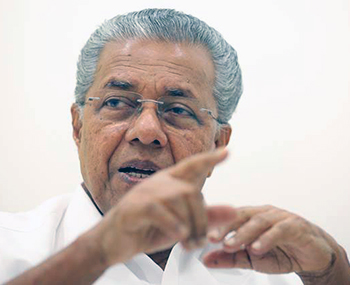
Kerala CM bats for song, says intolerance can't be accepted

Agencies
February 15, 2018

Thiruvananthapuram, Feb 15: Kerala Chief Minister Pinarayi Vijayan today came out in support of the teaser song of 'Oru Aadar Love" against which a police complaint has been filed for hurting religious sentiments.

Intolerance towards the free expression of art and thought cannot be accepted, Vijayan said in a Facebook post.

Referring to the police complaint in Hyderabad against the film's director, Omar Lulu, over the song 'Mani Manikya Malaraya poovi', Vijayan said intolerance from any quarter cannot be accepted.

"In this matter, if anybody suspects that Hindu and Muslim fundamentalists were hand in glove, they cannot be blamed," he said.

The song went viral in the social media catapulting debutante actress Priya Prakash Varrier to instant stardom with her wink and smile.

Vijayan, who hails from Thalassery in the northern Kannur district, said the song is a remix of the mapilla pattu (traditional Muslim song), penned by P M A Jabbar and rendered by Thalassery Rafeeq. It was broadcast by Akashvani in 1978.

The rendition had made the song very popular, he said.

The song about Prophet Mohammad's love for his wife and his marriage has been sung during traditional Muslim wedding ceremonies for decades, Vijayan said.

"The controversy reminds us that fundamentalists, whichever section they belong to, hate all expressions of art. They cannot tolerate the bliss and knowledge common people receive through art and literature," he said.

Art and literature are "strong weapons against religious fundamentalism and communalism and we need to stand by the followers of liberal arts," Vijayan added.

Comments

Rashid
 - 
Friday, 16 Feb 2018

A case if filed against song by an Individual or organization , it is the democratic right of them... no org or authorised political parties do not raised protest against them or complained against it... I do not understand why CM of kerala too hurry to comment on this.....


Music in islam for any song is prohibited.. it is the belief of muslims.. but muslims do not impose on others .. if some of people understand that it is wrong to paste religous song on modern love affairs.. why should we blame them....

Add new comment

  • Coastaldigest.com reserves the right to delete or block any comments.
  • Coastaldigset.com is not responsible for its readers’ comments.
  • Comments that are abusive, incendiary or irrelevant are strictly prohibited.
  • Please use a genuine email ID and provide your name to avoid reject.
News Network
December 24,2025

alhind.jpg

New Delhi: Two new airlines - Al Hind Air and FlyExpress - are set to take to the skies, with the carriers receiving their no objection certificates from the Civil Aviation Ministry.

In 2026, apart from these two carriers, Uttar Pradesh-based Shankh Air, which already has a No Objection Certificate (NOC), is likely to start operations.

Al Hind Air is being promoted by Kerala-based alhind Group.

The ministry is keen to have more airline operators in the country, which is one of the world's fastest growing domestic civil aviation markets.

Currently, there are nine operational scheduled domestic carriers in the country. Fly Big, a regional airline, suspended scheduled flights in October.

IndiGo and Air India Group - Air India and Air India Express - together have over 90 per cent of the domestic market share.

Concerns about apparent duopoly in the fast-growing domestic airlines' industry got amplified this month in the wake of the massive operational disruptions at IndiGo, which has a market share of more than 65 per cent.

"Over the last one week, pleased to have met teams from new airlines aspiring to take wings in Indian skies- Shankh Air, Al Hind Air and FlyExpress. While Shankh Air has already got the NOC from the Ministry, Al Hind Air and FlyExpress have received their NOCs this week," Civil Aviation Minister K Rammohan Naidu said in a post on X on Tuesday.

According to him, it has been the endeavour of the ministry to encourage more airlines in Indian aviation which is amongst the fastest growing aviation markets.

Schemes like UDAN, have enabled smaller carriers Star Air, India One Air and Fly91 to play an important role in the regional connectivity within the country and there is more scope for further growth, he added.

Apart from Air India, Air India Express, IndiGo and state-owned Alliance Air, other scheduled carriers are Akasa Air, SpiceJet, Star Air, Fly91 and IndiaOne Air, as per latest data from the Directorate General of Civil Aviation (DGCA).

In the past years, many airlines, including Go First and Jet Airways, stopped flying amid debt woes.

Comments

Add new comment

  • Coastaldigest.com reserves the right to delete or block any comments.
  • Coastaldigset.com is not responsible for its readers’ comments.
  • Comments that are abusive, incendiary or irrelevant are strictly prohibited.
  • Please use a genuine email ID and provide your name to avoid reject.
News Network
December 16,2025

jordan.jpg

Prime Minister Narendra Modi on Monday held talks with Jordan’s King Abdullah II in Amman, during which the two leaders discussed ways to further strengthen bilateral relations, with the Prime Minister outlining an eight-point vision covering key areas of cooperation.

Describing the meeting as “productive”, PM Modi said he shared a roadmap focused on trade and economy, fertilisers and agriculture, information technology, healthcare, infrastructure, critical and strategic minerals, civil nuclear cooperation, and people-to-people ties.

In a post on social media platform X, the Prime Minister praised King Abdullah II’s personal commitment to advancing India–Jordan relations, particularly as both countries mark the 75th anniversary of the establishment of diplomatic ties this year.

“Held productive discussions with His Majesty King Abdullah II in Amman. His personal commitment towards vibrant India-Jordan relations is noteworthy. This year, we are celebrating the 75th anniversary of our bilateral diplomatic relations,” PM Modi said.

The meeting took place at the Al Husseiniya Palace, where the two leaders also exchanged views on regional and global issues of mutual interest. According to the Ministry of External Affairs (MEA), both sides agreed to further deepen cooperation in areas including trade and investment, defence and security, counter-terrorism and de-radicalisation, fertilisers and agriculture, infrastructure, renewable energy, tourism, and heritage.

The MEA said both leaders reaffirmed their united stand against terrorism.

PM Modi arrived in Amman earlier on Monday and was received by Jordanian Prime Minister Jafar Hassan, who accorded him a formal welcome. Following the talks, King Abdullah II hosted a banquet dinner in honour of the Prime Minister, reflecting the warmth of bilateral ties.

Jordan is the first leg of PM Modi’s three-nation tour. From Amman, the Prime Minister will travel to Ethiopia at the invitation of Prime Minister Abiy Ahmed Ali, marking his first official visit to the African nation. The tour will conclude with a visit to Oman.

Comments

Add new comment

  • Coastaldigest.com reserves the right to delete or block any comments.
  • Coastaldigset.com is not responsible for its readers’ comments.
  • Comments that are abusive, incendiary or irrelevant are strictly prohibited.
  • Please use a genuine email ID and provide your name to avoid reject.
News Network
December 13,2025

New Delhi: School-going children are picking up drug and smoking habits and engaging in consumption of alcohol, with the average age of introduction to such harmful substances found to be around 13 years, suggesting a need for earlier interventions as early as primary school, a multi-city survey by AIIMS-Delhi said.

The findings also showed substance use increased in higher grades, with grade XI/XII students two times more likely to report use of substances when compared with grade VIII students. This emphasised the importance of continued prevention and intervention through middle and high school.

The study led by Dr Anju Dhawan of AIIMS's National Drug Dependence Treatment Centre, published in the National Medical Journal of India this month, looks at adolescent substance use across diverse regions.

The survey included 5,920 students from classes 8, 9, 11 and 12 in urban government, private and rural schools across 10 cities -- Bengaluru, Chandigarh, Delhi, Dibrugarh, Hyderabad, Imphal, Jammu, Lucknow, Mumbai, and Ranchi. The data were collected between May 2018 and June 2019.

The average age of initiation for any substance was 12.9 (2.8) years. It was lowest for inhalants (11.3 years) followed by heroin (12.3 years) and opioid pharmaceuticals (without prescription; 12.5 years).

Overall, 15.1 per cent of participants reported lifetime use, 10.3 per cent reported past year use, and 7.2 per cent reported use in the past month of any substance, the study found.

The most common substances used in the past year, after tobacco (4 per cent) and alcohol (3.8 per cent), were opioids (2.8 per cent), followed by cannabis (2 per cent) and inhalants (1.9 per cent). Use of non-prescribed pharmaceutical opioids was most common among opioid users (90.2 per cent).

On being asked, 'Do you think this substance is easily available for a person of your age' separately for each substance category, nearly half the students (46.3 per cent) endorsed that tobacco products and more than one-third of the students (36.5 per cent) agreed that a person of their age can easily procure alcohol products.

Similarly, for Bhang (21.9 per cent), ganja/charas (16.1 per cent), inhalants (15.2 per cent), sedatives (13.7 per cent), opium and heroin (10 per cent each), the students endorsed that these can be easily procured.

About 95 per cent of the children, irrespective of their grade, agreed with the statement that 'drug use is harmful'.

The rates of substance use (any) among boys were significantly higher than those of girls for substance use (ever), use in the past year and use in the past 30 days. Compared to grade VIII students, grade IX students were more likely, and grade XI/XII students were twice as likely to have used any substance (ever).

The likelihood of past-year use of any substance was also higher for grade IX students and for grade XI/XII students as compared to grade VIII students.

About 40 per cent of students mentioned that they had a family member who used tobacco or alcohol each. The use of cannabis (any product) and opioid (any product) by a family member was reported by 8.2 per cent and 3.9 per cent of students, respectively, while the use of other substances, such as inhalants/sedatives by family was 2-3 per cent, the study found.

A relatively smaller percentage of students reported use of tobacco or alcohol among peers as compared to among family members, while a higher percentage reported inhalants, sedatives, cannabis or opioid use among peers.

Children using substances (past year) compared to non-users reported significantly higher any substance use by their family members and peers.

There were 25.7 per cent students who replied 'yes' to the question 'conflicts/fights often occur in your family'. Most students also replied affirmatively to 'family members are aware of how their time is being spent' and 'damily members are aware of with whom they spend their time'.


Comments

Add new comment

  • Coastaldigest.com reserves the right to delete or block any comments.
  • Coastaldigset.com is not responsible for its readers’ comments.
  • Comments that are abusive, incendiary or irrelevant are strictly prohibited.
  • Please use a genuine email ID and provide your name to avoid reject.