



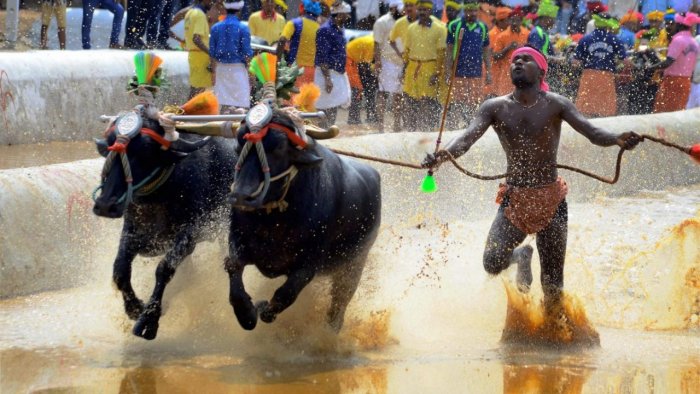
Kambala season begins to enthuse local folks in coastal Karnataka

News Network
December 17, 2022

kambala.jpg

Kambala, the traditional buffalo race event popular in the coastal Karnataka districts of Dakshina Kannada, Udupi and Kasaragod of Kerala, has embarked on a new season, entertaining tourists and the rural population in the region known as Tulu Nadu.

The first kambala (buffalo race in slushy paddy fields) of the season was set in motion at Kakkepadavu in Bantwal taluk of DK district on November 26.

Priest Raghavendra Bhat performed the rituals and temple pujari Yogindra Bhat inaugurated the ‘Sathya Dharma Kambala’ at the venue, which entered its decennial year. A total of 22 competitive kambalas have been tentatively scheduled for the 2022-23 season till April 8 next year, according to district Kambala committee president Rohit Hegde Yermal.

The last Kambala has been scheduled at Panapila in Moodbidri on April 8, 2023.

The events to be held at Bolangala near Mudipu and Panapila are the two new Kambalas which have been added to the season’s calendar. The kambala track at Bolangala is getting ready while the track at Panapila has already been prepared, sources said. Kambalas are usually held at 18 to 20 places in the region on behalf of the committee every year.

The number rose to 22 this season due to the apparent enthusiasm among the youth who are more attracted to the event in recent years. The sixth edition of Mangaluru Kambala under the aegis of Capt Brijesh Chowta will be held on January 22 at the Goldfinch city ground. Former MLC Capt Ganesh Karnik said Kambala sport needs to be preserved for future generations and youth need to be actively taking part in it.

The rich culture of the coastal belt through Kambala should be maintained, he said, seeking the support of all for the sixth Mangaluru kambala.

Two Kambalas at Katapadi (Beedu kambala) to be held on February 11, 2023, and Aikala (Bava Kambala) on January 28 are more than 100 years old and were once traditional events which later turned into competitive ones.

The competitive kambala events are held on two parallel race tracks filled with slushy fields. Buffalo owners and farmers in the region take good care of their buffalos and the best of them are well fed, oiled and nurtured for a race in kambala. Buffaloes are usually raced in pairs during a kambala event, held together with ploughs and ropes. The best of Kambala buffaloes can cover a 140-meter race track in around 12 seconds. The jockey or kambala runner is the man commanding the buffaloes and races along with them and only the most athletic youth can handle the animals.

The runner stands on a wooden plank (known as halage) supported to the setup that holds two buffaloes together (called Negilu). The Kambala runner controls the buffaloes with a whip or ropes.

The runner also entertains spectators by splashing water as high as possible during the race. Two teams of buffaloes along with their jockeys race towards the finish line on the two parallel race tracks. Race goes on all day and winners qualify for the next rounds. Kambala events usually begin in November after the October paddy harvest is done. More than 45 villages in coastal Karnataka celebrate the traditional, non-competitive kambala race every year. Major Kambala events are held at Aikala, Katapadi, Pilikula, Mangaluru, Moodbidri, Puttur, Paivalike, Kakkepadavu, Kulur, Surathkal, Uppinangadi, Vamanjoor and Venur.

Kambala has become an organised rural sport, with elaborate planning and scheduling to accommodate competitions at different places. While traditional Kambala was non-competitive with pairs running one by one, in the modern event, the contest generally takes place between two pairs of buffaloes. The winning pair of buffaloes were usually rewarded with coconuts and bananas. At present, winning owners earn gold and silver coins and in many competitions, cash prizes are also awarded. The length of the kambala tracks varies from 133.5 metre to 150 metre and has width from 15 feet to 17 feet.

The competitions are held in six categories of Kane halage, adda halage, hagga senior, hagga junior, naegilu hiriya and naegilu kiriya. More pairs of buffalos are expected this year for the hagga junior competitions as many youngsters are showing more interest in taking part in the events, a Kambala committee member said. The kambalas for the 2021-22 season, which began on November 27 last year, had to be temporarily cancelled due to the weekend curfew and other Covid-19 restrictions, after holding only six of the 19 scheduled events.

The events resumed on February 5, 2022 after the lifting of the curfew with a renewed calendar, listing 11 kambalas between February 5 and April 16. The kambala committee counts at least 100 jockeys taking part in the events in the region. Of them, 8 to 10 are top performers while around 20 have already displayed their brilliance in the sport. One of the jockeys, Srinivas Gowda, a construction worker, had shot into the limelight in 2020, when he covered 142.5 metres in 13.62 seconds, which when back-calculated, equates to 100-metre run in around 9.55 seconds. It was 0.03 seconds faster than Usain Bolt’s record time of 9.58 seconds. Many compared his feat to that of Bolt and Gowda was termed as the ‘Usain Bolt of Kambala.’

Later, he himself said putting him on the same plane as Usain Bolt would be a bit of a stretch. The race involves the athlete maintaining momentum with some help from his racing buffaloes.

Kambala had also stirred controversy in the past with the charge of ill-treatment of animals. In 2016, the event was banned for the first time by the High Court, based on a petition by animal rights activists group PETA. Just like the row over jallikattu in Tamil Nadu, a heated debate followed with arguments of people supporting the event and those against the rural sport. The state government later brought an ordinance in 2017 to pave the way for the continuance of kambala. The Prevention of Cruelty to Animals (Karnataka second amendment) Act, 2017, permits kambala to be organised with restrictions to protect the animals from mistreatment. The Supreme Court has also issued several guidelines to ensure that kambala buffaloes are not harmed, tortured or ill-treated during the races. 

Comments

Add new comment

  • Coastaldigest.com reserves the right to delete or block any comments.
  • Coastaldigset.com is not responsible for its readers’ comments.
  • Comments that are abusive, incendiary or irrelevant are strictly prohibited.
  • Please use a genuine email ID and provide your name to avoid reject.
News Network
February 5,2026

Bengaluru: As air quality continues to worsen across several parts of the city, hospitals in Bengaluru are reporting a steady rise in patients suffering from respiratory illnesses such as asthma, bronchitis and Chronic Obstructive Pulmonary Disease (COPD), health officials and doctors said.

Data from the Suvarna Arogya Suraksha Trust (SAST) shows that 3,891 patients received treatment for respiratory ailments between April and November 2024. The figure rose to 4,187 during the same period in 2025.

Private hospitals, too, are witnessing a 10–15 per cent year-on-year increase in such cases.

While doctors caution that the rise cannot be attributed solely to air pollution, a significant number of patients are non-smokers with no prior history of respiratory disease.

“Nearly 70 per cent of the patients we see are non-smokers with no previous respiratory issues. When other causes are ruled out, air pollution emerges as the most likely factor,” said Dr Manjunath PH, consultant interventional pulmonologist at a hospital in Kengeri.

Doctors noted that patient footfall spikes during the winter months and around Deepavali, when air quality typically worsens.

“There is a clear correlation between poor air quality and the rise in cases. People commonly present with persistent cough, breathlessness and irritation of the respiratory tract, indicating the impact of polluted air on their health,” said Dr Sheetal Chaurasia, consultant in pulmonary medicine at a private hospital in Whitefield.

Dr Chaurasia added that respiratory tract infections are also on the rise.

“Poor air quality leads to chronic airway inflammation, making the airways more vulnerable to infections. We are seeing an increase in both upper and lower respiratory tract infections,” she said.

Patients with pre-existing respiratory conditions remain the worst affected.

“For those already diagnosed with respiratory illnesses, deteriorating air quality significantly worsens the condition. Both the frequency and severity of attacks increase sharply,” said Dr Vandana P, a pulmonologist at a hospital on Bannerghatta Road.

Doctors also flagged a worrying trend of rising respiratory problems among younger adults and children.

To reduce exposure, they advised people to wear masks while travelling on two-wheelers or autos and ensure adequate ventilation at home to minimise indoor air pollution.

Comments

Add new comment

  • Coastaldigest.com reserves the right to delete or block any comments.
  • Coastaldigset.com is not responsible for its readers’ comments.
  • Comments that are abusive, incendiary or irrelevant are strictly prohibited.
  • Please use a genuine email ID and provide your name to avoid reject.
News Network
February 1,2026

Bengaluru: Karnataka Deputy Chief Minister D K Shivakumar on Sunday criticised the Union Budget presented by Finance Minister Nirmala Sitharaman, claiming it offered no tangible benefit to the state.

Though he said he was yet to study the budget in detail, Shivakumar asserted that Karnataka had gained little from it. “There is no benefit for our state from the central budget. I was observing it. They have now named a programme after Mahatma Gandhi, after repealing the MGNREGA Act that was named after him,” he said.

Speaking to reporters here, the Deputy Chief Minister demanded the restoration of MGNREGA, and made it clear that the newly enacted rural employment scheme — VB-G RAM G — which proposes a 60:40 fund-sharing formula between the Centre and the states, would not be implemented in Karnataka.

“I don’t see any major share for our state in this budget,” he added.

Shivakumar, who also holds charge of Bengaluru development, said there were high expectations for the city from the Union Budget. “The Prime Minister calls Bengaluru a ‘global city’, but what has the Centre done for it?” he asked.

He also drew attention to the problems faced by sugar factories, particularly those in the cooperative sector, alleging a lack of timely decisions and support from the central government.

Noting that the Centre has the authority to fix the minimum support price (MSP) for agricultural produce, Shivakumar said the Union government must take concrete steps to protect farmers’ interests.

Comments

Add new comment

  • Coastaldigest.com reserves the right to delete or block any comments.
  • Coastaldigset.com is not responsible for its readers’ comments.
  • Comments that are abusive, incendiary or irrelevant are strictly prohibited.
  • Please use a genuine email ID and provide your name to avoid reject.
News Network
January 31,2026

Roy.jpg

Bengaluru: The shooting incident involving CJ Roy, founder of the Confident Group, has once again put the spotlight on a businessman whose life has swung between flamboyant global success and persistent controversy at home.

Though Roy’s business interests extended across continents, his roots lay firmly in Karnataka. An alumnus of Christ School in Bengaluru, he later moved to Tumakuru to pursue an engineering degree. Those familiar with his early years describe him as intensely ambitious, beginning his career as a salesman at a small electronics firm dealing in computers.

Roy’s entry into large-scale real estate came through the Crystal Group, where he worked closely with Latha Namboothiri and rose from manager to director. However, the launch of the Confident Group in 2005 was clouded by industry speculation. Insiders speak of a fallout involving alleged “benami” properties and claims of deception that ultimately led to his independent venture—an episode Roy spent years trying to distance himself from, according to associates.

A tale of two cities

Roy’s professional trajectory diverged sharply across geographies.

In Dubai, he built a reputation as a bold and efficient developer, completing massive luxury residential projects in record time—some reportedly within 11 months. His rapid project delivery and lavish lifestyle in the Emirates earned him admiration and visibility in the real estate sector.

In Bengaluru, however, his image remained far more fractured. Sources say Roy stayed away from the city for several years amid disputes over unpaid dues to vendors and suppliers. Several projects were allegedly stalled, with accusations of unfulfilled commitments to cement and steel suppliers continuing to follow him.

Roy’s return to Bengaluru’s business and social circles began around 2018, marked by a conscious attempt at rebranding. His appointment as Honorary Consul of the Slovak Republic added diplomatic legitimacy, which he complemented with visible CSR initiatives, including ambulance donations and high-profile charity events.

Heavy police presence in Langford Town

Following the incident, police personnel from the Central division were deployed outside the Confident Group building in Langford Town, which also houses the Slovak Honorary Consulate in Bengaluru.

The otherwise busy premises near Hosur Road wore a deserted look on Friday, reflecting the shock and uncertainty that followed the tragedy.

Comments

Add new comment

  • Coastaldigest.com reserves the right to delete or block any comments.
  • Coastaldigset.com is not responsible for its readers’ comments.
  • Comments that are abusive, incendiary or irrelevant are strictly prohibited.
  • Please use a genuine email ID and provide your name to avoid reject.
