



India’s GDP contracts by record 23.9% in first quarter of FY2020

News Network
August 31, 2020

Bengaluru, Aug 31: India’s economy contracted at its steepest pace of 23.9% in the June quarter as the pandemic lockdown dented consumer and business spending, putting pressure on the government and central bank for further stimulus and a rate cut.

The gross domestic product (GDP) data released on Monday showed consumer spending, private investments and exports all collapsed during the world’s strictest lockdown imposed in late March to combat the COVID-19 pandemic.

A Reuters poll of economists had forecast that GDP in the world’s fifth-largest economy will contract by 18.3% in the June quarter, compared with 3.1% growth in the previous quarter, the worst performance in at least eight years.

COMMENTARY

PRITHVIRAJ SRINIVAS, CHIEF ECONOMIST, AXIS CAPITAL, MUMBAI

“The June-quarter GDP growth number confirms that India’s national lockdown was the most severe and the deepest GDP decline among large countries.

“The gradual reversal of the lockdown since mid-April is likely to reduce the severity of GDP contraction in coming quarters. However, to erase the contraction fully we need to see an improved consumer sentiment.”

SHASHANK MENDIRATTA, ECONOMIST, IBM, NEW DELHI

“As expected, growth contracted sharply in the June quarter. Investment demand recorded a 47% decline, while private consumption recorded a contraction of nearly 20%. With a contraction of 20.6% y/y, service sector was a key drag on the growth.

“While the overall growth print witnessed the weakest decline on record, this also marks a bottom in our view. Our assessment is that investment will likely stay weak, while consumption activity is likely to improve in subsequent quarters. For a broader recovery, however, supportive policy will need to provide a push.”

ADITI NAYAR, PRINCIPAL ECONOMIST, ICRA, GURUGRAM

“The GDP and GVA plunged precipitously in the lockdown-ridden Q1 of FY2021, both printing similar to our forecast of a 25% contraction. Moreover, incoming data on the MSME and less-formal sectors could manifest in a deeper contraction when revised data is released subsequently. We maintain our forecast that the Indian economy will contract by 9.5% in FY2021.

“The wide discrepancy between the double-digit growth of the government’s final consumption expenditure and the contraction in public administration, defence and other services on the production side, is rather incongruous.”

SUVODEEP RAKSHIT, SENIOR ECONOMIST, KOTAK INSTITUTIONAL EQUITIES, MUMBAI

“Real GDP growth at (-)23.9% in 1QFY21 was much lower than what the markets were expecting. The choice for the government will be on whether the consumption or the investment side needs to be pushed. Given the limited fiscal space and the need to stimulate a more durable growth, the growth recovery will be gradual and is likely to continue into 1HFY22.”

MADHAVI ARORA, LEAD ECONOMIST, FX AND RATES, EDELWEISS SECURITIES, MUMBAI

“The Q1 GDP growth print came in worse than our expectations of -18%. The surprise take-away elements were the better-than-expected performance of finance and real-estate sectors, and more pertinently, a sharp contraction in public administration (proxy for government spending) data. Nonetheless, it does little to change the broad contours of the growth trajectory.

“The sub-optimal policy response would only mean the downward cycle could stretch further, while structural constraints limit sustained secular growth pick-up ahead. We think the government will have to loosen its fiscal strings further in 2HFY21 if growth prospects remain weak.” SAKSHI GUPTA, SENIOR ECONOMIST, HDFC BANK, GURUGRAM”Given the lack of reporting due to the lockdown in Q1 (especially for the informal sector), we expect the GDP numbers to be revised down further in subsequent releases.

“Hopes of an economic recovery in the second half of the year have been pinned on a rural sector revival. However, with the virus spreading to the hinterland, the rural support might be lower than expected.

“In terms of the growth prints, Q1 is likely to be the worst print and it will be a very slow grind up from this bottom going forward. We continue to expect a -7.5% growth print for the year with a downward bias to our forecast.”

RAJANI SINHA, CHIEF ECONOMIST, KNIGHT FRANK INDIA, MUMBAI

“The sharp fall in the first-quarter GDP is on expected lines, given that around 70-80% of the economy was on a standstill in the first two months of this quarter.

“With the economy unlocking in the last few months, most economic parameters have improved to 70-90% level of the corresponding period of last year. However, a sustainable recovery would depend on the time taken to contain the spread of virus. Increased infrastructure investment by the government and demand-boosting measures are much required for the economy to recover.”

SUJAN HAJRA, CHIEF ECONOMIST, ANAND RATHI SECURITIES, MUMBAI

“This kind of a decline was expected as there was a lockdown for roughly half of the quarter. The infrastructure data showed the decline was less than 10%, and with the exception of cement and steel, all other sectors have done reasonably well. “The Reserve Bank of India (RBI) won’t lose too much sleep on this number as it was expected. The RBI still has its focus on growth. This (GDP number) slightly improves chances of a rate cut in October. Unless the inflation comes below 5% in the next reading, the RBI still might postpone the rate cut to December.”

RUPA REGE NITSURE, GROUP CHIEF ECONOMIST, L&T FINANCIAL HOLDINGS, MUMBAI

“Contraction of real GDP at 23.9% appears to be underestimated, as data collection efforts were hit by the pandemic.

“The NSO had to use substitutes and proxies to estimate the losses of informal sector. So there is a very high probability that this data will undergo several revisions in the future. But broader trends are clearly visible.

“Unless the central and state governments focus on re-starting the economic machine completely, the real process of repair and reconstruction will not gain momentum. Unless this is given the top-most priority, India will get trapped with the unsustainable debt burden.”

UPASNA BHARDWAJ, SENIOR ECONOMIST, KOTAK MAHINDRA BANK, MUMBAI

“After a record contraction in Q1, we expect the following quarters to normalise registering a much slower fall. The high-frequency data since June has been suggesting a significant pickup in activity. Nonetheless, the weakness in demand is expected to weigh across all sectors and some policy support will be necessary to cushion any further deterioration.

“We expect some kind of stimulus from the government in the coming few months. The recent policy measures from the RBI will help cap any sharp upside risks to bond yields in case of any incremental supply.”

SIDDHARTHA SANYAL, CHIEF ECONOMIST AND HEAD OF RESEARCH, BANDHAN BANK, KOLKATA

“The GDP contraction of nearly 24% y/y during Q1 FY21 was clearly sharper than expected. Also, given the lack of clarity about whether the disruption in informal sector activities were captured adequately, the possibility of further worsening of Q1 FY21 GDP estimate during subsequent rounds of revisions cannot be ruled out. Overall, GDP looks set to record near double-digit contraction during FY21.

“However, rural activities seem to be relatively more resilient at the moment and might benefit from the government’s rural-focused employment schemes. Given the recent uptick in CPI prints, it seems that the RBI may not be in a position to cut rates in the near-future.”

Comments

Add new comment

  • Coastaldigest.com reserves the right to delete or block any comments.
  • Coastaldigset.com is not responsible for its readers’ comments.
  • Comments that are abusive, incendiary or irrelevant are strictly prohibited.
  • Please use a genuine email ID and provide your name to avoid reject.
News Network
January 23,2026

Karnataka Governor Thaawarchand Gehlot read only three lines from the 122-paragraph address prepared by the Congress-led state government while addressing the joint session of the Legislature on Thursday, effectively bypassing large sections critical of the BJP-led Union government.

The omitted portions of the customary Governor’s address outlined what the state government described as a “suppressive situation in economic and policy matters” under India’s federal framework. The speech also sharply criticised the Centre’s move to replace the Mahatma Gandhi National Rural Employment Guarantee Act (MGNREGA) with the Viksit Bharat–Guarantee for Rozgar and Ajeevika Mission (Gramin) Act, commonly referred to as the VB-GRAM (G) Act.

Governor Gehlot had earlier conveyed his objection to several paragraphs that were explicitly critical of the Union government. On Thursday, he confined himself to the opening lines — “I extend a warm welcome to all of you to the joint session of the State legislature. I am extremely pleased to address this august House” — before jumping directly to the concluding sentence of the final paragraph.

He ended the address by reading the last line of paragraph 122: “Overall, my government is firmly committed to doubling the pace of the State’s economic, social and physical development. Jai Hind — Jai Karnataka.”

According to the prepared speech, the Karnataka government demanded the scrapping of the VB-GRAM (G) Act, describing it as “contractor-centric” and detrimental to rural livelihoods, and called for the full restoration of MGNREGA. The state government argued that the new law undermines decentralisation, weakens labour protections, and centralises decision-making in violation of constitutional norms.

Key points from the unread sections of the speech:

•    Karnataka facing a “suppressive” economic and policy environment within the federal system

•    Repeal of MGNREGA described as a blow to rural livelihoods

•    VB-GRAM (G) Act accused of protecting corporate and contractor interests

•    New law alleged to weaken decentralised governance

•    Decision-making said to be imposed by the Centre without consulting states

•    Rights of Adivasis, women, backward classes and agrarian communities curtailed

•    Labourers allegedly placed under contractor control

•    States facing mounting fiscal stress due to central policies

•    VB-GRAM (G) Act accused of enabling large-scale corruption

Comments

Add new comment

  • Coastaldigest.com reserves the right to delete or block any comments.
  • Coastaldigset.com is not responsible for its readers’ comments.
  • Comments that are abusive, incendiary or irrelevant are strictly prohibited.
  • Please use a genuine email ID and provide your name to avoid reject.
News Network
January 23,2026

modIKERALA.jpg

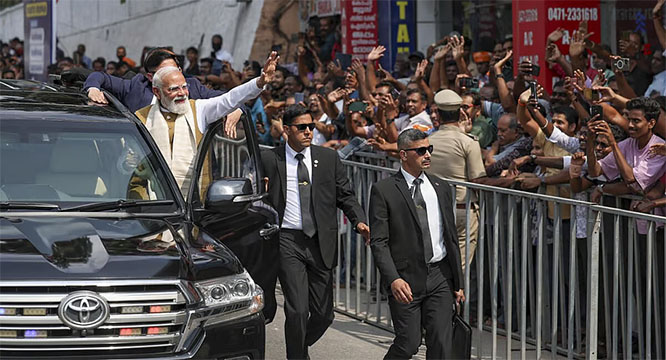
Prime Minister Narendra Modi, during his visit to Thiruvananthapuram on Friday, January 23, indicated that the Bharatiya Janata Party (BJP) is aiming to expand its political footprint in Kerala ahead of the Assembly elections scheduled in the coming months.

Speaking at a BJP-organised public meeting, Modi drew parallels between the party’s early electoral gains in Gujarat and its recent victory in the Thiruvananthapuram Municipal Corporation. The civic body win, which ended decades of Left control, was cited by the Prime Minister as a possible starting point for the party’s broader ambitions in the state.

Recalling BJP’s political trajectory in Gujarat, Modi said the party was largely insignificant before 1987 and received little media attention. He pointed out that the BJP’s first major breakthrough came with its victory in the Ahmedabad Municipal Corporation that year.

“Just as our journey in Gujarat began with one city, Kerala’s journey has also started with a single city,” Modi said, suggesting that the party’s municipal-level success could translate into wider electoral acceptance.

The Prime Minister alleged that successive governments led by the Left Democratic Front (LDF) and the United Democratic Front (UDF) had failed to adequately develop Thiruvananthapuram. He accused both fronts of corruption and neglect, claiming that basic infrastructure and facilities were denied to the capital city for decades.

According to Modi, the BJP’s control of the civic body represents a shift driven by public dissatisfaction with the existing political alternatives. He asserted that the BJP administration in Thiruvananthapuram had begun working towards development, though no specific details or timelines were outlined.

Addressing the gathering at Putharikandam Maidan, Modi said the BJP intended to project Thiruvananthapuram as a “model city,” reiterating his party’s commitment to governance-led change.

The Prime Minister’s visit to Kerala also included the inauguration of several development projects and the flagging off of new train services, as the BJP intensifies its political outreach in the poll-bound state.

Comments

Add new comment

  • Coastaldigest.com reserves the right to delete or block any comments.
  • Coastaldigset.com is not responsible for its readers’ comments.
  • Comments that are abusive, incendiary or irrelevant are strictly prohibited.
  • Please use a genuine email ID and provide your name to avoid reject.
News Network
February 3,2026

Bengaluru: Following reports of fresh Nipah virus (NiV) cases in West Bengal and heightened vigilance across parts of Southeast Asia, the Karnataka Health Department has placed the state on high alert and activated emergency preparedness protocols.

Health officials said enhanced surveillance measures have been initiated after two healthcare workers in Barasat, West Bengal, tested positive for the virus earlier this month. While no cases have been reported in Karnataka so far, authorities said the state’s past exposure to Nipah outbreaks and high inter-state mobility warranted preventive action.

Officials have directed district health teams to intensify monitoring, particularly at hospitals and points of entry, and to ensure early detection and isolation of suspected cases.

High Mortality Virus with Multiple Transmission Routes

Nipah virus is a zoonotic disease that can spread from animals to humans and has a reported fatality rate ranging between 60 and 75 per cent. Fruit bats, also known as flying foxes, are the natural reservoirs of the virus and can transmit it by contaminating food sources with saliva or urine.

Known modes of transmission include:

•    Contaminated food: Consumption of fruits partially eaten by bats or raw date-palm sap
•    Animal contact: Exposure to infected pigs or other animals
•    Human-to-human transmission: Close contact with body fluids of infected persons, particularly in healthcare settings

Symptoms and Disease Progression

The incubation period typically ranges from 4 to 14 days, though delayed onset has also been reported. Early symptoms often resemble common viral infections, making prompt clinical suspicion critical.

•    Initial symptoms: Fever, headache, body aches, fatigue, sore throat
•    Progressive symptoms: Drowsiness, disorientation, altered mental state
•    Severe stage: Seizures, neck stiffness and acute encephalitis, which can rapidly progress to coma

Public Health Advisory

The Health Department has issued precautionary guidelines urging the public to adopt risk-avoidance practices to prevent any local spillover.

Do’s
•    Wash fruits thoroughly before consumption
•    Drink boiled and cooled water
•    Use protective equipment while handling livestock
•    Maintain strict hand hygiene

Don’ts
•    Avoid fruits found on the ground or showing bite marks
•    Do not consume beverages made from raw tree sap, including toddy
•    Avoid areas with dense bat populations
•    Do not handle sick or dead animals

Preparedness Measures

Officials confirmed that isolation wards are being readied in major government hospitals and that medical staff are being sensitised to identify early warning signs.

“There is no cause for panic, but there is a need for heightened vigilance,” a senior health official said, adding that there is currently no approved vaccine or specific antiviral treatment for Nipah, and care remains largely supportive.

Comments

Add new comment

  • Coastaldigest.com reserves the right to delete or block any comments.
  • Coastaldigset.com is not responsible for its readers’ comments.
  • Comments that are abusive, incendiary or irrelevant are strictly prohibited.
  • Please use a genuine email ID and provide your name to avoid reject.