International kite festival concludes

January 23, 2012

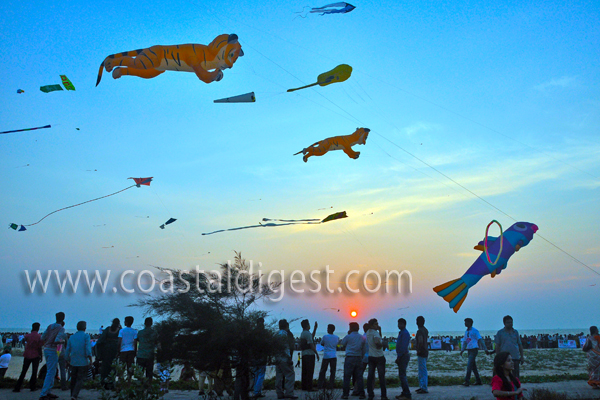
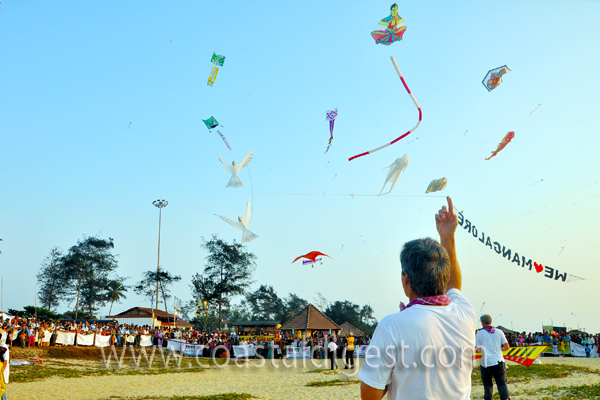
Mangalore, January 23: On Sunday, it was not sea and the shore at Panambur, instead it was sea and oceanic crowd on the shore along with hundreds of kites flying high adding to the happiness of the crowd who had gathered to have a glimpse of them.

Sunday being a holiday, people came as families bringing along elders to kids to enjoy the rare lavish spectacle that happens at Panambur beach-the International Kite Festival. While the kites of different shapes and sizes flew high resembling the aspirations of the hands flying them, Panambur beach took a look of a gala fair.

To cater to the flowing crowd, several shops had come up. While some plush make-shift restaurants flaunted cozy couches served hot, creamy coffee, sandwiches and burgers, there were couple of ice cream stalls helping the crowd to beat the heat. Rest of the smaller shacks sold sugar cane juice, Manchurians, Kebabs, biryanis and even masala powders. Churmuri and groundnut vendors were busy calling on their potential customers, making brisk business during the festival.

In a beauty lounge, couples of artists were busy drawing portraits of their subjects while some drew beautiful mehndi designs on their customers.

Kids were busy checking the market available for them. A stall selling kites saw highest buyers. From elderly to youth to kids everyone thronged at this stall to pick kites for themselves. While designer kites flew high, tiny kites of plastic made appearances all over. While children jumped on the sand to make their kite fly, elders returned to relive moments of childhood by attempting to try their hands on kite flying.

“Kite flying is not very popular in this region, but as a child, I got an opportunity to live in old Delhi for three to four years. It was there that I learnt the art of making and flying kite. I was a mediocre in the art, but I seemed excellent here in Mangalore because not many of my counterparts knew kite flying,” says Sanjeeva Nayak, a businessman in his late 60s.

As many as seven nations- Netherlands, Indonesia, South Korea, UK, France, Kuwait and Lebanon took part in the fest.

Otto Vassen, the participant from the Netherlands was seen interacting with the crowd by handing over the thread of his kite to the individuals in the crowd asking them to fly it. Lot of people enjoyed this nature of Vassen because everyone, deep down their hearts wanted to fly the big, beautiful kites in the arena.

Bob from UK said that the wind at Panambur beach on Sunday evening was favourable for kite flying because it was simply subtle enough to keep the kite safe intact in the air.

“One fascinating thing about flying kite in India is that the space around the arena is never empty. There is cheering crowd all around the arena, which adds to any kite flier's passion. It is an adrenaline for any flier,” says Bob, who feels that Team Mangalore's kites are the best because it always showcases Mangalore's culture.

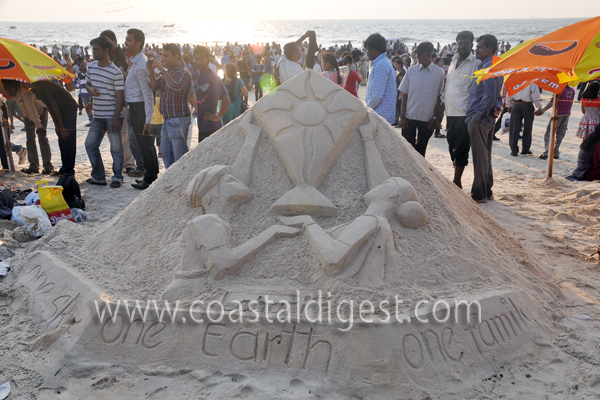
The paper kites made by special kids from Chetana, Mangala Jyoti, Saanidhya and Abhaya Ashraya Mangalore were displayed at the venue. The paintings on the kite spoke eloquently on the feelings of the special children, their wish for peace, tranquility and greenery on earth. The section really upheld the theme of the festival-“One sky, one earth, one family.'

For the first time in India, night kite flying was held using high power beams. Colourful kites embellished black background of sky, adding to the glory of the event.

Some groups were even seen making sand art at the venue, which too bagged good response.

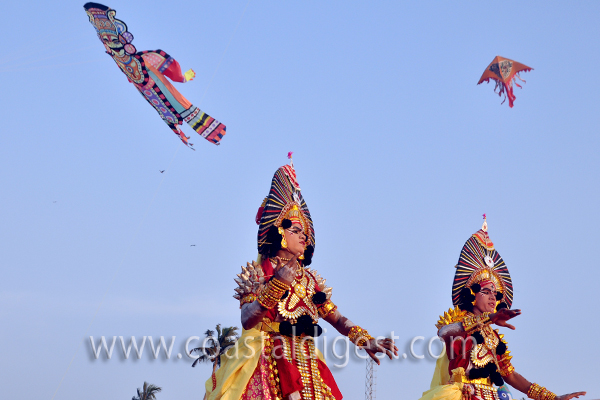
All in all, the kite show ended on Sunday but the memory of the paper falcons' ballet in the sky will live for long, only to be replaced by the fresh kites of next year.

kite1_copy

kite2_copy

kite3

kite4

kite5

kite6

kite7

kite8

kite9

kite10

kite11

Comments

Add new comment

  • Coastaldigest.com reserves the right to delete or block any comments.
  • Coastaldigset.com is not responsible for its readers’ comments.
  • Comments that are abusive, incendiary or irrelevant are strictly prohibited.
  • Please use a genuine email ID and provide your name to avoid reject.
News Network
January 23,2026

Karnataka Governor Thaawarchand Gehlot read only three lines from the 122-paragraph address prepared by the Congress-led state government while addressing the joint session of the Legislature on Thursday, effectively bypassing large sections critical of the BJP-led Union government.

The omitted portions of the customary Governor’s address outlined what the state government described as a “suppressive situation in economic and policy matters” under India’s federal framework. The speech also sharply criticised the Centre’s move to replace the Mahatma Gandhi National Rural Employment Guarantee Act (MGNREGA) with the Viksit Bharat–Guarantee for Rozgar and Ajeevika Mission (Gramin) Act, commonly referred to as the VB-GRAM (G) Act.

Governor Gehlot had earlier conveyed his objection to several paragraphs that were explicitly critical of the Union government. On Thursday, he confined himself to the opening lines — “I extend a warm welcome to all of you to the joint session of the State legislature. I am extremely pleased to address this august House” — before jumping directly to the concluding sentence of the final paragraph.

He ended the address by reading the last line of paragraph 122: “Overall, my government is firmly committed to doubling the pace of the State’s economic, social and physical development. Jai Hind — Jai Karnataka.”

According to the prepared speech, the Karnataka government demanded the scrapping of the VB-GRAM (G) Act, describing it as “contractor-centric” and detrimental to rural livelihoods, and called for the full restoration of MGNREGA. The state government argued that the new law undermines decentralisation, weakens labour protections, and centralises decision-making in violation of constitutional norms.

Key points from the unread sections of the speech:

•    Karnataka facing a “suppressive” economic and policy environment within the federal system

•    Repeal of MGNREGA described as a blow to rural livelihoods

•    VB-GRAM (G) Act accused of protecting corporate and contractor interests

•    New law alleged to weaken decentralised governance

•    Decision-making said to be imposed by the Centre without consulting states

•    Rights of Adivasis, women, backward classes and agrarian communities curtailed

•    Labourers allegedly placed under contractor control

•    States facing mounting fiscal stress due to central policies

•    VB-GRAM (G) Act accused of enabling large-scale corruption

Comments

Add new comment

  • Coastaldigest.com reserves the right to delete or block any comments.
  • Coastaldigset.com is not responsible for its readers’ comments.
  • Comments that are abusive, incendiary or irrelevant are strictly prohibited.
  • Please use a genuine email ID and provide your name to avoid reject.
News Network
February 5,2026

In an era where digital distractions are the primary rival to academic excellence, the Karnataka Education Department is taking the fight directly to the living room. As the SSLC (Class 10) annual examinations loom, officials have launched a localized "digital strike" to ensure students aren't losing their competitive edge to scrolling or soap operas.

The 7-to-9 Lockdown

The department has issued a formal directive urging—and in some cases, enforcing via home visits—a total blackout of mobile phones and television sets between 7:00 PM and 9:00 PM. This two-hour window is being designated as "sacred study time" across the state until the examinations conclude on April 2.

Key Pillars of the Initiative:

•    Doorstep Advocacy: Teachers are transitioning from classrooms to living rooms, meeting parents to explain the psychological benefits of a distraction-free environment.

•    Parental Accountability: The campaign shifts the burden of discipline from the student to the household, asking parents to lead by example and switch off their own devices.

•    The Timeline: The focus remains sharp on the upcoming exam block, scheduled from March 18 to April 2.

"The objective is simple: uninterrupted focus. We are reclaiming the evening hours for the students, ensuring their environment is as prepared as their minds," stated a senior department official.

Student vs. Reality

While the student community has largely welcomed the "forced focus"—with many admitting they lack the willpower to ignore notifications—the move has sparked a debate on enforceability. Without a "TV Police," the success of this initiative rests entirely on the shoulders of parents and the persuasive power of visiting educators.

Comments

Add new comment

  • Coastaldigest.com reserves the right to delete or block any comments.
  • Coastaldigset.com is not responsible for its readers’ comments.
  • Comments that are abusive, incendiary or irrelevant are strictly prohibited.
  • Please use a genuine email ID and provide your name to avoid reject.
News Network
February 1,2026

Bengaluru: The Karnataka High Court has refused to quash an investigation against a WhatsApp group administrator accused of allowing the circulation of obscene and offensive images depicting Hindutva politicians and idols in 2021.

Justice M Nagaprasanna observed that, prima facie, the ingredients of the offence under Section 295A of the Indian Penal Code were made out. “The offence under Section 295A of the IPC is met to every word of its ingredient, albeit prima facie,” the judge said.

The petitioner, Sirajuddin, a resident of Belthangady taluk in Dakshina Kannada district, had challenged the FIR registered against him at the CEN (Cyber, Economics and Narcotics) police station, Mangaluru, for offences under Section 295A of the IPC and Section 67 of the Information Technology Act. Section 295A relates to punishment for deliberate and malicious acts intended to outrage the religious feelings of any class of citizens.

According to the complaint filed by K Jayaraj Salian, also a resident of Belthangady taluk, he received a WhatsApp group link from an unknown source and was added to the group after accessing it. The group reportedly had six administrators and around 250 participants, where obscene and offensive images depicting Hindu deities and certain political figures were allegedly circulated repeatedly.

Sirajuddin was arrested in connection with the case and later released on bail on February 16, 2021. He argued before the court that he was being selectively targeted, while other administrators—including the creator of the group—were neither arrested nor investigated. He also contended that the Magistrate could not have taken cognisance of the offence under Section 295A without prior sanction under Section 196(1) of the CrPC.

Rejecting the argument, Justice Nagaprasanna held that prior sanction is required only at the stage of taking cognisance, and not at the stage of registration of the crime or during investigation.

The judge noted that the State had produced the entire investigation material before the court. “A perusal of the material reveals depictions of Hindu deities in an extraordinarily obscene, demeaning and profane manner. The content is such that its reproduction in a judicial order would itself be inappropriate,” the court said, adding that the material, on its face, had the tendency to outrage religious feelings and disturb communal harmony.

Observing that the case was still at the investigation stage, the court said it could not interdict the probe at this juncture. However, it expressed concern that the investigating officer appeared to have not proceeded uniformly against all administrators. The court clarified that if the investigation revealed the active involvement of any member in permitting the circulation of such content, they must also be proceeded against.

“At this investigative stage, any further observation by this Court would be unnecessary,” the order concluded.

Comments

Add new comment

  • Coastaldigest.com reserves the right to delete or block any comments.
  • Coastaldigset.com is not responsible for its readers’ comments.
  • Comments that are abusive, incendiary or irrelevant are strictly prohibited.
  • Please use a genuine email ID and provide your name to avoid reject.