AIMIT holds national conference on data science and business analytics

May 10, 2012

National_C_5

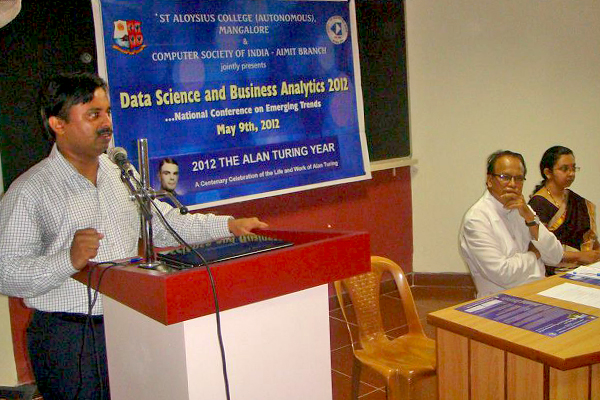
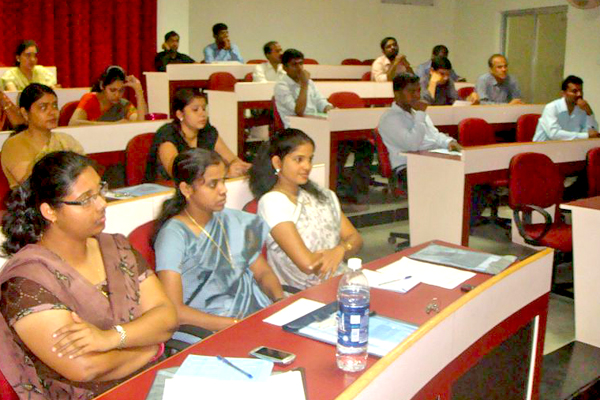
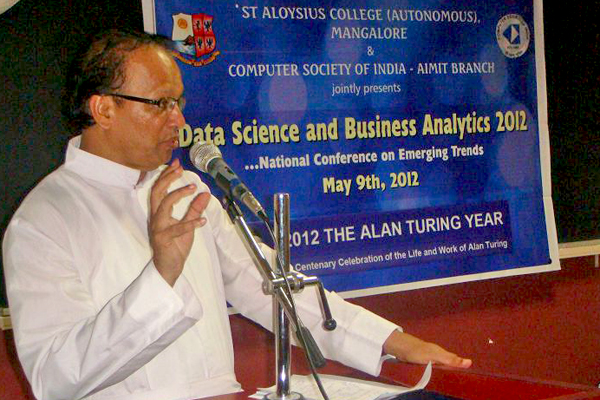
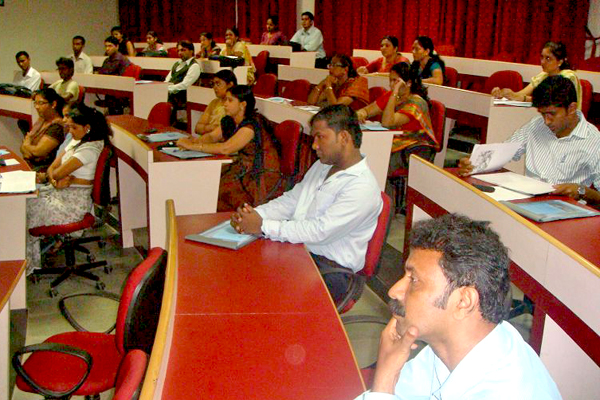
Mangalore, May 10: The national level conference on Data Science and Business Analytics was held at AIMIT campus of St Aloysius College on Wednesday.

Denzil Lobo S.J., Director, AIMIT in his inaugural speech spoke about the processing power of our brain and said, “the most sophisticated computers even today cannot compare with the working of brain of an ant in its ability to process and store voluminous amount of data”.

He spoke of future development in computing paradigms and the day would come when our computers will try to mimic the functioning of a human brain and will be self-learning machines. He also stressed on the need of change in learning paradigm and said that students must be encouraged to THINK rather than memorise.

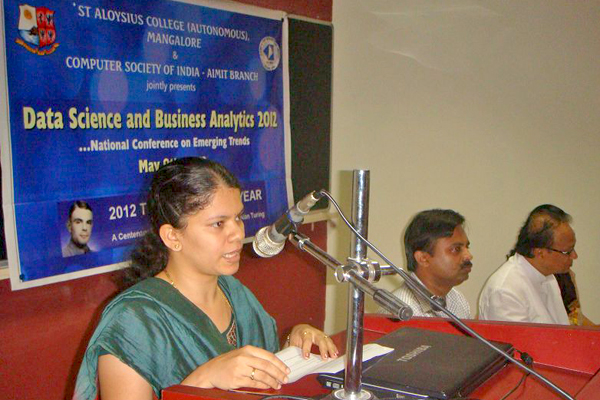
Prof. Santosh Rebello, Dean of the I.T. section, AIMIT, in his introductory remarks and welcome speech spoke about management of “big” data. He said that unstructured data has revolutionized the world and said that if we have to progress, we need to accept and adapt the changes that are taking place. Medha Kudari proposed the vote of thanks.


Sessions

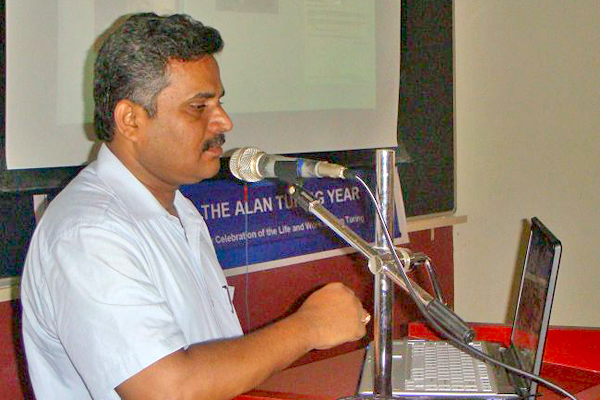
The first session of the day started with the keynote address delivered by Mr. Shekhar, Dept. of M.C.A., Mangalore University. It was on “Machine learning for Vision Applications”. He started his talk by stating that learning is good only when it is efficient; and that whenever changes are made to the system, it should be adaptable and efficient. He illustrated the importance of training and clustering in Machine learning, gave a brief idea of computer vision and started examples with applications. It was concluded that extreme dependence on the machines to reduce the functional capabilities of the person. Finally, Prof. Santosh Rebello mentioned a few insights on Digital space and how to create value out of it.

During the second session papers by the participants were presented. The first paper, titled “Business Intelligence – Achieving success through Data Quality” was presented by Ms. Anusha G. Sabhahit followed by the next paper “Industry Application of Data Mining” by Mr. D M Arvind Mallik. Ms. Kavitha presented the paper “Enhanced Adaptive Item Sequencing using Biserial Correlation and Bayesian Classification” and the paper on “Evolution of statistical software design: Futuristic Agenda” by Ms. Sumitha P V, Mr. Ashok D'souza and Mr. Madhukar S M was presented.

A paper on “Time series data mining algorithm” by Yachana was presented by Ankitha Nayak and Neetha Kripalani Bangera and the paper on “Introduction to Nano-sensors for detecting diabetics and its importance”by Shobha K Bawiskar, Savitha A Lothe, Aqueel Ahmed and Ramesh Manza was presented by Ashwin Kumar and Manish Bharadwaj.

The afternoon session started at 2pm. The keynote address was delivered by Mrs. Rohini Rao, Dept. of M.C.A., Manipal Institute of Technology based on “The role of Domain Ontology in Semantic Data Integration”. She elaborated the definition of Ontology – branch of Metaphysics. She explained about Domain Ontology and how it can be possible to create our own Ontology. She further illustrated on the use of Domain Ontology in data integration with a set of examples.

A paper on “Optimizing Artificial Neural Networks for protein secondary structure prediction” was presented by Mr. Lanwin Lobo. Next, a paper on “A practical approach for implementing Business Intelligence in terms of DSS and KM in socio-economic reality of organization” by Mr. Suman A Lasrado, Mr. Arun D'silva and Mr. Roshan Suvaris was presented which was followed by a tea break for 15 minutes.

A paper on “Incorporating Divide and Conquer approach for clustering large data set with prior K-means algorithm” by Umadevi C and Sowmyapriya G V was presented by Mithun Kumar Shetty and Sujoy K R and the paper on “Analysis on cloud capabilities and adoption using maturity model” by Thanuja G V was presented by Deeksha J Shetty and Devendra Kumar.

The conference came to an end with the valedictory function where the certificates of participation were distributed to the participants.
National_C_1

National_C_6

National_C_7

National_C_3

National_C_2

Comments

Vijay Sharma
 - 
Monday, 4 Jan 2021

Fantastic blog extremely good well enjoyed with the incredible informative content which surely activates the learners to gain enough knowledge. This, in turn, makes the readers explore themselves and involve deeply in the subject. Wish you to dispatch similar content successively in the future as well.

Machine Learning Courses

Add new comment

  • Coastaldigest.com reserves the right to delete or block any comments.
  • Coastaldigset.com is not responsible for its readers’ comments.
  • Comments that are abusive, incendiary or irrelevant are strictly prohibited.
  • Please use a genuine email ID and provide your name to avoid reject.
News Network
February 5,2026

In an era where digital distractions are the primary rival to academic excellence, the Karnataka Education Department is taking the fight directly to the living room. As the SSLC (Class 10) annual examinations loom, officials have launched a localized "digital strike" to ensure students aren't losing their competitive edge to scrolling or soap operas.

The 7-to-9 Lockdown

The department has issued a formal directive urging—and in some cases, enforcing via home visits—a total blackout of mobile phones and television sets between 7:00 PM and 9:00 PM. This two-hour window is being designated as "sacred study time" across the state until the examinations conclude on April 2.

Key Pillars of the Initiative:

•    Doorstep Advocacy: Teachers are transitioning from classrooms to living rooms, meeting parents to explain the psychological benefits of a distraction-free environment.

•    Parental Accountability: The campaign shifts the burden of discipline from the student to the household, asking parents to lead by example and switch off their own devices.

•    The Timeline: The focus remains sharp on the upcoming exam block, scheduled from March 18 to April 2.

"The objective is simple: uninterrupted focus. We are reclaiming the evening hours for the students, ensuring their environment is as prepared as their minds," stated a senior department official.

Student vs. Reality

While the student community has largely welcomed the "forced focus"—with many admitting they lack the willpower to ignore notifications—the move has sparked a debate on enforceability. Without a "TV Police," the success of this initiative rests entirely on the shoulders of parents and the persuasive power of visiting educators.

Comments

Add new comment

  • Coastaldigest.com reserves the right to delete or block any comments.
  • Coastaldigset.com is not responsible for its readers’ comments.
  • Comments that are abusive, incendiary or irrelevant are strictly prohibited.
  • Please use a genuine email ID and provide your name to avoid reject.
News Network
February 3,2026

wind.jpg

Dakshina Kannada MP Capt Brijesh Chowta has urged the Centre to give high priority to offshore wind energy generation along the Mangaluru coast, citing its strategic importance to India’s green energy and port-led development goals.

Raising the issue in the Lok Sabha under Rule 377, Chowta said studies by the National Institute of Oceanography have identified the Mangaluru coastline as part of India’s promising offshore wind ‘Zone-2’, covering nearly 6,490 sq km. He noted that the region’s relatively low exposure to cyclones and earthquakes makes it suitable for long-term offshore wind projects and called for its development as a dedicated offshore wind energy zone.

Highlighting the role of New Mangalore Port, Chowta said its modern infrastructure, multiple berths and heavy cargo-handling capacity position it well as a logistics hub for transporting and assembling large wind energy equipment.

He also pointed to the presence of major industrial units such as MRPL, OMPL, UPCL and the Mangaluru SEZ, which could serve as direct buyers of green power through power purchase agreements, improving project viability and speeding up execution.

With Karnataka’s peak power demand crossing 18,000 MW in early 2025, Chowta stressed the need to diversify renewable energy sources. He added that offshore wind projects in the Arabian Sea are strategically safer compared to the cyclone-prone Bay of Bengal.

Calling the project vital to India’s target of 500 GW of renewable energy by 2030, Chowta urged the Ministry of New and Renewable Energy to initiate resource assessments, pilot projects and stakeholder consultations at the earliest.

Comments

Add new comment

  • Coastaldigest.com reserves the right to delete or block any comments.
  • Coastaldigset.com is not responsible for its readers’ comments.
  • Comments that are abusive, incendiary or irrelevant are strictly prohibited.
  • Please use a genuine email ID and provide your name to avoid reject.