Beedi workers stage statewide protest demanding revised minimum wages

May 18, 2012

beedi_karmica_protest_5

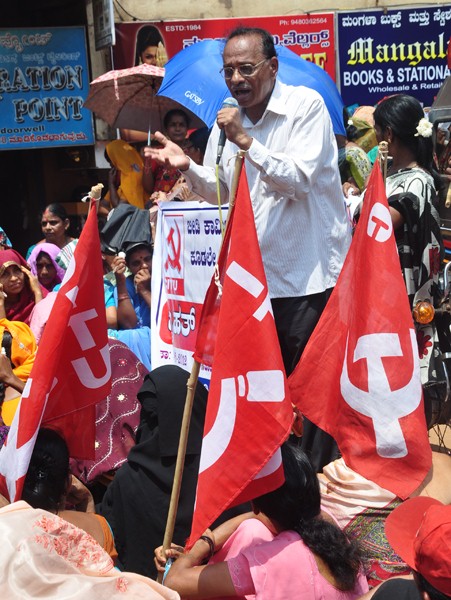
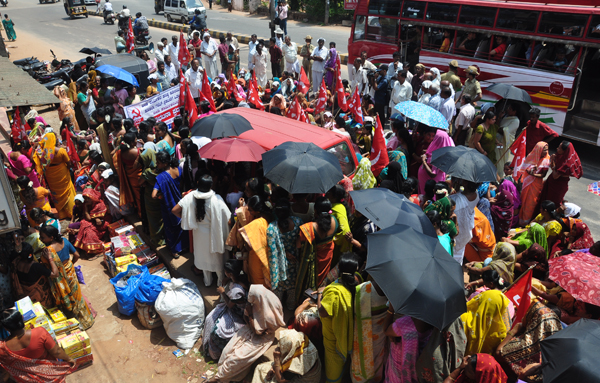
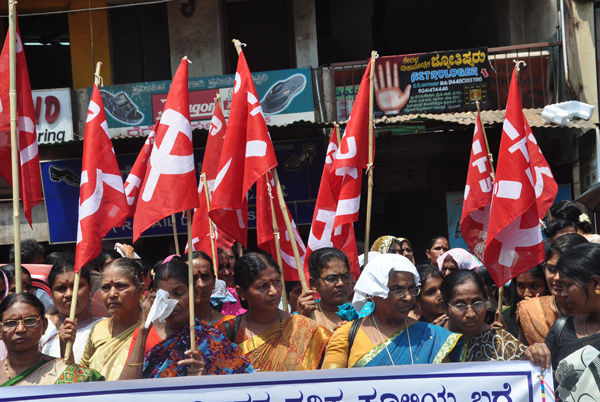
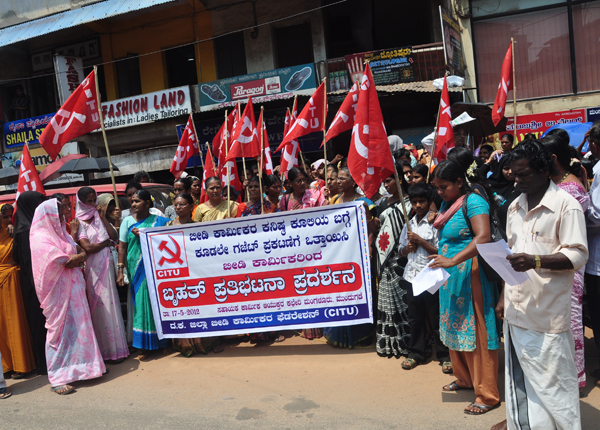
Mangalore/Udupi, May 18: Members of Karnataka State Beedi Workers' Federation on Thursday staged a state-wide protest including in Mangalore and Udupi demanding final notification of revised minimum wages to beedi workers.

Addressing protesters in front of the office of the Assistant Labour Commissioner of Mangalore Region at Kankanady, Federation president B. Madhava said that beedi workers would stop working if the State Government did not publish the gazette notification on the revised minimum wages for workers in the sector within the next seven days.

Mr. Madhava said that a committee appointed by the Government in its meeting on March 8, had resolved to revise the minimum wages for workers for rolling 1,000 beedis to Rs. 106.

It had also resolved to increase the dearness allowance of workers to three paisa per point if the consumer price index went up above 4,284 points.

Accordingly, beedi workers should get Rs. 116.20 including dearness allowance for rolling 1,000 beedis from April 1, 2012.

But owners of beedi companies had not implemented the revised scale stating that the Government had not issued a gazette notification on the revision.

He said the Government had constituted the committee under Section 5 (1) (A) of Minimum Wages Act. It had representatives from the government, workers' unions, and beedi companies.

Mr. Madhava said that the workers would intensify the agitation if the government ignored their demand.

Udupi

In Udupi the protest was held in front of the taluk office. Federation general secretary Ramesh Mendon told presspersons that the Government had agreed to revise the minimum wages for beedi workers to Rs. 116.20 for every 1,000 beedis after trilateral talks between the representatives of beedi firm owners, beedi workers, and the Government.

Nearly 10 lakh beedi workers in the State were expecting the final notification on the revised minimum wages, which were to come to effect on April 1, 2012.

But the Labour Department did not issue the final notification. With the result, the revised minimum wages had not come into force. This was grave injustice to beedi workers.

The Labour Department had shown lack of concern to beedi workers. These beedi workers tied beedis, despite the impact they had on their health, just to eke out a livelihood. The Labour Department had been inhuman in dealing with this issue.

The department wanted to protect the interests of a few owners of beedi firms by its inaction.

The Labour Department should immediately notify the revised minimum wages and make it effective from April 1, Mr. Mendon said.

Federation leaders P. Vishwanath Rai, Dogu Suvarna, Vittal Poojary, K. Lakshman, Indira Kukkikatte, Pushpa M., Revathi Majoor, Indira Kaup, and Prema were present.

The protestors later submitted a memorandum addressed to the Chief Minister at the taluk office.
beedi_karmica_protest_4

beedi_karmica_protest_3

beedi_karmica_protest_2

beedi_karmica_protest_1

Comments

Add new comment

  • Coastaldigest.com reserves the right to delete or block any comments.
  • Coastaldigset.com is not responsible for its readers’ comments.
  • Comments that are abusive, incendiary or irrelevant are strictly prohibited.
  • Please use a genuine email ID and provide your name to avoid reject.
News Network
February 3,2026

wind.jpg

Dakshina Kannada MP Capt Brijesh Chowta has urged the Centre to give high priority to offshore wind energy generation along the Mangaluru coast, citing its strategic importance to India’s green energy and port-led development goals.

Raising the issue in the Lok Sabha under Rule 377, Chowta said studies by the National Institute of Oceanography have identified the Mangaluru coastline as part of India’s promising offshore wind ‘Zone-2’, covering nearly 6,490 sq km. He noted that the region’s relatively low exposure to cyclones and earthquakes makes it suitable for long-term offshore wind projects and called for its development as a dedicated offshore wind energy zone.

Highlighting the role of New Mangalore Port, Chowta said its modern infrastructure, multiple berths and heavy cargo-handling capacity position it well as a logistics hub for transporting and assembling large wind energy equipment.

He also pointed to the presence of major industrial units such as MRPL, OMPL, UPCL and the Mangaluru SEZ, which could serve as direct buyers of green power through power purchase agreements, improving project viability and speeding up execution.

With Karnataka’s peak power demand crossing 18,000 MW in early 2025, Chowta stressed the need to diversify renewable energy sources. He added that offshore wind projects in the Arabian Sea are strategically safer compared to the cyclone-prone Bay of Bengal.

Calling the project vital to India’s target of 500 GW of renewable energy by 2030, Chowta urged the Ministry of New and Renewable Energy to initiate resource assessments, pilot projects and stakeholder consultations at the earliest.

Comments

Add new comment

  • Coastaldigest.com reserves the right to delete or block any comments.
  • Coastaldigset.com is not responsible for its readers’ comments.
  • Comments that are abusive, incendiary or irrelevant are strictly prohibited.
  • Please use a genuine email ID and provide your name to avoid reject.
News Network
February 4,2026

shettigar.jpg

An Indian resident who won the Dh20 million (approximately Rs 50 crore) jackpot in Abu Dhabi's Big Ticket draw has told of his joy at sharing his life-changing fortune with a friend.

Shanthanu Shettigar, a shop manager in Muscat, regularly buys tickets for the monthly grand prize draw with one of his closest friends – and the pair won on February 3.

Mr Shettigar, 33, who is from Udyavar in Udupi district of the southern state of Karnataka and has lived in the Omani capital for eight years, said he was left speechless after learning of his success.

“When I first moved to Muscat, many of my colleagues were purchasing Big Ticket, which encouraged me to give it a try,” he said.

“I started buying tickets on my own, and later began sharing tickets with a close friend. The ticket that brought me this win was one we purchased together.”

“Like most people, I receive a lot of spam calls, and I was fully absorbed in my work as well. I knew the live draw was taking place tonight, but I never imagined my name would be announced,” he said.

“When I realised it was real and that I had won, I was honestly speechless. It still hasn’t fully sunk in, but I’m extremely happy.”

Mr Shettigar is not sure how he will spend his share of the money, but encouraged others to take part.

“This win was completely unexpected, so I want to take some time to think things through before deciding what to do next,” he said.

“I would definitely encourage others to participate with Big Ticket, whether with family or friends – you never know when your moment might come.”

The Big Ticket was established in 1992 with an initial first prize of Dh1 million. It is one of the most popular monthly raffles in the UAE.

It has transformed the lives of many people across the Emirates and beyond.

Entry to the Big Ticket Millionaire is Dh500. Tickets can be bought online or at counters at Zayed International Airport and Al Ain Airport.

Comments

Add new comment

  • Coastaldigest.com reserves the right to delete or block any comments.
  • Coastaldigset.com is not responsible for its readers’ comments.
  • Comments that are abusive, incendiary or irrelevant are strictly prohibited.
  • Please use a genuine email ID and provide your name to avoid reject.
News Network
February 5,2026

In an era where digital distractions are the primary rival to academic excellence, the Karnataka Education Department is taking the fight directly to the living room. As the SSLC (Class 10) annual examinations loom, officials have launched a localized "digital strike" to ensure students aren't losing their competitive edge to scrolling or soap operas.

The 7-to-9 Lockdown

The department has issued a formal directive urging—and in some cases, enforcing via home visits—a total blackout of mobile phones and television sets between 7:00 PM and 9:00 PM. This two-hour window is being designated as "sacred study time" across the state until the examinations conclude on April 2.

Key Pillars of the Initiative:

•    Doorstep Advocacy: Teachers are transitioning from classrooms to living rooms, meeting parents to explain the psychological benefits of a distraction-free environment.

•    Parental Accountability: The campaign shifts the burden of discipline from the student to the household, asking parents to lead by example and switch off their own devices.

•    The Timeline: The focus remains sharp on the upcoming exam block, scheduled from March 18 to April 2.

"The objective is simple: uninterrupted focus. We are reclaiming the evening hours for the students, ensuring their environment is as prepared as their minds," stated a senior department official.

Student vs. Reality

While the student community has largely welcomed the "forced focus"—with many admitting they lack the willpower to ignore notifications—the move has sparked a debate on enforceability. Without a "TV Police," the success of this initiative rests entirely on the shoulders of parents and the persuasive power of visiting educators.

Comments

Add new comment

  • Coastaldigest.com reserves the right to delete or block any comments.
  • Coastaldigset.com is not responsible for its readers’ comments.
  • Comments that are abusive, incendiary or irrelevant are strictly prohibited.
  • Please use a genuine email ID and provide your name to avoid reject.