People breathe a sigh of relief as rainy season begins in Coastal districts

[email protected] (CD Network, Photos by Ahmed Anwar)
June 5, 2012

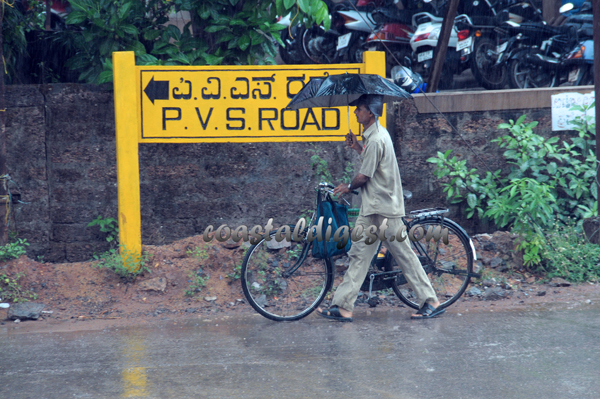
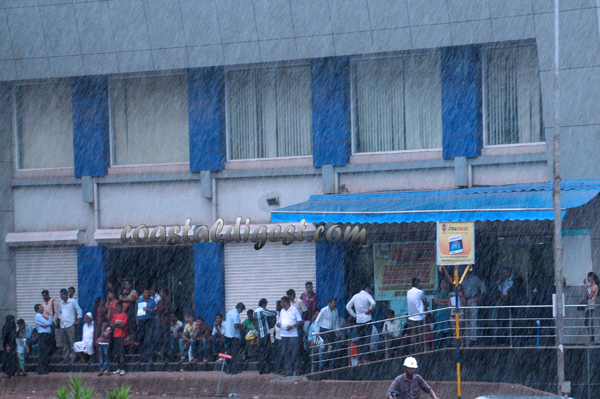
Mangalore, June 5: Coastal districts of Karnataka have been receiving heavy rain with thunder storms since Monday afternoon, setting a much-awaited stage for the arrival of monsoon in the State.

The constant rains brought the much-needed respite to the people of Dakshina Kannada and Udupi from the oppressive heat.

However, motorists and pedestrians including school children had to face the problem as many roads were inundated due to heavy rains in both the coastal cities of Mangalore and Udupi.

India Metrological Department (IMD), Bangalore, had forecast that the coast would receive over 65 mm of rain on Monday and Tuesday. The forecast came true as people in the twin districts woke up to a rainy morning on Tuesday.

However, B. Puttana, Director of the department, said that it was too early to declare this as the onset of monsoon.

“Monsoon has officially not hit the Kerala or Karnataka coast. Though it will rain heavily, the wind speeds are just around 10 nautical miles, when it should be more than 30 to be declared as monsoon showers. Dakshina Kannada and coastal areas are only receiving pre-monsoon showers,” he said.

He said if rain persisted over the coast and conditions continued to remain favourable, the onset of monsoon may be declared as early as June 6.

And with wind speeds picking up and the seas expected to be choppy, the department had advised fishermen to refrain from venturing into the sea.

In Delhi, India Meteorological Department Director-General Laxman Singh Rathore said: “Monsoon is round the corner. Parts of Kerala have been receiving rain since this morning. We may declare the onset of monsoon by Wednesday.”

Kerala usually receives monsoon showers by June 1. Rathore said there was no need to paint a gloomy picture as the progress of the seasonal rainfall phenomenon was well with the forecast limits which have a model error of four days.

A unique feature of this year's monsoon will be its steady progress along the western coast bringing rain to coastal Kerala and leaving the peninsular region relatively dry. Current observations show central and northern Kerala receiving rainfall whileThiruvananthapuram getting little rain.

Weather watchers attribute the slight delay in the onset of monsoon to “Typhoon Mawar,” which was active in the western Pacific Ocean off the Philippines and sucking away moisture and wind currents to power itself.

“The typhoon has moved northward towards Japan and will no longer affect the progression of the monsoon,” Rathore said.

Monsoon rains are crucial for agriculture as only 40 per cent of the cultivable area is under irrigation. The farm sector contributes about only 15 per cent to the country's Gross Domestic Product, but it employs about 60 per cent of India's population. Rathore said deviation of three to four days in arrival of monsoon rains would have no adverse impact on sowing of kharif crops.

"There is no concern for paddy sowing because seedlings are raised first in nursery through irrigation and then transplanted in the field much later,” he said.

There may be no impact on cotton and sugarcane crops as these long-duration crops are mostly cultivated in areas with irrigation facilities.

On the back of good monsoon in 2010 and 2011, the country harvested a record grain production of 245 million tonnes and 252.56 million tonnes, respectively.

Rain_Mangalore_1

Rain_Mangalore_2

Rain_Mangalore_3

Rain_Mangalore_4

Rain_Mangalore_5

Rain_Mangalore_6

Rain_Mangalore_7

Rain_Mangalore_8

Rain_Mangalore_9

Rain_Mangalore_10

Comments

Add new comment

  • Coastaldigest.com reserves the right to delete or block any comments.
  • Coastaldigset.com is not responsible for its readers’ comments.
  • Comments that are abusive, incendiary or irrelevant are strictly prohibited.
  • Please use a genuine email ID and provide your name to avoid reject.
News Network
February 5,2026

Bengaluru: As air quality continues to worsen across several parts of the city, hospitals in Bengaluru are reporting a steady rise in patients suffering from respiratory illnesses such as asthma, bronchitis and Chronic Obstructive Pulmonary Disease (COPD), health officials and doctors said.

Data from the Suvarna Arogya Suraksha Trust (SAST) shows that 3,891 patients received treatment for respiratory ailments between April and November 2024. The figure rose to 4,187 during the same period in 2025.

Private hospitals, too, are witnessing a 10–15 per cent year-on-year increase in such cases.

While doctors caution that the rise cannot be attributed solely to air pollution, a significant number of patients are non-smokers with no prior history of respiratory disease.

“Nearly 70 per cent of the patients we see are non-smokers with no previous respiratory issues. When other causes are ruled out, air pollution emerges as the most likely factor,” said Dr Manjunath PH, consultant interventional pulmonologist at a hospital in Kengeri.

Doctors noted that patient footfall spikes during the winter months and around Deepavali, when air quality typically worsens.

“There is a clear correlation between poor air quality and the rise in cases. People commonly present with persistent cough, breathlessness and irritation of the respiratory tract, indicating the impact of polluted air on their health,” said Dr Sheetal Chaurasia, consultant in pulmonary medicine at a private hospital in Whitefield.

Dr Chaurasia added that respiratory tract infections are also on the rise.

“Poor air quality leads to chronic airway inflammation, making the airways more vulnerable to infections. We are seeing an increase in both upper and lower respiratory tract infections,” she said.

Patients with pre-existing respiratory conditions remain the worst affected.

“For those already diagnosed with respiratory illnesses, deteriorating air quality significantly worsens the condition. Both the frequency and severity of attacks increase sharply,” said Dr Vandana P, a pulmonologist at a hospital on Bannerghatta Road.

Doctors also flagged a worrying trend of rising respiratory problems among younger adults and children.

To reduce exposure, they advised people to wear masks while travelling on two-wheelers or autos and ensure adequate ventilation at home to minimise indoor air pollution.

Comments

Add new comment

  • Coastaldigest.com reserves the right to delete or block any comments.
  • Coastaldigset.com is not responsible for its readers’ comments.
  • Comments that are abusive, incendiary or irrelevant are strictly prohibited.
  • Please use a genuine email ID and provide your name to avoid reject.
News Network
February 5,2026

In an era where digital distractions are the primary rival to academic excellence, the Karnataka Education Department is taking the fight directly to the living room. As the SSLC (Class 10) annual examinations loom, officials have launched a localized "digital strike" to ensure students aren't losing their competitive edge to scrolling or soap operas.

The 7-to-9 Lockdown

The department has issued a formal directive urging—and in some cases, enforcing via home visits—a total blackout of mobile phones and television sets between 7:00 PM and 9:00 PM. This two-hour window is being designated as "sacred study time" across the state until the examinations conclude on April 2.

Key Pillars of the Initiative:

•    Doorstep Advocacy: Teachers are transitioning from classrooms to living rooms, meeting parents to explain the psychological benefits of a distraction-free environment.

•    Parental Accountability: The campaign shifts the burden of discipline from the student to the household, asking parents to lead by example and switch off their own devices.

•    The Timeline: The focus remains sharp on the upcoming exam block, scheduled from March 18 to April 2.

"The objective is simple: uninterrupted focus. We are reclaiming the evening hours for the students, ensuring their environment is as prepared as their minds," stated a senior department official.

Student vs. Reality

While the student community has largely welcomed the "forced focus"—with many admitting they lack the willpower to ignore notifications—the move has sparked a debate on enforceability. Without a "TV Police," the success of this initiative rests entirely on the shoulders of parents and the persuasive power of visiting educators.

Comments

Add new comment

  • Coastaldigest.com reserves the right to delete or block any comments.
  • Coastaldigset.com is not responsible for its readers’ comments.
  • Comments that are abusive, incendiary or irrelevant are strictly prohibited.
  • Please use a genuine email ID and provide your name to avoid reject.
News Network
February 1,2026

Golf.jpg

The coastal city of Mangaluru is gearing up for a major sporting milestone with the launch of a Golf Excellence Academy at the Pilikula Golf Club (PGC), scheduled to open on May 31. The initiative aims to position Mangaluru firmly on India’s national golfing map.

Speaking to reporters on Saturday during PGC’s first-ever floodlit Pro-Am tournament, club captain Manoj Kumar Shetty said the project is being funded by UAE-based philanthropist Michael D’Souza and is currently in the design phase. Experts from leading golf academies across the country are expected to visit Mangaluru to help shape the training programme and infrastructure.

The academy will train 20 young golfers at a time, with a long-term vision of producing national-level players from the region. Until now, PGC relied on an in-house coach, but the recent renovation of the course and the introduction of floodlights have opened new possibilities for expanding the sport.

Shetty said discussions are underway with two reputed coaching academies, whose heads are expected to visit PGC shortly. “A dormitory for trainers is already under construction. We are inviting academies to assess the facilities and suggest changes so we can build a truly world-class Golf Excellence Academy,” he said.

Professional golfer Aryan Roopa Anand noted that the floodlit course would be a game-changer for young players. “Students can now practise after school hours, even up to 8 or 9 pm, without compromising on academics,” he said.

Comments

Add new comment

  • Coastaldigest.com reserves the right to delete or block any comments.
  • Coastaldigset.com is not responsible for its readers’ comments.
  • Comments that are abusive, incendiary or irrelevant are strictly prohibited.
  • Please use a genuine email ID and provide your name to avoid reject.