


Mumbai, Mar 27: The Reserve Bank of India (RBI) on Friday lowered the key repo rate by 75 basis points to 4.4 per cent in a bid to arrest the economic slowdown amid coronavirus (COVID-19) outbreak.
The reverse repo rate now stands at 4 per cent, down by 90 basis points, said RBI Governor Shaktikanta Das adding this has been done to make it unattractive for banks to passively deposit funds with the central bank and instead lend it to the productive sectors.
The six-member monetary policy committee (MPC) met on March 24, 25 and 27 and voted 4:2 in favour of the repo rate reduction. The MPC also decided to continue with the accommodative stance as long as it is necessary to revive growth and mitigate the impact of COVID-19 on the economy while ensuring that inflation remains within the target.
"The need of the hour is to shield the economy from the pandemic," said Das. "We need to mitigate the impact of coronavirus, revive economic growth and provide financial stability."
Repo rate is the rate at which a country's central bank lends money to commercial banks, and the reverse repo rate is the rate at which it borrows from them.
The RBI Governor further said that the economic growth and inflation projection will be highly contingent depending on the duration, spread and intensity of the pandemic.
"Global economic activity has come to a near standstill as COVID-19 related lockdowns and social distancing are imposed across a widening swathe of affected countries. Expectations of a shallow recovery in 2020 from 2019's decade low in global growth have been dashed," said Das.
"The outlook is now heavily contingent upon the intensity, spread and duration of the pandemic. There is a rising probability that large parts of the global economy will slip into recession," he said.
However, the RBI has injected liquidity of Rs 2.8 lakh crore via various instruments equal to 1.4 per cent of GDP. "Along with today's measures, liquidity measures equal to 3.2 per cent of GDP. The RBI will take continuous measures to ensure liquidity in the system."
The RBI governor has said that all banking institutions can offer a three-month moratorium on all loans for a period of three months. The RBI has also allowed banks to restructure the working capital cycle for companies without worrying that these will have to be classified as a non-performing asset (NPA).
The three-month moratorium will permit banks to avoid a large onset of NPAs during the 21-day lockdown and keep their books healthy.
Das said banks and other financial institutions should do all they can to keep credit flowing to economic agents facing financial stress on account of the isolation that the virus has imposed.
"Market participants should work with regulators like the RBI and the Securities and Exchange Board of India (SEBI) to ensure the orderly functioning of markets in their role of price discovery and financial intermediation," he said.
Search
RBI reduces repo rate by 75 basis points to battle COVID-19 impact

News Network
March 27, 2020
PM Modi, King Abdullah II share 8-point vision to deepen India-Jordan ties

News Network
December 16,2025
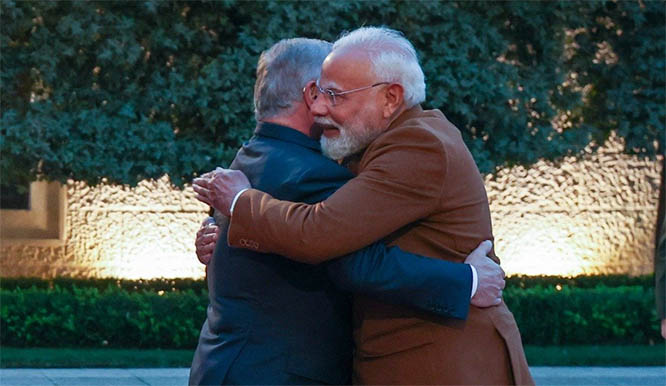
Prime Minister Narendra Modi on Monday held talks with Jordan’s King Abdullah II in Amman, during which the two leaders discussed ways to further strengthen bilateral relations, with the Prime Minister outlining an eight-point vision covering key areas of cooperation.
Describing the meeting as “productive”, PM Modi said he shared a roadmap focused on trade and economy, fertilisers and agriculture, information technology, healthcare, infrastructure, critical and strategic minerals, civil nuclear cooperation, and people-to-people ties.
In a post on social media platform X, the Prime Minister praised King Abdullah II’s personal commitment to advancing India–Jordan relations, particularly as both countries mark the 75th anniversary of the establishment of diplomatic ties this year.
“Held productive discussions with His Majesty King Abdullah II in Amman. His personal commitment towards vibrant India-Jordan relations is noteworthy. This year, we are celebrating the 75th anniversary of our bilateral diplomatic relations,” PM Modi said.
The meeting took place at the Al Husseiniya Palace, where the two leaders also exchanged views on regional and global issues of mutual interest. According to the Ministry of External Affairs (MEA), both sides agreed to further deepen cooperation in areas including trade and investment, defence and security, counter-terrorism and de-radicalisation, fertilisers and agriculture, infrastructure, renewable energy, tourism, and heritage.
The MEA said both leaders reaffirmed their united stand against terrorism.
PM Modi arrived in Amman earlier on Monday and was received by Jordanian Prime Minister Jafar Hassan, who accorded him a formal welcome. Following the talks, King Abdullah II hosted a banquet dinner in honour of the Prime Minister, reflecting the warmth of bilateral ties.
Jordan is the first leg of PM Modi’s three-nation tour. From Amman, the Prime Minister will travel to Ethiopia at the invitation of Prime Minister Abiy Ahmed Ali, marking his first official visit to the African nation. The tour will conclude with a visit to Oman.
Comments
Add new comment
- Coastaldigest.com reserves the right to delete or block any comments.
- Coastaldigset.com is not responsible for its readers’ comments.
- Comments that are abusive, incendiary or irrelevant are strictly prohibited.
- Please use a genuine email ID and provide your name to avoid reject.
‘No constitutional approval required’: RSS chief says ‘India already a Hindu nation’
News Network
December 22,2025
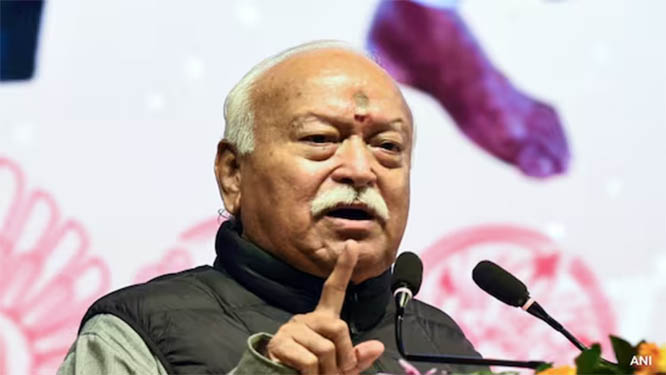
Kolkata: Stressing that India is a "Hindu nation," Rashtriya Swayamsevak Sangh (RSS) Chief Mohan Bhagwat on Sunday said that no constitutional approval is needed as it is the "truth".
Addressing an event marking 100 years of the RSS, Bhagwat said that India is, and will remain, a Hindu nation until Indian culture is appreciated in the country.
"The Sun rises in the east; we don't know since when this has been happening. So, do we need constitutional approval for that, too? Hindustan is a Hindu nation. Whoever considers India their motherland appreciates Indian culture, as long as there is even one person alive on the land of Hindustan who believes in and cherishes the glory of Indian ancestors, India is a Hindu nation. This is the ideology of the Sangh," he said at the '100 Vyakhyan Mala' program of RSS in Kolkata.
"If Parliament ever decides to amend the Constitution and add that word, whether they do it or not, it's fine. We don't care about that word because we are Hindus, and our nation is a Hindu nation. That is the truth. The caste system based on birth is not the hallmark of Hindutva," he added.
RSS has always argued that India is a "Hindu Nation," given the culture and majority's affiliations to Hinduism. However, 'secular' was not originally part of the Preamble of the Constitution, but it was added along with the word 'socialist' by the Constitution (42nd Amendment) Act, 1976, during the Emergency imposed by then Prime Minister Indira Gandhi.
Bhagwat also urged people to visit the organisation's offices and 'shakhas' to understand its work, so that what he dubbed as the “false perception” of the organisation as anti-Muslim can be dispelled!
Bhagwat said that people have understood that the organisation advocates for the protection of Hindus, and are "staunch nationalists," but not anti-muslim.
"If there is a perception that we are anti-Muslim, then, as I said, the RSS work is transparent. You can come anytime and see for yourself, and if you see anything like that happening, then you keep your views, and if you don't see it, then you change your views. There is a lot to understand (about RSS), but if you don't want to understand, then no one can change your mind," Bhagwat said.
He said, but anyone unwilling to learn cannot be helped.
"After seeing, people have said that you are staunch nationalists. You organise Hindus, and you advocate for the protection of Hindus. But you are not anti-Muslim. Many people have accepted this, and those who want to know more should come and see the RSS for themselves," he said.
Comments
Add new comment
- Coastaldigest.com reserves the right to delete or block any comments.
- Coastaldigset.com is not responsible for its readers’ comments.
- Comments that are abusive, incendiary or irrelevant are strictly prohibited.
- Please use a genuine email ID and provide your name to avoid reject.
Average age of school children picking up drugs, smoking habit in 10 Indian cities around 13 years!
News Network
December 13,2025
New Delhi: School-going children are picking up drug and smoking habits and engaging in consumption of alcohol, with the average age of introduction to such harmful substances found to be around 13 years, suggesting a need for earlier interventions as early as primary school, a multi-city survey by AIIMS-Delhi said.
The findings also showed substance use increased in higher grades, with grade XI/XII students two times more likely to report use of substances when compared with grade VIII students. This emphasised the importance of continued prevention and intervention through middle and high school.
The study led by Dr Anju Dhawan of AIIMS's National Drug Dependence Treatment Centre, published in the National Medical Journal of India this month, looks at adolescent substance use across diverse regions.
The survey included 5,920 students from classes 8, 9, 11 and 12 in urban government, private and rural schools across 10 cities -- Bengaluru, Chandigarh, Delhi, Dibrugarh, Hyderabad, Imphal, Jammu, Lucknow, Mumbai, and Ranchi. The data were collected between May 2018 and June 2019.
The average age of initiation for any substance was 12.9 (2.8) years. It was lowest for inhalants (11.3 years) followed by heroin (12.3 years) and opioid pharmaceuticals (without prescription; 12.5 years).
Overall, 15.1 per cent of participants reported lifetime use, 10.3 per cent reported past year use, and 7.2 per cent reported use in the past month of any substance, the study found.
The most common substances used in the past year, after tobacco (4 per cent) and alcohol (3.8 per cent), were opioids (2.8 per cent), followed by cannabis (2 per cent) and inhalants (1.9 per cent). Use of non-prescribed pharmaceutical opioids was most common among opioid users (90.2 per cent).
On being asked, 'Do you think this substance is easily available for a person of your age' separately for each substance category, nearly half the students (46.3 per cent) endorsed that tobacco products and more than one-third of the students (36.5 per cent) agreed that a person of their age can easily procure alcohol products.
Similarly, for Bhang (21.9 per cent), ganja/charas (16.1 per cent), inhalants (15.2 per cent), sedatives (13.7 per cent), opium and heroin (10 per cent each), the students endorsed that these can be easily procured.
About 95 per cent of the children, irrespective of their grade, agreed with the statement that 'drug use is harmful'.
The rates of substance use (any) among boys were significantly higher than those of girls for substance use (ever), use in the past year and use in the past 30 days. Compared to grade VIII students, grade IX students were more likely, and grade XI/XII students were twice as likely to have used any substance (ever).
The likelihood of past-year use of any substance was also higher for grade IX students and for grade XI/XII students as compared to grade VIII students.
About 40 per cent of students mentioned that they had a family member who used tobacco or alcohol each. The use of cannabis (any product) and opioid (any product) by a family member was reported by 8.2 per cent and 3.9 per cent of students, respectively, while the use of other substances, such as inhalants/sedatives by family was 2-3 per cent, the study found.
A relatively smaller percentage of students reported use of tobacco or alcohol among peers as compared to among family members, while a higher percentage reported inhalants, sedatives, cannabis or opioid use among peers.
Children using substances (past year) compared to non-users reported significantly higher any substance use by their family members and peers.
There were 25.7 per cent students who replied 'yes' to the question 'conflicts/fights often occur in your family'. Most students also replied affirmatively to 'family members are aware of how their time is being spent' and 'damily members are aware of with whom they spend their time'.
Comments
Add new comment
- Coastaldigest.com reserves the right to delete or block any comments.
- Coastaldigset.com is not responsible for its readers’ comments.
- Comments that are abusive, incendiary or irrelevant are strictly prohibited.
- Please use a genuine email ID and provide your name to avoid reject.
Comments
Add new comment