VP Venkaiah Naidu starts consultations with legal experts on 'impeachment' notice against CJI

Agencies
April 22, 2018

New Delhi, Apr 23: Rajya Sabha Chairman M Venkaiah Naidu on Sunday set in motion the process of consultation on the impeachment notice against Chief Justice of India Dipak Misra and held discussions with a number of constitutional and legal experts, including Attorney General K K Venugopal, and former top law officer K Parasaran.

The vice president cut short his visit to Hyderabad and reached here to hold deliberations over the notice given by the seven opposition parties.

According to officials, Naidu spoke to former Lok Sabha secretary general Subhash Kashyap, ex-law secretary P K Malhotra and former legislative secretary Sanjay Singh on the issue.

He also held deliberations with senior officials of the Rajya Sabha Secretariat, they said, adding that Naidu also spoke to former Supreme Court judge B Sudarshan Reddy.

The officials said the vice president also spoke to the attorney general on the issue.

They also said Naidu continued with the deliberations till late in the evening and also spoke to K Parasaran, who was the attorney general during the Congress governments led by Indira Gandhi and Rajiv Gandhi and was also a member to the Upper House nominated by the party.

Leaders of the opposition parties had on Friday met Naidu and handed over the notice of impeachment against the chief justice of India (CJI) bearing signatures of 64 MPs and seven former members, who recently retired.

The opposition parties, led by the Congress, initiated the unprecedented step to impeach the CJI by moving the notice levelling charges against him. The parties had briefed the media after handing over the notice to the Upper House chairman.

While reviewing the notice, the Rajya Sabha officials had mentioned that making public the contents of a notice before it is admitted by the chair is in violation of parliamentary rules.

According to the provisions in the handbook for Rajya Sabha members, no advance publicity should be given to any notice to be taken up in the House till it is admitted by the chairman.

The move to propose impeachment notice against the CJI has led to a slugfest between the Congress and the BJP.

Meanwhile, the Congress said that the CJI should be considering recusing himself from judicial and administrative duties until his name is cleared.

The BJP has said the Congress was trying to demean, degrade and denigrate the judiciary by moving the notice.

The Constitution of India, however, nowhere mentions impeachment in connection with the judiciary. The term impeachment is used only in relation to the President of India under Article 61 of the Constitution and in Article 124 in Chapter IV, which is about the Union Judiciary and establishment and constitution of Supreme Court, the term "removed" is used.

So while a judge and even the Chief Justice of India can be removed, he or she can never be impeached according to the the Constitution or The Judges (Inquiry) Act, 1968 which regulates "the procedure for the investigation and proof of the misbehaviour or incapacity of a Judge of the Supreme Court or of the presentation of an address by Parliament to the President and for matters connected therewith".

The procedure to remove a judge has to also take into account Article 14 of the Constitution which comes under the Fundamental Rights. Article 14 states that "the State shall not deny to any person equality before the law or the equal protection of the laws within the territory of India."

Comments

Add new comment

  • Coastaldigest.com reserves the right to delete or block any comments.
  • Coastaldigset.com is not responsible for its readers’ comments.
  • Comments that are abusive, incendiary or irrelevant are strictly prohibited.
  • Please use a genuine email ID and provide your name to avoid reject.
News Network
December 22,2025

bhagavat.jpg

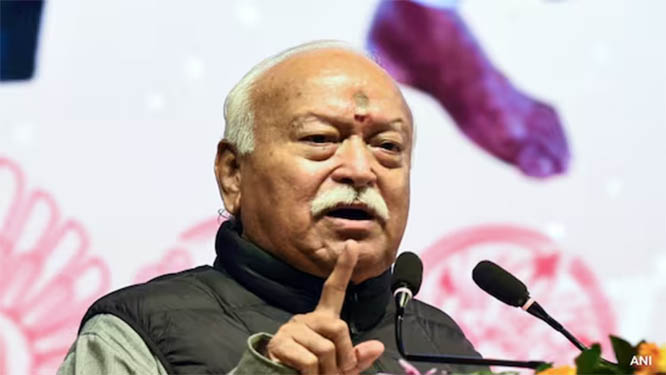
Kolkata: Stressing that India is a "Hindu nation," Rashtriya Swayamsevak Sangh (RSS) Chief Mohan Bhagwat on Sunday said that no constitutional approval is needed as it is the "truth".

Addressing an event marking 100 years of the RSS, Bhagwat said that India is, and will remain, a Hindu nation until Indian culture is appreciated in the country.

"The Sun rises in the east; we don't know since when this has been happening. So, do we need constitutional approval for that, too? Hindustan is a Hindu nation. Whoever considers India their motherland appreciates Indian culture, as long as there is even one person alive on the land of Hindustan who believes in and cherishes the glory of Indian ancestors, India is a Hindu nation. This is the ideology of the Sangh," he said at the '100 Vyakhyan Mala' program of RSS in Kolkata.

"If Parliament ever decides to amend the Constitution and add that word, whether they do it or not, it's fine. We don't care about that word because we are Hindus, and our nation is a Hindu nation. That is the truth. The caste system based on birth is not the hallmark of Hindutva," he added.

RSS has always argued that India is a "Hindu Nation," given the culture and majority's affiliations to Hinduism. However, 'secular' was not originally part of the Preamble of the Constitution, but it was added along with the word 'socialist' by the Constitution (42nd Amendment) Act, 1976, during the Emergency imposed by then Prime Minister Indira Gandhi.

Bhagwat also urged people to visit the organisation's offices and 'shakhas' to understand its work, so that what he dubbed as the “false perception” of the organisation as anti-Muslim can be dispelled!

Bhagwat said that people have understood that the organisation advocates for the protection of Hindus, and are "staunch nationalists," but not anti-muslim.

"If there is a perception that we are anti-Muslim, then, as I said, the RSS work is transparent. You can come anytime and see for yourself, and if you see anything like that happening, then you keep your views, and if you don't see it, then you change your views. There is a lot to understand (about RSS), but if you don't want to understand, then no one can change your mind," Bhagwat said.

He said, but anyone unwilling to learn cannot be helped.

"After seeing, people have said that you are staunch nationalists. You organise Hindus, and you advocate for the protection of Hindus. But you are not anti-Muslim. Many people have accepted this, and those who want to know more should come and see the RSS for themselves," he said.

Comments

Add new comment

  • Coastaldigest.com reserves the right to delete or block any comments.
  • Coastaldigset.com is not responsible for its readers’ comments.
  • Comments that are abusive, incendiary or irrelevant are strictly prohibited.
  • Please use a genuine email ID and provide your name to avoid reject.
News Network
December 21,2025

hadith.jpg

Invoking the teachings of Prophet Muhammad—“pay the worker before his sweat dries”—the Madras High Court has directed a municipal corporation to settle long-pending legal dues owed to a former counsel. The court observed that this principle reflects basic fairness and applies equally to labour and service-related disputes.

Justice G. R. Swaminathan made the observation while hearing a petition filed by advocate P. Thirumalai, who claimed that the Madurai City Municipal Corporation failed to pay him legal fees amounting to ₹13.05 lakh. Earlier, the High Court had asked the corporation to consider his representation. However, a later order rejected a major portion of his claim, prompting the present petition.

The court allowed Thirumalai to approach the District Legal Services Authority (DLSA) and submit a list of cases in which he had appeared. It also directed the corporation to settle the verified fee bills within two months, without interest. The court noted that the petitioner had waited nearly 18 years before challenging the non-payment and that the corporation could not be fully blamed, as the fee bills were not submitted properly.

‘A Matter of Embarrassment’

Justice Swaminathan described it as a “matter of embarrassment” that the State has nearly a dozen Additional Advocate Generals. He observed that appointing too many law officers often leads to unnecessary allocation of work and frequent adjournments, as government counsel claim that senior officers are engaged elsewhere.

He expressed hope that such practices would end at least in the Madurai Bench of the High Court and added that Additional Advocate Generals should “turn a new leaf” from 2026 onwards.

‘Scandalously High Amounts’

While stating that the court cannot examine the exact fees paid to senior counsel or law officers, Justice Swaminathan stressed that good governance requires public funds to be used prudently. He expressed concern over the “scandalously high amounts” paid by government and quasi-government bodies to a few favoured law officers.

In contrast, the court noted that Thirumalai’s total claim was “a pittance” considering the large number of cases he had handled.

Background

Thirumalai served as the standing counsel for the Madurai City Municipal Corporation for more than 14 years, from 1992 to 2006. During this period, he represented the corporation in about 818 cases before the Madurai District Courts.

As the former counsel was unable to hire a clerk to obtain certified copies of judgments in all 818 cases, the court directed the District Legal Services Authority to collect the certified copies within two months. The court further ordered the corporation to bear the cost incurred by the DLSA and deduct that amount from the final settlement payable to the petitioner.

Comments

Add new comment

  • Coastaldigest.com reserves the right to delete or block any comments.
  • Coastaldigset.com is not responsible for its readers’ comments.
  • Comments that are abusive, incendiary or irrelevant are strictly prohibited.
  • Please use a genuine email ID and provide your name to avoid reject.