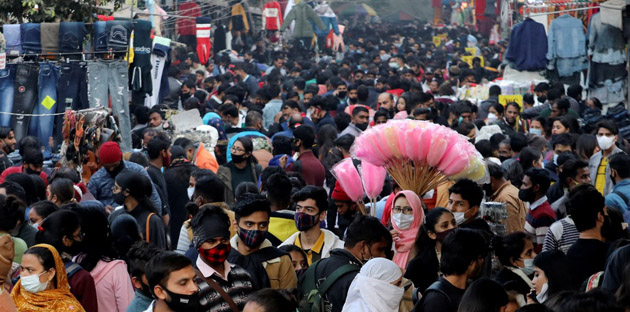
Omicron dampens festive spirit, worries hospitality sector

News Network
December 24, 2021

festive.jpg

‘Tis indeed the season to be jolly but the emergence of a new Covid variant and reimposed restrictions in some places just when things were looking up has the hospitality sector– and party-goers hoping to make the most of Christmas and year-end festivities – worried yet again.

Though Christmas lights are up in several cities, the feeling of déjà vu, of another year-end of lengthening Covid shadows – this time of the Omicron variant – has dampened the Yuletide spirit. And while many restaurants and hotels are going ahead with their Christmas and New Year plans, it’s all edged with uncertainty and dread that another wave might be just around the corner.

The party may not go on. But nobody can be sure. Be it Delhi or Mumbai, Kolkata or Bengaluru, optimism for a happy and healthy end to the year clashes with the stress of not really knowing what lies ahead. The mantra, as an industry insider put it, is cautiously optimistic

In the national capital, where the Delhi Disaster Management Authority on Wednesday directed district magistrates to ensure no Christmas and New Year gathering takes place in view of the rising Omicron cases, restaurateurs sought more clarity.

The DDMA order, they said, permits bars and restaurants to operate with up to 50 per cent of seating capacity without specifying whether they can host Christmas and New Year parties.

"Whether we can organise a party or not is a grey area. We hope the government will issue a clarification before December 31," Joy Singh, co-partner of Raasta and Yeti, said.

He said they are opting to be cautious and organise only sit-down lunches and dinners.

A restaurant owner in Khan Market, the buzzing shopping and eating destination in the heart of the city, said this is their turnaround moment but it may not happen.

"We were hoping the (DDMA) order would bring some relief but we will have to settle for 50 per cent of the crowd. Ever since the pandemic, we have been facing issues with lockdown and then the curbs… We understand there is the Omicron threat, but other areas are fully functional, so why to target our industry?"

Sahil Sambhi of the Drunken Botanist, a bar-eatery in Gurgaon’s Cyber Hub abutting Delhi, is equally despairing.

“…This is the most rewarding time for the F&B industry. That said, we will abide by the 50 per cent rule strictly and will follow all Covid protocols to the tee. We had planned a few events on the occasion, but I am afraid we have to cancel those now amid the fresh curbs imposed by the state government,” the director of Drunken Botanist said.

Given the escalating number of cases and the fear of another wave, the industry is battling tremendous odds anyway.

According to a survey by English news app Inshorts,  about 63 per cent of Delhi residents said they will "stay at home" while 29 per cent said they would like to be part of "small get-togethers". Of the 15,000 people surveyed, four per cent said they would like to dine out or travel on the occasion.

In Karnataka, the state government has said there will no deejays, no parties from December 31 to January 2. And the 50 per cent cap on occupancy also stands. To add to it, some groups have announced a shutdown on New Year’s Eve to press for a ban on the Maharashtra Ekikaran Samiti, which recently allegedly defaced the statue of 19th-century warrior Sangolli Rayanna, in Belagavi.

Chetan Hegde, the owner of 1522- The Pub in the state capital Bengaluru, said business has dipped by 30 to 40 per cent in the last two years.

"We were expecting a good business this year but again the Omicron has surfaced. We are bound by all the restrictions," Hegde said.

"We had sold our tickets online in good numbers but the restrictions came in the last minute,” added Hitesh Tulsani, operations manager of the Raahi Neo Kitchen and Bar in the city.

Tracking the falling numbers during peak season for the business, he said there was a crowd of about 500 people in his restaurant on December 31, 2019. This plunged to only 30 last year. And this year looks dismal too.

The mood is distinctly downcast in Tamil Nadu as well.

Residency Group COO Gopinath B said they are waiting for official communication from the government.

If there is a ban, celebrations will be subdued; if not, New Year’s Eve will be a big celebration, complete with deejays.       

"Covid will not only affect the hospitality industry but also other kinds of industries… We want to be very careful instead of slipping into another mess," he said.

The mood is optimistic but the uncertainty is palpable in Mumbai as well.

"Currently, we are witnessing positive consumer sentiment following pent up demand," said Nikhil Sharma, Wyndham Hotels and Resorts Regional Director - Eurasia.

The company's Ramada Plaza Juhu property has been getting over 55 per cent footfalls for the Christmas and New Year period, and these bookings are expected to rise further for this period.
"Mumbai, as a destination, sees last-minute bookings by locals during this period, and we remain cautiously optimistic," Sharma added.

“Business has been encouraging in the last two months and the sentiment for the festive season is very positive,” said Ravi Ramachandran, general manager, Radisson Mumbai, Andheri MIDC.

But the situation could change. At the moment, due to reports on rising Omicron cases in Maharashtra, bookings for New Year celebrations a week away are low and the outlook is not as promising as it seemed at the beginning of the month.

In Kolkata, famous for its year-end festive vibe, the mood is optimistic.

According to Sudesh Poddar, president of the Hotel and Restaurants Association of Eastern India, the threat of Omicron has so far not impacted the hospitality industry in the city and in other parts of West Bengal. "All our restaurants are recording good turnout which is only increasing in the run-up to Christmas. Restaurants will be open till 1 am from December 24 to January 1 and those serving liquor beyond that if permitted by the Excise department,” Poddar, who also runs Songhai and Manthan, said.

Nitin Kothari, the owner of Peter Cat and Mocambo, said the popular eateries have been seeing full houses for the last week. "We have been maintaining all Covid protocols since the restaurants opened after the lockdown. There has been no laxity… we are adhering to the 70 per cent occupancy limit as stipulated by the state."

India recorded 122 cases of the Omicron variant, the highest so far, pushing its tally in the country to 358, according to Union Health Ministry data on Friday. Of these, 114 have either recovered or migrated.

India recorded 6,650 new coronavirus infections, taking its tally of cases to 3,47,72,626.

Comments

Add new comment

  • Coastaldigest.com reserves the right to delete or block any comments.
  • Coastaldigset.com is not responsible for its readers’ comments.
  • Comments that are abusive, incendiary or irrelevant are strictly prohibited.
  • Please use a genuine email ID and provide your name to avoid reject.
News Network
December 2,2025

A major upgrade in safety and monitoring is planned for Haj 2026, with every Indian pilgrim set to receive a Haj Suvidha smart wristband linked to the official Haj Suvidha mobile app. The initiative aims to support pilgrims—especially senior citizens—who may struggle with smartphones during the 45-day journey.

What the Smart Wristband Will Do

Officials said the device will come with:
•    Location tracking
•    Pedometer
•    SOS emergency button
•    Qibla compass
•    Prayer timings
•    Basic health monitoring

SP Tiwari, secretary of the UP State Haj Committee, said the goal is to make the pilgrimage safer and more comfortable.

“Most Hajis are elderly and not comfortable with mobile apps,” he said. “The smartwatch will help locate pilgrims who forget their way or cannot communicate their location.”

The wristbands will be monitored by the Consulate General of India in Saudi Arabia, similar to mobile tracking via the Haj Suvidha App.

Free Distribution and Training

•    Smart wristbands will be given free of cost.
•    Training for pilgrims will be conducted between January and February 2026.
•    Sample units will reach state Haj committees soon.
•    Final devices will be distributed as pilgrims begin their journey.

New Rules for Accommodation

Two major decisions have also been finalised for Haj 2026:
1.    Separate rooms for men and women – including married couples. They may stay on the same floor but must occupy different rooms, following stricter Saudi guidelines.
2.    Cooking banned – gas cylinders will not be allowed; all meals will be provided through official catering services arranged by the Haj Committee of India.

These decisions were finalised during a meeting of the Haj Committee of India and state representatives in Mumbai.

Haj Suvidha App Launched Earlier

The government launched the Haj Suvidha App in 2024, offering:

•    Training modules
•    Accommodation and flight details
•    Baggage information
•    SOS and translation tools
•    Grievance redressal

Haj 2026 Quota and Key States

•    India’s total Haj quota for 2026: 1,75,025 pilgrims
•    70% (1,25,000) allotted to the Haj Committee of India
•    30% (around 50,000) reserved for Haj Group Organisers

Uttar Pradesh has the largest allocation (around 30,000 seats), though approximately 18,000 pilgrims are expected to go this year. States with high pilgrim numbers include Kerala, Maharashtra and Gujarat.

Dates of Haj 2026

The pilgrimage is scheduled to take place from 24 May to 29 May, 2026 (tentative).
Haj is one of the five pillars of Islam and is mandatory for Muslims who meet the required conditions.

Comments

Add new comment

  • Coastaldigest.com reserves the right to delete or block any comments.
  • Coastaldigset.com is not responsible for its readers’ comments.
  • Comments that are abusive, incendiary or irrelevant are strictly prohibited.
  • Please use a genuine email ID and provide your name to avoid reject.
News Network
November 30,2025

The United Nations Committee against Torture (CAT) has condemned the Israeli regime for enforcing a policy of “organized torture” against Palestinians.

In a report published on Friday, CAT stated that the occupying regime enforces a deliberate policy of “organized and widespread torture and ill-treatment” against Palestinian abductees, particularly since October 7, 2023, when Israel launched its genocidal war on Gaza.

The committee expressed “deep concern over repeated severe beatings, dog attacks, electrocution, water-boarding, use of prolonged stress positions [and] sexual violence” inflicted on Palestinians.

Palestinian prisoners were degraded by “being made to act like animals or being urinated on,” systematically denied medical care, and subjected to excessive restraints, “in some cases resulting in amputation,” the report added.

CAT also condemned the routine application of “unlawful combatants law” to justify the prolonged detention without trial of thousands of Palestinian men, women, and children.

More than 10,000 Palestinians, including women and children, are currently held in Israeli prisons, according to Palestinian and international human rights groups, with 3,474 Palestinians in “administrative detention,” meaning they are imprisoned without trial for indefinite periods.

The report highlighted the “high proportion of children who are currently detained without charge or on remand,” noting that while Israel sets the age of criminal responsibility at 12, even younger children have been abducted.

Children designated as security prisoners face severe restrictions on family contact, may be subjected to solitary confinement, and are denied access to education, in clear violation of international law.

The committee further suggested that Israel’s policies across the Occupied Territories constitute collective torture against the Palestinian population.

“A range of policies adopted by Israel in the course of its continued unlawful presence in the Occupied Palestinian Territory amounts to cruel, inhuman or degrading living conditions for the Palestinian population,” the report said.

On Thursday, the Palestinian resistance movement Hamas condemned the systematic killing and torture of Palestinian abductees in Israeli prisons, urging international action to halt these abuses.

Citing human rights data, Hamas stated that 94 Palestinians have been killed in Israeli prisons since the start of Tel Aviv’s genocidal war on Gaza.

“This reflects an organized criminal approach that has turned these prisons into direct killing grounds to eliminate our people,” the resistance movement said.

Hamas called on the international community, the UN, and human rights organizations to immediately pressure Israel to end crimes against prisoners and uphold their rights as guaranteed by all international conventions and norms.

Comments

Add new comment

  • Coastaldigest.com reserves the right to delete or block any comments.
  • Coastaldigset.com is not responsible for its readers’ comments.
  • Comments that are abusive, incendiary or irrelevant are strictly prohibited.
  • Please use a genuine email ID and provide your name to avoid reject.
News Network
November 22,2025

gaza.jpg

The Israeli regime’s forces have killed two Palestinian children in the Gaza Strip every day since the ceasefire began in early October, UNICEF has warned.

The UN children’s agency said on Friday that Israeli forces continue to attack Palestinians in Gaza even though the agreement was meant to stop the killing.

“Since 11 October, while the ceasefire has been in effect, at least 67 children have been killed in conflict-related incidents in the Gaza Strip. Dozens more have been injured. That is an average of almost two children killed every day since the ceasefire took effect,” UNICEF spokesperson Ricardo Pires said in Geneva, reminding that each number in the statistics represents a child whose life had ended violently.

“These are not statistics,” he said. “Each child had a story, a family, and a future that was stolen from them.”

Data from Palestinian factions, human rights groups, and government bodies recorded since the US-brokered ceasefire deal went into effect on October 10 show that Israeli forces have carried out numerous attacks, each constituting a separate ceasefire violation.

UNICEF teams say they repeatedly continue to witness heart-wrenching scenes of fearful Palestinian children sleeping outdoors with amputated limbs, while others live as orphans in flooded, makeshift shelters.

“I saw this myself in August. There is no safe place for them. The world cannot normalize their suffering,” Pires said, lamenting that the UN could “do a lot more if the aid that is really needed was entering faster.”

The UNICEF spokesperson warned that with the advent of winter, the risks for hundreds of thousands of displaced children will increase.

He warned, “The stakes are incredibly high” for children as winter acts as a threat multiplier, where children have no heating, no insulation, and few blankets. He said respiratory infections rise.

“Too many children have already paid the highest price,” Pires said. “Too many are still paying it, even under a ceasefire. The world promised them it would stop and that we would protect them.”

“Now we must act like it,” the UNICEF spokesperson added.

Since the Israeli regime launched its genocidal war against Palestinians in Gaza in October 2023, it has killed nearly 70,000 people in the territory, most of them women and children, and injured over 170,000 more, while reducing most of the structures in the enclave to rubble.

Comments

Add new comment

  • Coastaldigest.com reserves the right to delete or block any comments.
  • Coastaldigset.com is not responsible for its readers’ comments.
  • Comments that are abusive, incendiary or irrelevant are strictly prohibited.
  • Please use a genuine email ID and provide your name to avoid reject.