UP cop killed by saffron extremists was investigation officer in Akhlaq lynching case

News Network
December 4, 2018

Meerut, Dec 4: Police inspector Subodh Kumar Singh, who was murdered by the Hindutva extremists yesterday at Syana village of Bulandshahr district in Uttar Pradesh, was also the investigation officer (IO) in the 2015 lynching of Mohammad Akhlaq by another group of Hindutva extremists at Bisadha village in Greater Noida’s Dadri.

Singh had collected all the circumstantial evidence after the incident, including the meat sample from Akhlaq’s house. However he was transferred to Varanasi in the middle of the investigation, by the government.

“He was the IO of the Akhlaq lynching case from September 28, 2015 to November 9, 2015. The charge-sheet in the case was filed by a different IO in March 2015," said UP ADG (law and order) Anand Kumar.

Originally a resident of Targana village in Etah, Singh joined UP Police in 1998 and spent considerable period of his police career in the Meerut zone, including Meerut, Saharanpur and Muzaffarnagar districts. Singh is survived by wife and two teenage sons.

“Singh will always be known for his stronghold over crime. He was very hard-working and always had a smiling face. After being transferred from Bisadha, he was sent to Varanasi and later to Mathura where he was promoted. He was the SHO Vrindavan for a very long time before he was deployed in Bulandshahr,” a batch-mate was quoted as saying by a news paper.

During an encounter in Vrindavan in January 2016, he had also suffered injuries. He took over as station officer of Syana just two months ago.

Prashant Kumar, ADG (Meerut zone), said, “We have lost an able officer in this violence. We will ensure the perpetrators of this attack are not left unpunished. A high-level investigation is under way.”

Also Read: 

Hindutva cow vigilantes launch violent agitation in UP; cop among two killed, dozens injured

BJP, VHP, BD extremists booked for killing cop who taught his family not to hate Muslims

Comments

Reshma kodialbail
 - 
Tuesday, 4 Dec 2018

Saffrons are same.. This is done by BD goon. BJP, RSS, BD etc all are same in their work pattern

Suresh
 - 
Tuesday, 4 Dec 2018

BJP inducting only criminals to their party's higher level. All are criminals

Vinod
 - 
Tuesday, 4 Dec 2018

Those who stood against  bjp, they just finished off all. They are doing the same now also

Sruti Kotian
 - 
Tuesday, 4 Dec 2018

Similar strategy they done on Jus. Loya. Amit shah got clean chit also in that

Add new comment

  • Coastaldigest.com reserves the right to delete or block any comments.
  • Coastaldigset.com is not responsible for its readers’ comments.
  • Comments that are abusive, incendiary or irrelevant are strictly prohibited.
  • Please use a genuine email ID and provide your name to avoid reject.
News Network
January 20,2026

iran.jpg

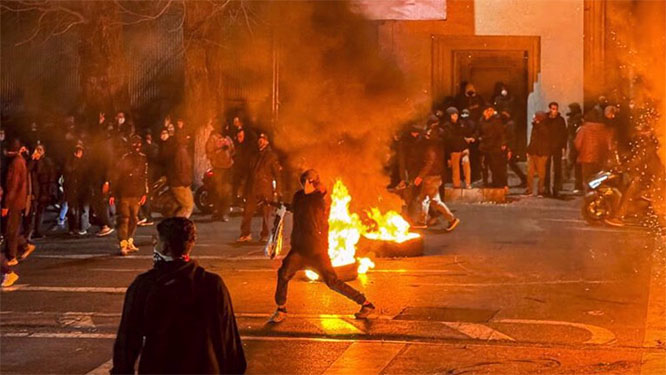
Iranian security and intelligence forces have captured more than 470 individuals in three provinces, identified as key figures behind the recent wave of violent unrest and terrorist activities linked to foreign-backed networks.

The Intelligence Ministry's provincial office in Khorasan Razavi announced on Monday the arrest of 192 armed terrorists, identified as the main agents behind recent riots in the region. 

According to an official statement, the detainees were involved in the killing of several security personnel and civilians, setting fire to mosques, public service facilities, and buses, as well as attacks on military and law enforcement centers.

The seized items from the group include several bulletproof vests, Kalashnikov rifles, hunting weapons, Winchester rifles, and various cold weapons such as daggers, swords, brass knuckles, tactical knives, crossbows, and chains.

Evidence indicates that some of the individuals were tied to hostile movements and terrorist organizations, with links overseas. Others were identified as members of violent criminal gangs, actively taking part in the unrest alongside their associates.

Simultaneously, in the western province of Lorestan, the IRGC announced the arrest of 134 individuals as the main leaders and influential field agents of a US-Israeli terrorist network.

The IRGC statement stated that these individuals formed terrorist cells during the recent unrest, committing "Daesh-like" acts.

They wounded security forces with firearms and cold weapons, and burned and destroyed public and private properties, including mosques, shops, banks, and private and public vehicles.

In the northwestern province of Zanjan, the police reported detaining 150 people identified as principal leaders and agents behind recent riots.

Authorities noted that these individuals were responsible for destroying public and private property and intentionally setting fire to vehicles in the province's squares.

Their crimes include shedding the blood of innocent people, destroying public and private property, attempting to enter military sites, disrupting public order, and spreading terror among citizens.

A variety of cold weapons were reportedly seized from the detainees.

What began late last month as peaceful protests over economic hardship across Iran turned violent after public statements by US and Israeli regime figures encouraged vandalism and disorder.

During the unrest, foreign-backed mercenaries rampaged through cities, killing security forces and civilians and damaging public property.

Comments

Add new comment

  • Coastaldigest.com reserves the right to delete or block any comments.
  • Coastaldigset.com is not responsible for its readers’ comments.
  • Comments that are abusive, incendiary or irrelevant are strictly prohibited.
  • Please use a genuine email ID and provide your name to avoid reject.
News Network
January 14,2026

phone.jpg

Bidar (Karnataka): A routine ride turned fatal when a nylon kite string slit the throat of a 48-year-old motorcyclist in Karnataka’s Bidar district, claiming his life in a chilling reminder of the deadly threat posed by banned kite-flying materials.

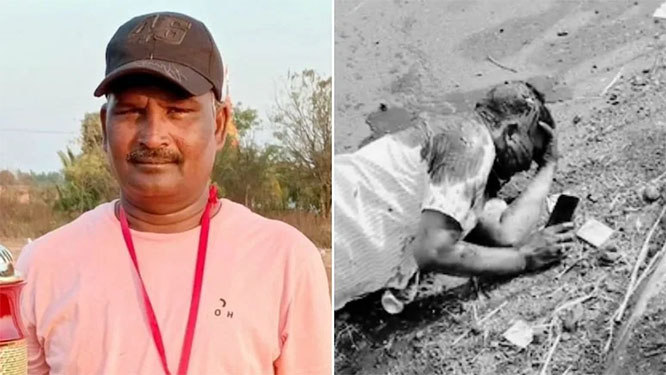
The victim, identified as Sanjukumar Hosamani, was riding near the Talamadagi Bridge when a taut kite string stretched across the road cut deep into his neck, causing profuse bleeding. Critically injured, Hosamani collapsed from his motorcycle but managed to place a final phone call to his daughter.

A disturbing video circulating on social media shows Hosamani drenched in blood, struggling to dial his daughter’s number as life ebbed away.

A passerby attempted to help by pressing a cloth against the wound to stop the bleeding. Locals said an ambulance was called immediately, but it arrived too late. Hosamani succumbed to his injuries before he could be taken to a hospital.

Family members have blamed the delay in emergency response for his death, alleging that timely medical assistance could have saved his life.

Following the incident, Hosamani’s relatives and local residents staged a protest at the accident spot, demanding strict action against the use of nylon kite strings and urgent improvements in emergency medical services.

Police have registered a case at Manna Ekhelli Police Station and said an investigation is underway.

Kite flying during Makar Sankranti is a long-standing tradition across many parts of India. While cotton strings coated with powdered glass were once common, they have increasingly been replaced by cheaper and more durable nylon strings. This durability, however, has proven lethal, as nylon can slice through skin with ease.

Commonly referred to as Chinese manjha, these strings pose a grave danger to two-wheeler riders, who often fail to notice the nearly invisible lines stretched across roads and flyovers.

The Karnataka incident is the latest in a series of such deaths reported across the country. Just this week, a 45-year-old man in Indore died after a kite string slit his throat. Delhi has witnessed multiple fatalities in recent years, including the deaths of a 22-year-old businessman in 2025, a biker in 2022, and a seven-year-old child in 2023.

Despite periodic raids and seizures by authorities, the recurring deaths underline serious gaps in enforcement, raising questions about whether current measures are sufficient to prevent further loss of life.

Comments

Add new comment

  • Coastaldigest.com reserves the right to delete or block any comments.
  • Coastaldigset.com is not responsible for its readers’ comments.
  • Comments that are abusive, incendiary or irrelevant are strictly prohibited.
  • Please use a genuine email ID and provide your name to avoid reject.
News Network
January 6,2026

lamp.jpg

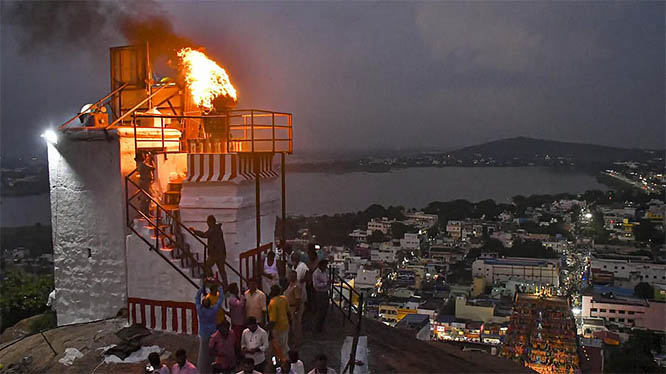
Chennai: The Madras High Court has strongly criticised the Tamil Nadu government for citing what it termed an “imaginary” law and order concern to delay the implementation of a court order permitting the lighting of the Deepam on the Deepathoon atop the Thiruparankundram hills in Madurai.

Upholding an earlier order passed by Justice G R Swaminathan, a division bench of Justices G Jayachandran and K K Ramakrishnan of the Madurai Bench dismissed the appeal filed by the state government and reaffirmed that the Deepam could be lit at the site during Karthigai Deepam.

The bench expressed displeasure over the government’s failure to implement the single judge’s directive, even after permission was granted for CISF personnel to accompany the petitioner, Rama Ravikumar, to the hilltop on December 3 to light the lamp. While allowing the ritual, the court clarified that the number of people permitted to climb the hill would be determined by the Archaeological Survey of India (ASI).

The state government had objected to the single judge’s order, arguing that allowing people to climb the hill and light the Deepam could trigger law and order issues, as the Sikkander Badusha Dargah is located about 50 metres from the Deepathoon. Meanwhile, officials of the Hindu Religious and Charitable Endowments (HR&CE) Department went ahead with lighting the lamp at the Uchipillaiyar temple at 6 pm, following established tradition.

Rejecting the government’s stand, the division bench said the apprehension of law and order problems was an “imaginary ghost” created by the authorities for their own convenience and criticised the district administration for not complying with the court’s order. The judges observed that instead of raising unfounded fears, the administration should have used the judgment as an opportunity to foster dialogue and harmony between communities.

The court also noted that neither the state government nor representatives of the dargah had produced any evidence to show that agama shastra prohibited the lighting of the Deepam at the site.

The Thiruparankundram hill has historically been a symbol of communal harmony, housing the Subramaniya Swamy temple, the Kasi Viswanathan temple and the Sikkander Badusha Dargah for centuries. However, the site became a flashpoint in February 2025 after protests by Hindu organisations over allegations that Lok Sabha MP Nawaz Kani consumed meat on the hill. Despite the controversy, local residents continue to live in peace and mutual coexistence. 

Comments

Add new comment

  • Coastaldigest.com reserves the right to delete or block any comments.
  • Coastaldigset.com is not responsible for its readers’ comments.
  • Comments that are abusive, incendiary or irrelevant are strictly prohibited.
  • Please use a genuine email ID and provide your name to avoid reject.