



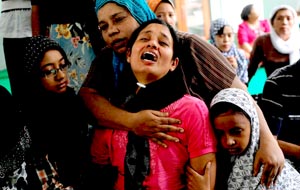
Inter-religious violence has flared throughout the country over the past two years, threatening to undermine political reforms initiated by the quasi-civilian government of President Thein Sein, which took office in 2011 following 49 years of repressive military rule.
Hundreds of people have been killed and more than 140,000 displaced since June 2012. Most of the victims have been members of Myanmar's Muslim minority, estimated to be about 5 percent of the population.
Around 300 Buddhist terrorist were riding around Mandalay on Friday, many of them wielding knives, clubs and bamboo poles.
"We're going to kill all the Muslims," some shouted as they rode through the streets after attending the funeral of a Buddhist man stabbed to death on Wednesday night.
A Muslim man was also killed, beaten to death early on Thursday on his way to morning prayers.
Police said 19 people were hurt in the riots in the central Myanmar city of about a million people on Tuesday and Wednesday nights.
A 9 p.m. to 5 a.m. curfew backed up by a heavy police presence prevented further trouble on Thursday night and the same curfew will be in force on Friday.
The violence began late on Tuesday when a group of about 300 Buddhists converged on a tea shop owned by a Muslim man accused of raping a Buddhist woman.
A police officer in the capital, Naypyitaw, said on Thursday that charges of rape had been filed against the tea shop owner and his brother.
An imam at Mandalay's largest mosque said that five innocent Muslims had been arrested on Friday after police searched homes nearby and found ceremonial knives. "Police definitely know these are used for ceremonial purposes," said Ossaman, the imam. "They were not breaking any law."
A police officer confirmed the arrests but refused to provide further details and asked that his name be withheld as he was not authorised to speak to the media.
Anti-Muslim violence is not new in Myanmar. The former junta imposed a curfew in Mandalay after riots in the city in 1997 following rumours that a Muslim man had raped a Buddhist girl.
But outbreaks of violence have become more common under the reformist government, which lifted restrictions on freedom of speech, including access to the Internet, which had previously been tightly controlled by the military.
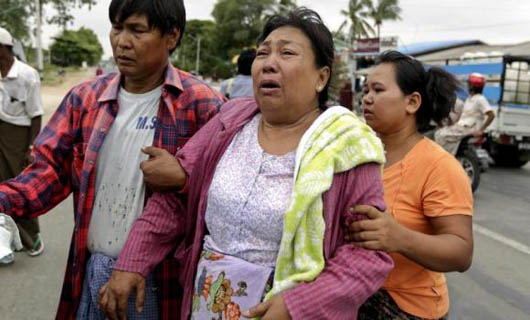
The mother of 36-year old Tun Tun who was killed by Buddhist terrorists in Mandalay, cries at the funeral services in Mandalay, Myanmar.



Comments
Add new comment