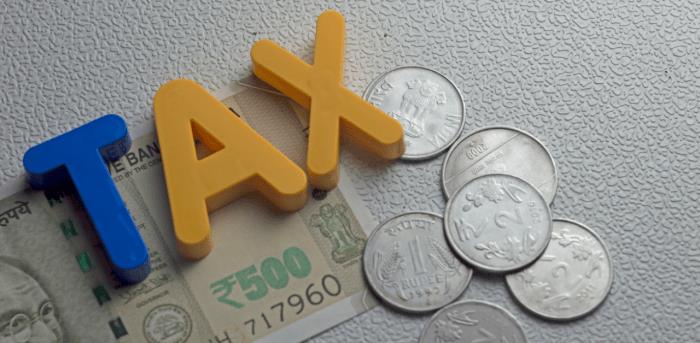
For every rupee in govt coffer, 58 paise to come from taxes, 35 paise from borrowings, other liabilities

News Network
February 1, 2022

taxes.jpg

New Delhi, Feb 1: For every rupee in the government coffer, 58 paise will come from direct and indirect taxes, 35 paise from borrowings and other liabilities, 5 paise from non-tax revenue like disinvestment and 2 paise from non-debt capital receipts, according to the Budget documents for 2022-23.

According to the Union Budget 2022-23 presented in Parliament by Finance Minister Nirmala Sitharaman on Tuesday, goods and services tax will contribute 16 paise in every rupee revenue, while corporation tax will contribute 15 paise to each rupee earned.

The government is also looking to earn 7 paise for every rupee from Union excise duty and 5 paise from customs duty. Income tax will yield 15 paise to every rupee collection.

The collection from 'borrowings and other liabilities' will be 35 paise, according to the Budget 2022-23.

On the expenditure side, the biggest outlay component is interest payments at 20 paise for every rupee, followed by the states' share of taxes and duties at 17 paise.

Allocation for the defence stood at 8 paise.

Expenditure on central sector schemes will be 15 paise, while the allocation for centrally-sponsored schemes will be 9 paise.

The expenditure on the 'Finance Commission and other transfers' is pegged at 10 paise. Subsidies and pension will account for 8 paise and 4 paise, respectively, in each rupee spending.

The government will spend 9 paise in every rupee on 'other expenditures'.  

Comments

Add new comment

  • Coastaldigest.com reserves the right to delete or block any comments.
  • Coastaldigset.com is not responsible for its readers’ comments.
  • Comments that are abusive, incendiary or irrelevant are strictly prohibited.
  • Please use a genuine email ID and provide your name to avoid reject.
News Network
February 3,2026

Bengaluru: Following reports of fresh Nipah virus (NiV) cases in West Bengal and heightened vigilance across parts of Southeast Asia, the Karnataka Health Department has placed the state on high alert and activated emergency preparedness protocols.

Health officials said enhanced surveillance measures have been initiated after two healthcare workers in Barasat, West Bengal, tested positive for the virus earlier this month. While no cases have been reported in Karnataka so far, authorities said the state’s past exposure to Nipah outbreaks and high inter-state mobility warranted preventive action.

Officials have directed district health teams to intensify monitoring, particularly at hospitals and points of entry, and to ensure early detection and isolation of suspected cases.

High Mortality Virus with Multiple Transmission Routes

Nipah virus is a zoonotic disease that can spread from animals to humans and has a reported fatality rate ranging between 60 and 75 per cent. Fruit bats, also known as flying foxes, are the natural reservoirs of the virus and can transmit it by contaminating food sources with saliva or urine.

Known modes of transmission include:

•    Contaminated food: Consumption of fruits partially eaten by bats or raw date-palm sap
•    Animal contact: Exposure to infected pigs or other animals
•    Human-to-human transmission: Close contact with body fluids of infected persons, particularly in healthcare settings

Symptoms and Disease Progression

The incubation period typically ranges from 4 to 14 days, though delayed onset has also been reported. Early symptoms often resemble common viral infections, making prompt clinical suspicion critical.

•    Initial symptoms: Fever, headache, body aches, fatigue, sore throat
•    Progressive symptoms: Drowsiness, disorientation, altered mental state
•    Severe stage: Seizures, neck stiffness and acute encephalitis, which can rapidly progress to coma

Public Health Advisory

The Health Department has issued precautionary guidelines urging the public to adopt risk-avoidance practices to prevent any local spillover.

Do’s
•    Wash fruits thoroughly before consumption
•    Drink boiled and cooled water
•    Use protective equipment while handling livestock
•    Maintain strict hand hygiene

Don’ts
•    Avoid fruits found on the ground or showing bite marks
•    Do not consume beverages made from raw tree sap, including toddy
•    Avoid areas with dense bat populations
•    Do not handle sick or dead animals

Preparedness Measures

Officials confirmed that isolation wards are being readied in major government hospitals and that medical staff are being sensitised to identify early warning signs.

“There is no cause for panic, but there is a need for heightened vigilance,” a senior health official said, adding that there is currently no approved vaccine or specific antiviral treatment for Nipah, and care remains largely supportive.


Comments

Add new comment

  • Coastaldigest.com reserves the right to delete or block any comments.
  • Coastaldigset.com is not responsible for its readers’ comments.
  • Comments that are abusive, incendiary or irrelevant are strictly prohibited.
  • Please use a genuine email ID and provide your name to avoid reject.
News Network
February 9,2026

The Supreme Court on Monday expressed grave concern over digital frauds, noting that more than ₹54,000 crore has been siphoned off through cyber crimes, and described the scale of the fraud as “absolutely robbery or dacoity”.

A bench of the apex court sought swift and coordinated action from the Reserve Bank of India (RBI), banks and other agencies to curb the rising menace of digital fraud. Observing that such large-scale losses could not occur without serious lapses, the court said the frauds “may be due to collusion or negligence of bank officials”.

The bench directed inter-departmental agencies to prepare a draft memorandum of understanding (MoU) within four weeks to strengthen coordination and effectively tackle digital frauds.

Taking note of an existing standard operating procedure (SOP) framed by the RBI, which prescribes immediate steps such as temporarily blocking debit cards to prevent cyber-enabled fraud, the court directed the Centre to formally adopt and implement the RBI’s SOP across the country.

“We direct the Centre to ensure pan-India implementation of the RBI SOP for inter-agency coordination in dealing with digital frauds. We also direct the CBI to identify cases of so-called ‘digital arrest’,” the bench said.

The Supreme Court further asked the Gujarat and Delhi governments to grant sanction for investigation in identified cases. It also directed the RBI, the Department of Telecommunications (DoT) and other concerned authorities to jointly hold a meeting to evolve a framework for compensation to victims of digital arrest frauds.

Emphasising victim relief, the court said a “pragmatic and liberal approach” is required while considering compensation for those affected by digital arrest scams.

If you want it sharper, more dramatic, or more neutral (wire-style), tell me which tone you’re aiming for.

Comments

Add new comment

  • Coastaldigest.com reserves the right to delete or block any comments.
  • Coastaldigset.com is not responsible for its readers’ comments.
  • Comments that are abusive, incendiary or irrelevant are strictly prohibited.
  • Please use a genuine email ID and provide your name to avoid reject.