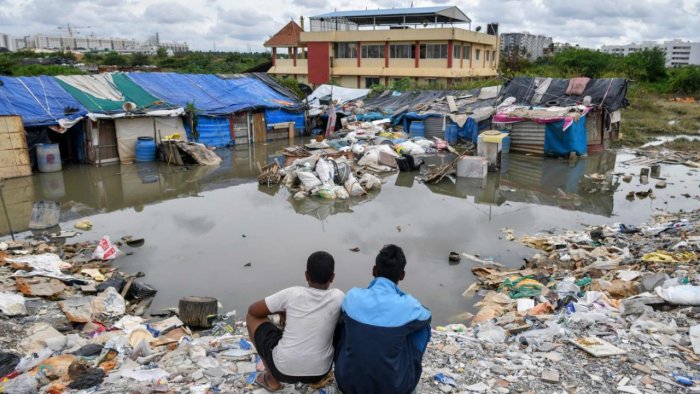
India ranks 132 out of 191 in UNDP's human development index; Bangladesh better

News Network
September 8, 2022

india.jpg

India ranked 132 out of 191 countries in the 2021 human development index, according to a report released by the United Nations Development Programme (UNDP).

India's HDI value of 0.633 places the country in the medium human development category, lower than its value of 0.645 in the 2020 report. India ranked 131 among 189 countries in the 2020 human development index.

"Like global trends, in India's case, the drop in HDI from 0.645 in 2019 to 0.633 in 2021 can be attributed to falling life expectancy - 69.7 to 67.2 years. India's expected years of schooling stand at 11.9 years, and the mean years of schooling are at 6.7 years," the report said.

Human Development - a measure of a nation's health, education, and average income - has declined for two years in a row - 2020 and 2021, reversing five years of progress, the report said.

This is in line with the global decline, indicating that human development across the world has stalled for the first time in 32 years, the report said.

The report said a large contributor to the Human Development Index's recent decline is a global drop in life expectancy, down from 72.8 years in 2019 to 71.4 years in 2021.

The latest Human Development Report - Uncertain Times, Unsettled Lives: Shaping our Future in a Transforming World - launched by UNDP - argues that layers of uncertainty are stacking up and interacting to unsettle life in unprecedented ways.

"The world is scrambling to respond to back-to-back crises. We have seen with the cost of living and energy crises that, while it is tempting to focus on quick fixes like subsidizing fossil fuels, immediate relief tactics are delaying the long-term systemic changes we must make," said Achim Steiner, administrator, UNDP.

"We are collectively paralyzed in making these changes. In a world defined by uncertainty, we need a renewed sense of global solidarity to tackle our interconnected, common challenges," Steiner said.

These intersecting crises have impacted India's development trajectory just as they have in much of the world.

The HDI measures progress on 3 key dimensions of human development - a long and healthy life, access to education, and a decent standard of living. It is calculated using four indicators – life expectancy at birth, mean years of schooling, expected years of schooling, and the Gross National Income (GNI) per capita.

"The Human Development Report shows that progress globally is in reverse. India's decline in human development mirrors this trend – impacted by intersecting crises. But there is good news. Compared to 2019, the impact of inequality on human development is lower," said Shoko Noda, UNDP Resident Representative in India.

"India is bridging the human development gap between men and women faster than the world. This development has come at a smaller cost to the environment. India's growth story reflects the country's investments in inclusive growth, social protection, gender-responsive policies, and push towards renewables to ensure no one is left behind," said Noda.

While some countries are beginning to get back on their feet, recovery is uneven and partial, further widening inequalities in human development. Despite a significant economic recovery in 2021, the health crisis intensified, with two-thirds of countries recording even further reductions in life expectancy at birth, the report said.

India's HDI value continues to exceed South Asia's average human development. India's HDI value has been steadily catching up to the world average since 1990 - indicating a faster than the global rate of progress in human development. This is a result of policy choices made by the country over time, including investments made in health and education.

South Asian economies like Bangladesh (129) and Bhutan bucked the trend and registered an improvement, the report pointed out.

The report also suggested that stress, sadness, anger, and worry have been increasing over the last decade, now reaching record levels.

On average, countries spend less than two per cent of their healthcare budgets on mental health, which limits access to mental health services for citizens globally.

Uncertainty, inequality, and insecurity go hand in hand with polarization and lack of trust. Polarization and mistrust shrink our capacity for social dialogue and stifle collective action, it said.

The report recommends implementing policies that focus on 3 Is - investment - from renewable energy to preparedness for pandemics and insurance - including social protection - to prepare our societies for the ups and downs of an uncertain world. While innovation in its many forms - technological, economic, cultural - can also build capacities to respond to whatever challenges come next.

"Policies that focus on the 3Is will enable people to thrive in the face of uncertainty. India is already a frontrunner in these areas with its push towards renewable energy, boosting social security for the most vulnerable and driving the world's largest vaccination drive through Co-WIN, supported by UNDP," added Noda.

Over the last decade, India has lifted a staggering 271 million out of multidimensional poverty.

The country is improving access to clean water, sanitation, and affordable clean energy. India has also boosted access to social protection for vulnerable sections of society, especially during and after the pandemic, with a 9.8 per cent increase in the budgetary allocation to the Social Services sector in 2021-22 over 2020-21, the report said.

Comments

Add new comment

  • Coastaldigest.com reserves the right to delete or block any comments.
  • Coastaldigset.com is not responsible for its readers’ comments.
  • Comments that are abusive, incendiary or irrelevant are strictly prohibited.
  • Please use a genuine email ID and provide your name to avoid reject.
News Network
December 13,2025

New Delhi: School-going children are picking up drug and smoking habits and engaging in consumption of alcohol, with the average age of introduction to such harmful substances found to be around 13 years, suggesting a need for earlier interventions as early as primary school, a multi-city survey by AIIMS-Delhi said.

The findings also showed substance use increased in higher grades, with grade XI/XII students two times more likely to report use of substances when compared with grade VIII students. This emphasised the importance of continued prevention and intervention through middle and high school.

The study led by Dr Anju Dhawan of AIIMS's National Drug Dependence Treatment Centre, published in the National Medical Journal of India this month, looks at adolescent substance use across diverse regions.

The survey included 5,920 students from classes 8, 9, 11 and 12 in urban government, private and rural schools across 10 cities -- Bengaluru, Chandigarh, Delhi, Dibrugarh, Hyderabad, Imphal, Jammu, Lucknow, Mumbai, and Ranchi. The data were collected between May 2018 and June 2019.

The average age of initiation for any substance was 12.9 (2.8) years. It was lowest for inhalants (11.3 years) followed by heroin (12.3 years) and opioid pharmaceuticals (without prescription; 12.5 years).

Overall, 15.1 per cent of participants reported lifetime use, 10.3 per cent reported past year use, and 7.2 per cent reported use in the past month of any substance, the study found.

The most common substances used in the past year, after tobacco (4 per cent) and alcohol (3.8 per cent), were opioids (2.8 per cent), followed by cannabis (2 per cent) and inhalants (1.9 per cent). Use of non-prescribed pharmaceutical opioids was most common among opioid users (90.2 per cent).

On being asked, 'Do you think this substance is easily available for a person of your age' separately for each substance category, nearly half the students (46.3 per cent) endorsed that tobacco products and more than one-third of the students (36.5 per cent) agreed that a person of their age can easily procure alcohol products.

Similarly, for Bhang (21.9 per cent), ganja/charas (16.1 per cent), inhalants (15.2 per cent), sedatives (13.7 per cent), opium and heroin (10 per cent each), the students endorsed that these can be easily procured.

About 95 per cent of the children, irrespective of their grade, agreed with the statement that 'drug use is harmful'.

The rates of substance use (any) among boys were significantly higher than those of girls for substance use (ever), use in the past year and use in the past 30 days. Compared to grade VIII students, grade IX students were more likely, and grade XI/XII students were twice as likely to have used any substance (ever).

The likelihood of past-year use of any substance was also higher for grade IX students and for grade XI/XII students as compared to grade VIII students.

About 40 per cent of students mentioned that they had a family member who used tobacco or alcohol each. The use of cannabis (any product) and opioid (any product) by a family member was reported by 8.2 per cent and 3.9 per cent of students, respectively, while the use of other substances, such as inhalants/sedatives by family was 2-3 per cent, the study found.

A relatively smaller percentage of students reported use of tobacco or alcohol among peers as compared to among family members, while a higher percentage reported inhalants, sedatives, cannabis or opioid use among peers.

Children using substances (past year) compared to non-users reported significantly higher any substance use by their family members and peers.

There were 25.7 per cent students who replied 'yes' to the question 'conflicts/fights often occur in your family'. Most students also replied affirmatively to 'family members are aware of how their time is being spent' and 'damily members are aware of with whom they spend their time'.

Comments

Add new comment

  • Coastaldigest.com reserves the right to delete or block any comments.
  • Coastaldigset.com is not responsible for its readers’ comments.
  • Comments that are abusive, incendiary or irrelevant are strictly prohibited.
  • Please use a genuine email ID and provide your name to avoid reject.
News Network
December 2,2025

Mangaluru, Dec 2: Mangaluru International Airport responded to a medical emergency late on Monday night. Air India Express flight IX 522, travelling from Riyadh to Thiruvananthapuram, was diverted to Mangaluru Airport after a passenger in his late 30s experienced a medical emergency on board.

The Airport’s Operations Control Centre received an alert regarding the passenger’s health condition. The airport activated its emergency response protocol, mobilising the airport medical team and coordinating with stakeholders including CISF, immigration, and customs. 

Upon landing, airport medical personnel attended to the passenger, assessed his condition, and arranged to shift him to a local tertiary-care hospital for further treatment. The passenger’s relatives accompanied the passenger, who incidentally received necessary medical care on board, which helped stabilise the situation.

Following the handling of the emergency, the flight departed for Thiruvananthapuram at 2:05 am on Tuesday.

"We appreciate the cooperation of all parties involved, and this incident reaffirms our ongoing commitment to prioritising passenger safety and readiness to respond to unforeseen emergencies with professionalism and care," the Airport spokesperson said. 

Comments

Add new comment

  • Coastaldigest.com reserves the right to delete or block any comments.
  • Coastaldigset.com is not responsible for its readers’ comments.
  • Comments that are abusive, incendiary or irrelevant are strictly prohibited.
  • Please use a genuine email ID and provide your name to avoid reject.
News Network
December 15,2025

Mangaluru, Dec 15: Educational institutions in Mangaluru that rely on the popular Mangala Stadium for their annual sports events are bracing for an inconvenience as the city's key sporting venue is set to close its gates for a significant upgrade. The stadium is expected to be unavailable for approximately two months starting from January 15, 2026.

The closure is necessitated by a proposed overhaul of the stadium's facilities, with a special focus on upgrading the synthetic track. Pradeep Dsouza, Assistant Director of the District of Youth Empowerment and Sports (DYES), Dakshina Kannada, confirmed the development.

"Experts have visited the stadium, conducted a thorough inspection, and have given the go-ahead for a complete makeover," Dsouza stated. "Funds have been allocated for the project, and we are currently awaiting the final green signal from state officials to commence the work. We anticipate that the work will likely begin in the second week of January. Consequently, we have stopped renting out the stadium to colleges and other organizations in preparation for the upgrade."

The timing presents a logistical challenge for colleges, as many schools have already concluded their sports meets.

"Colleges will now be organizing their events and will need to find alternative locations to host their sports meets," Dsouza added. He suggested a few potential venues, including the Dakshina Kannada police ground, University College grounds, Panambur grounds, Swaraj Maidan in Moodbidri, and the Mangalore University sports grounds in Konaje.

However, many institutions note that finding a comparable venue will be difficult. While the DK police ground and University College grounds are closer to the city center, they do not possess the extensive facilities and infrastructure offered by Mangala Stadium.

Dr. P Dayananda Pai - P Satisha Govt First Grade College, Carstreet, is one such institution dependent on the stadium. Principal Jayakar Bhandary expressed hope for a swift completion of the work. "We expect the work to be completed at the earliest. If not, we will be forced to look for other venues to host the sports day for our students," Bhandary said, highlighting the pressing need for the city's main sporting facility.

Comments

Add new comment

  • Coastaldigest.com reserves the right to delete or block any comments.
  • Coastaldigset.com is not responsible for its readers’ comments.
  • Comments that are abusive, incendiary or irrelevant are strictly prohibited.
  • Please use a genuine email ID and provide your name to avoid reject.