



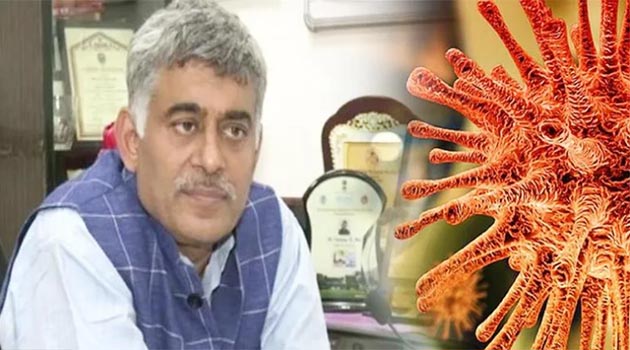
Modi govt's decision on covid vaccination for children 'unscientific': Senior AIIMS epidemiologist

News Network
December 26, 2021

AIIMS Rai.jpg

New Delhi, Dec 26: A senior epidemiologist at AIIMS who is the principal investigator of Covaxin trials for adults and children at the institute on Sunday termed the Centre's decision to vaccinate children against Covid "unscientific" and said it will not yield any additional benefit.

Dr Sanjay K Rai, who is also the president of the Indian Public Health Association, said before implementing the decision, data from countries that have already started vaccinating children should be analysed.

In an address to the nation on Saturday night, Prime Minister Narendra Modi announced that vaccination against Covid-19 for children in the 15 to 18 age group will start from January 3.

This will reduce the worries of children going to schools and colleges and their parents, and boost the fight against the pandemic, he said, adding that the move is also likely to aid in normalisation of teaching in schools.

"I am a great fan of PM Modi for his selfless service to nation and taking right decisions at right time. But I am completely disappointed with his unscientific decision on children vaccination," Rai said in a tweet tagging the Prime Minister's Office.

Elaborating his viewpoint, Rai said there should be a clear-cut objective of any intervention. The objective is to either prevent coronavirus infection or severity or death.

"But according to whatever knowledge we have about vaccines, they are unable to make a significant dent in the infection. In some countries, people are getting infected even after taking booster shots.

"Also, 50,000 breakthrough infections are being reported per day in the UK. So this proves that vaccination is not preventing coronavirus infection but vaccines are effective in preventing severity and death," Rai said. 

He said mortality due to Covid-19 in susceptible populations is around 1.5 per cent, which means 15,000 deaths per million population.

"Through vaccination, we can prevent 80-90 per cent of these deaths, which means that 13,000 to 14,000 deaths per million (population) can be prevented," he added.

Serious adverse events following immunisation are between 10 to 15 per million population, Rai said.

"So, if you do the risk and benefit analysis in adults, it is a huge benefit," he said.

In the case of children, he said, the severity of infection is very low and according to data available in the public domain, only two deaths per million population have been reported.

"In this section (children), 15,000 (people) are not dying and keeping in mind the adverse effects also, if you do the risk and benefit analysis, then the risk is more than the benefits based on the available data," Rai explained.

"Both the objectives are not being fulfilled by initiating vaccination among children," he said.

Few countries, including the US, started vaccinating children four-five months ago. The data of these countries should be analysed before initiating Covid vaccination for children, he said.


Comments

Add new comment

  • Coastaldigest.com reserves the right to delete or block any comments.
  • Coastaldigset.com is not responsible for its readers’ comments.
  • Comments that are abusive, incendiary or irrelevant are strictly prohibited.
  • Please use a genuine email ID and provide your name to avoid reject.
News Network
February 4,2026

Mangaluru: Urban local bodies and gram panchayats should make the use of Kannada on signboards mandatory while issuing trade licences to commercial establishments, Dakshina Kannada Deputy Commissioner Darshan HV said. He also called for regular inspections to ensure compliance.

Presiding over the District Kannada Awareness Committee meeting at the deputy commissioner’s office, Darshan said the city corporation would be directed to ensure that shops operating in malls prominently display their names in Kannada. “All commercial establishments, including shops, companies, offices and hotels, must mandatorily display their names in Kannada on signboards,” he said.

The deputy commissioner added that the National Highways Authority of India (NHAI) would be instructed to include Kannada on signboards along national highways. Banks, he said, would be directed through committee meetings to provide application forms in Kannada.

“Even if English-medium schools and colleges impart education in English, their signboards must display the institution’s name in Kannada. Steps will also be taken to ensure that private buses display place names in Kannada,” Darshan said.

During the meeting, committee members raised concerns over the closure of Kannada-medium schools in rural areas due to a shortage of teachers and stressed the need for immediate corrective measures. They also pointed out that several industries employ workers from other states while overlooking local candidates.

Members further demanded that nationalised banks provide deposit and withdrawal slips in Kannada. It was brought to the deputy commissioner’s notice that the presence of staff without knowledge of Kannada in rural branches of nationalised banks is causing hardship to local customers.

Meanwhile, MP Srinath, president of the District Kannada Sahitya Parishat, urged the district administration to allot land for the construction of a district Kannada Bhavana in Mangaluru.

Comments

Add new comment

  • Coastaldigest.com reserves the right to delete or block any comments.
  • Coastaldigset.com is not responsible for its readers’ comments.
  • Comments that are abusive, incendiary or irrelevant are strictly prohibited.
  • Please use a genuine email ID and provide your name to avoid reject.
News Network
February 3,2026

wind.jpg

Dakshina Kannada MP Capt Brijesh Chowta has urged the Centre to give high priority to offshore wind energy generation along the Mangaluru coast, citing its strategic importance to India’s green energy and port-led development goals.

Raising the issue in the Lok Sabha under Rule 377, Chowta said studies by the National Institute of Oceanography have identified the Mangaluru coastline as part of India’s promising offshore wind ‘Zone-2’, covering nearly 6,490 sq km. He noted that the region’s relatively low exposure to cyclones and earthquakes makes it suitable for long-term offshore wind projects and called for its development as a dedicated offshore wind energy zone.

Highlighting the role of New Mangalore Port, Chowta said its modern infrastructure, multiple berths and heavy cargo-handling capacity position it well as a logistics hub for transporting and assembling large wind energy equipment.

He also pointed to the presence of major industrial units such as MRPL, OMPL, UPCL and the Mangaluru SEZ, which could serve as direct buyers of green power through power purchase agreements, improving project viability and speeding up execution.

With Karnataka’s peak power demand crossing 18,000 MW in early 2025, Chowta stressed the need to diversify renewable energy sources. He added that offshore wind projects in the Arabian Sea are strategically safer compared to the cyclone-prone Bay of Bengal.

Calling the project vital to India’s target of 500 GW of renewable energy by 2030, Chowta urged the Ministry of New and Renewable Energy to initiate resource assessments, pilot projects and stakeholder consultations at the earliest.

Comments

Add new comment

  • Coastaldigest.com reserves the right to delete or block any comments.
  • Coastaldigset.com is not responsible for its readers’ comments.
  • Comments that are abusive, incendiary or irrelevant are strictly prohibited.
  • Please use a genuine email ID and provide your name to avoid reject.
News Network
February 9,2026

The Supreme Court on Monday expressed grave concern over digital frauds, noting that more than ₹54,000 crore has been siphoned off through cyber crimes, and described the scale of the fraud as “absolutely robbery or dacoity”.

A bench of the apex court sought swift and coordinated action from the Reserve Bank of India (RBI), banks and other agencies to curb the rising menace of digital fraud. Observing that such large-scale losses could not occur without serious lapses, the court said the frauds “may be due to collusion or negligence of bank officials”.

The bench directed inter-departmental agencies to prepare a draft memorandum of understanding (MoU) within four weeks to strengthen coordination and effectively tackle digital frauds.

Taking note of an existing standard operating procedure (SOP) framed by the RBI, which prescribes immediate steps such as temporarily blocking debit cards to prevent cyber-enabled fraud, the court directed the Centre to formally adopt and implement the RBI’s SOP across the country.

“We direct the Centre to ensure pan-India implementation of the RBI SOP for inter-agency coordination in dealing with digital frauds. We also direct the CBI to identify cases of so-called ‘digital arrest’,” the bench said.

The Supreme Court further asked the Gujarat and Delhi governments to grant sanction for investigation in identified cases. It also directed the RBI, the Department of Telecommunications (DoT) and other concerned authorities to jointly hold a meeting to evolve a framework for compensation to victims of digital arrest frauds.

Emphasising victim relief, the court said a “pragmatic and liberal approach” is required while considering compensation for those affected by digital arrest scams.

If you want it sharper, more dramatic, or more neutral (wire-style), tell me which tone you’re aiming for.

Comments

Add new comment

  • Coastaldigest.com reserves the right to delete or block any comments.
  • Coastaldigset.com is not responsible for its readers’ comments.
  • Comments that are abusive, incendiary or irrelevant are strictly prohibited.
  • Please use a genuine email ID and provide your name to avoid reject.