



From illiterate to social activist: Belthangady's own 'Medha Patkar'

[email protected] (CD Network)
June 13, 2012

She is no Kiran Bedi, nor does she have the aura of Medha Patkar. But the 55-year-old Sumathi from Ilanthila village in Belthangady has in her own little way contributed to the empowerment of women. Her life is a saga of courage, struggle and perseverance. Her tale stands testimony to the fact that the innate strength of an individual comes out shining only when challenged. Sumathi saw a new opportunity in every difficulty that she faced, and today she stands tall as the brave woman, who brought a telling change in the lives of thousands of women in her village.

She was like any other woman of her village until 1991, when she became one of the beneficiaries of the Literacy drive launched by the government and learnt the art of reading and writing. The process of learning exposed her to world beyond the confines of her home. Armed with the new-found weapon of education, she started 'continuing education centres' in Kadadabakil, Nuja and opened a 'Grama Vikasa Kendra' in her tiny home. She joined the drama troupe 'Kannada Nadu Saksharara Nadu' and travelled around the State. Thanks to her initiative, as many as 14 'continuing education centres' were established in her village. By now, she had realized the empowering women through education and employment is the only way to fight poverty and exploitation. She organized women in her village and formed a number of self-help groups.
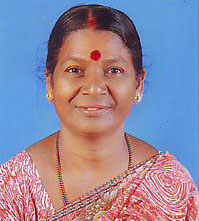
Sumathi

But, it was an incident in 1994, that caught the imagination of the entire country. The socio-economic initiatives launched by Sumathi and her friends had apparently not gone well with some sections of the society. She and her colleagues had to endure barbs from the men sitting at the village arrack shop whenever they passed by to attend meetings at the panchayat. The drunkards used to abuse women in loud voice and draw fun out of it. One day, a young woman named Veda, became the target of drunkards, who started following her. The petrified girl ran into Sumathi's house.

Sumathi, along with other enlightened women, took the owner of the arrack shop into task and warned him. The owner did not pay heed to the complaint and instead tried to shout down the women. The issue was taken up with the police and the excise department, but the women had to run from pillar to post seeking justice. Meanwhile, the highhandedness of the drunkards continued and women increasingly became a target of the barbs and abuses. The women of the village met under the leadership of Sumathi and decided to resolve the issue once for all. On a predetermined day, the women went to the arrack shop in hundreds and set fire to it. The incident became a national-level news and the fight of Sumathi won accolades from across the country.

But, the job was far from over. The arrack lobby worked overtime to settle scores with Sumathi. They used Sumathi's husband, also a drunkard, to clip the woman's wings. Dancing to the tunes of the liquor lobby, he started torturing her. In the next few days, she was beaten up black and blue by the drunkard husband. Although Sumathi resisted, she could hardly match her husband in physical strength. Moreover, she was worried about her family feud affecting the larger cause of women's empowerment. After putting Sumathi and her three children through untold hardship, the husband left home for good one morning.

But, undeterred by the adversities, Sumathi continued her fight and became a part of the de-addiction camps being organized by Dharmasthala institutions. Initially, it was a difficult job for her to convince the drunkards to join the camp. But, gradually she started wooing them by holding some other benefits as the bait. She got her neighbour Anand attending the camp after promising him to help him out on setting right his tenancy document. Ever since she became a gram panchayat member, her social service activities got a new fillip. She started helping the poor and the marginalized people by securing them benefits under various government schemes including Ashraya, Indira Avaas, Neralina Bhagya. She also helped a number of people in securing old-age pension, widowhood pension, handicapped pension etc. In order to empower women economically, Sumathi set up tailoring training centres, phenol manufacturing unit, and also introduced them to insurance schemes and savings schemes.

Today, tailoring training centres are functioning in Ilanthila, Andethadka, Nejikar, Kadapudabakil, Bannengala, Karaya, and Kallerige. Due to her efforts as many as 175 women have got tailoring machine. Several beneficiaries have started their own stitching units. Gayatri, one of the beneficiaries, today has set up a tailoring shop in Uppinangady and as many as five women are employed in her unit. Thanks to her tireless endeavor, the Paradka-Elmadi-Manipar road has been asphalted. After being deserted by her husband Sumathi brought up her three girl children on her own and gave them good education. She was able to marry them off without having to pay dowry as all of them had attained good jobs. This has also inspired other women in the village to educate their daughters and make them economically independent.

The silent revolution brought about by Sumathi in her village goes on to prove how education can transform the life of an individual and also at the same time make her an agent of change. She has been elected to the gram panchayat thrice and has also served as the vice-president for one term. After realizing many of her dreams, she still thinks much more needed to be done to ensure equal opportunities for women both at home and in the society. Her passion and dedication reminds one of Robert Frost's immortal lines: “The woods are lovely, dark and deep. But, I have promises to keep. Miles to go before I sleep.”

Comments

Add new comment

  • Coastaldigest.com reserves the right to delete or block any comments.
  • Coastaldigset.com is not responsible for its readers’ comments.
  • Comments that are abusive, incendiary or irrelevant are strictly prohibited.
  • Please use a genuine email ID and provide your name to avoid reject.
News Network
February 4,2026

Mangaluru: Urban local bodies and gram panchayats should make the use of Kannada on signboards mandatory while issuing trade licences to commercial establishments, Dakshina Kannada Deputy Commissioner Darshan HV said. He also called for regular inspections to ensure compliance.

Presiding over the District Kannada Awareness Committee meeting at the deputy commissioner’s office, Darshan said the city corporation would be directed to ensure that shops operating in malls prominently display their names in Kannada. “All commercial establishments, including shops, companies, offices and hotels, must mandatorily display their names in Kannada on signboards,” he said.

The deputy commissioner added that the National Highways Authority of India (NHAI) would be instructed to include Kannada on signboards along national highways. Banks, he said, would be directed through committee meetings to provide application forms in Kannada.

“Even if English-medium schools and colleges impart education in English, their signboards must display the institution’s name in Kannada. Steps will also be taken to ensure that private buses display place names in Kannada,” Darshan said.

During the meeting, committee members raised concerns over the closure of Kannada-medium schools in rural areas due to a shortage of teachers and stressed the need for immediate corrective measures. They also pointed out that several industries employ workers from other states while overlooking local candidates.

Members further demanded that nationalised banks provide deposit and withdrawal slips in Kannada. It was brought to the deputy commissioner’s notice that the presence of staff without knowledge of Kannada in rural branches of nationalised banks is causing hardship to local customers.

Meanwhile, MP Srinath, president of the District Kannada Sahitya Parishat, urged the district administration to allot land for the construction of a district Kannada Bhavana in Mangaluru.

Comments

Add new comment

  • Coastaldigest.com reserves the right to delete or block any comments.
  • Coastaldigset.com is not responsible for its readers’ comments.
  • Comments that are abusive, incendiary or irrelevant are strictly prohibited.
  • Please use a genuine email ID and provide your name to avoid reject.
News Network
February 1,2026

Bengaluru: The Karnataka High Court has refused to quash an investigation against a WhatsApp group administrator accused of allowing the circulation of obscene and offensive images depicting Hindutva politicians and idols in 2021.

Justice M Nagaprasanna observed that, prima facie, the ingredients of the offence under Section 295A of the Indian Penal Code were made out. “The offence under Section 295A of the IPC is met to every word of its ingredient, albeit prima facie,” the judge said.

The petitioner, Sirajuddin, a resident of Belthangady taluk in Dakshina Kannada district, had challenged the FIR registered against him at the CEN (Cyber, Economics and Narcotics) police station, Mangaluru, for offences under Section 295A of the IPC and Section 67 of the Information Technology Act. Section 295A relates to punishment for deliberate and malicious acts intended to outrage the religious feelings of any class of citizens.

According to the complaint filed by K Jayaraj Salian, also a resident of Belthangady taluk, he received a WhatsApp group link from an unknown source and was added to the group after accessing it. The group reportedly had six administrators and around 250 participants, where obscene and offensive images depicting Hindu deities and certain political figures were allegedly circulated repeatedly.

Sirajuddin was arrested in connection with the case and later released on bail on February 16, 2021. He argued before the court that he was being selectively targeted, while other administrators—including the creator of the group—were neither arrested nor investigated. He also contended that the Magistrate could not have taken cognisance of the offence under Section 295A without prior sanction under Section 196(1) of the CrPC.

Rejecting the argument, Justice Nagaprasanna held that prior sanction is required only at the stage of taking cognisance, and not at the stage of registration of the crime or during investigation.

The judge noted that the State had produced the entire investigation material before the court. “A perusal of the material reveals depictions of Hindu deities in an extraordinarily obscene, demeaning and profane manner. The content is such that its reproduction in a judicial order would itself be inappropriate,” the court said, adding that the material, on its face, had the tendency to outrage religious feelings and disturb communal harmony.

Observing that the case was still at the investigation stage, the court said it could not interdict the probe at this juncture. However, it expressed concern that the investigating officer appeared to have not proceeded uniformly against all administrators. The court clarified that if the investigation revealed the active involvement of any member in permitting the circulation of such content, they must also be proceeded against.

“At this investigative stage, any further observation by this Court would be unnecessary,” the order concluded.

Comments

Add new comment

  • Coastaldigest.com reserves the right to delete or block any comments.
  • Coastaldigset.com is not responsible for its readers’ comments.
  • Comments that are abusive, incendiary or irrelevant are strictly prohibited.
  • Please use a genuine email ID and provide your name to avoid reject.
News Network
February 1,2026

Bengaluru: Karnataka Deputy Chief Minister D K Shivakumar on Sunday criticised the Union Budget presented by Finance Minister Nirmala Sitharaman, claiming it offered no tangible benefit to the state.

Though he said he was yet to study the budget in detail, Shivakumar asserted that Karnataka had gained little from it. “There is no benefit for our state from the central budget. I was observing it. They have now named a programme after Mahatma Gandhi, after repealing the MGNREGA Act that was named after him,” he said.

Speaking to reporters here, the Deputy Chief Minister demanded the restoration of MGNREGA, and made it clear that the newly enacted rural employment scheme — VB-G RAM G — which proposes a 60:40 fund-sharing formula between the Centre and the states, would not be implemented in Karnataka.

“I don’t see any major share for our state in this budget,” he added.

Shivakumar, who also holds charge of Bengaluru development, said there were high expectations for the city from the Union Budget. “The Prime Minister calls Bengaluru a ‘global city’, but what has the Centre done for it?” he asked.

He also drew attention to the problems faced by sugar factories, particularly those in the cooperative sector, alleging a lack of timely decisions and support from the central government.

Noting that the Centre has the authority to fix the minimum support price (MSP) for agricultural produce, Shivakumar said the Union government must take concrete steps to protect farmers’ interests.

Comments

Add new comment

  • Coastaldigest.com reserves the right to delete or block any comments.
  • Coastaldigset.com is not responsible for its readers’ comments.
  • Comments that are abusive, incendiary or irrelevant are strictly prohibited.
  • Please use a genuine email ID and provide your name to avoid reject.