



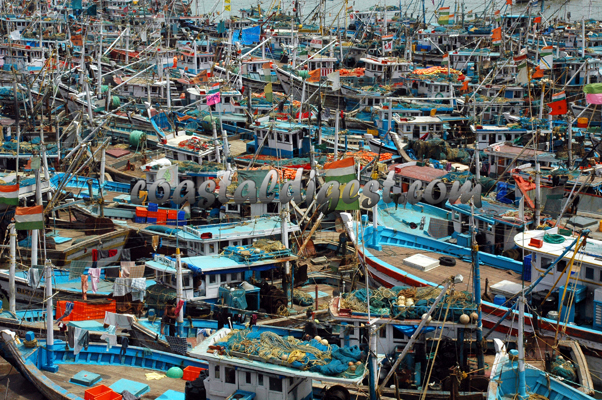
Mechanised boats drop anchor as fishing ban comes into force

[email protected] (CD Network, Photo by Ahmed Anwar )
June 15, 2012

boats


Mangalore, June 15: Hundreds of mechanised boats in Dakshina Kannada, Udupi and Uttara Kannada districts will not put out to sea for nearly two months as the annual ban on fishing activities across the coastal Karnataka came into force on Friday.

The ban has been enforced under Coastal Fishing (Regulation) Act 1986 on deep sea fishing using mechanised and traditional boats fitted with engines of 10 horse power capacity or more.

The ban intended to allow fish to breed, will remain in force for 57 days and will conclude on August 10 in Dakshina Kannada and Udupi districts. In Uttara Kannada district the ban will be in force only for 47 days and will end on July 31.

However, use of fishing boats having up to 10 horse power or traditional boats without engines are permitted during the period of ban.

The region's supply of fish during this holiday will come from the east coast, particularly from Chennai. In Andhra Pradesh, the ban on fishing is in force in the month of April-May, said sources in Marine Products Exports Development Authority.

Responding to the ban order, fishermen have returned with their trawlers, long-liners and other mechanised vessels to the shore and have anchored them in the fishing ports.

During the ban period, fishermen generally go for traditional fishing where they will be able to fetch the income of some 30 days. Country craft of 10 horse power engine are used for the purpose. They go four to five nautical miles into the sea and catch fishes in traditional way. Some others go for fishing in the inland water bodies like rivers and lakes.

“If any tragedies occur during the period of the ban, the concerned will be solely held responsible, and the government will not pay any relief or compensation. The mechanised boats which do not obey this ban, will lose subsidy, concession on the central excise and supply of diesel sans sales tax,” said sources in fisheries department.

Due to the ban the prices of fish have skyrocketed in all three coastal districts.

Senior fishermen leader Vasudeva Boloor said that as per Unorganised Workers' Social Security Act, 2008, there are 129 unorganised sectors in India. About 93 per cent of the labourers are unorganised. The state government has come forward to provide insurance, pension for these unorganised labourers. “If our fishermen get all the benefits, then it will help them.”

The fishermen in Mangalore are facing the problem of lack of space to anchor the boats. The work on extension of the jetty is pending for the last several years.

The work on dredging is taken up recently. At present, about 700 mechanised boats can be anchored in the Mangalore Old Port area. As per the available records, there are 65 purse seine boats and 1,005 trawlers.

As per the fisheries department, the fish catch from April 2011 to March 2012 was Rs 620 crore. Prawns, pomfret, sardine, mackeral, silver fish were exported in large quantity.

It may be mentioned here that the Karnataka Budget for 2012-13 has increased the supply of tax-free diesel to fishermen to 1.25 lakh kilo litres for 2012-13. This was 1 lakh kilo litres in the 2011-12 Budget. But later during that year, the quantity was increased by 15,000 kilo litres taking the total to 1.15 lakh kilo litres during 2011-12.

In Goa

The Goa Government has also imposed annual fishing ban from June 15 to July 31. Efforts of the Government to extend the 45-day ban to 60 days failed to materialise this year too as there was no consensus between various groups and stakeholders in fishing activity, said a spokesman of Goa government. The ban would be monitored and violations by trawlers and other mechanised vessels would invite strong action, he said.


Comments

Add new comment

  • Coastaldigest.com reserves the right to delete or block any comments.
  • Coastaldigset.com is not responsible for its readers’ comments.
  • Comments that are abusive, incendiary or irrelevant are strictly prohibited.
  • Please use a genuine email ID and provide your name to avoid reject.
News Network
February 5,2026

Bengaluru: As air quality continues to worsen across several parts of the city, hospitals in Bengaluru are reporting a steady rise in patients suffering from respiratory illnesses such as asthma, bronchitis and Chronic Obstructive Pulmonary Disease (COPD), health officials and doctors said.

Data from the Suvarna Arogya Suraksha Trust (SAST) shows that 3,891 patients received treatment for respiratory ailments between April and November 2024. The figure rose to 4,187 during the same period in 2025.

Private hospitals, too, are witnessing a 10–15 per cent year-on-year increase in such cases.

While doctors caution that the rise cannot be attributed solely to air pollution, a significant number of patients are non-smokers with no prior history of respiratory disease.

“Nearly 70 per cent of the patients we see are non-smokers with no previous respiratory issues. When other causes are ruled out, air pollution emerges as the most likely factor,” said Dr Manjunath PH, consultant interventional pulmonologist at a hospital in Kengeri.

Doctors noted that patient footfall spikes during the winter months and around Deepavali, when air quality typically worsens.

“There is a clear correlation between poor air quality and the rise in cases. People commonly present with persistent cough, breathlessness and irritation of the respiratory tract, indicating the impact of polluted air on their health,” said Dr Sheetal Chaurasia, consultant in pulmonary medicine at a private hospital in Whitefield.

Dr Chaurasia added that respiratory tract infections are also on the rise.

“Poor air quality leads to chronic airway inflammation, making the airways more vulnerable to infections. We are seeing an increase in both upper and lower respiratory tract infections,” she said.

Patients with pre-existing respiratory conditions remain the worst affected.

“For those already diagnosed with respiratory illnesses, deteriorating air quality significantly worsens the condition. Both the frequency and severity of attacks increase sharply,” said Dr Vandana P, a pulmonologist at a hospital on Bannerghatta Road.

Doctors also flagged a worrying trend of rising respiratory problems among younger adults and children.

To reduce exposure, they advised people to wear masks while travelling on two-wheelers or autos and ensure adequate ventilation at home to minimise indoor air pollution.

Comments

Add new comment

  • Coastaldigest.com reserves the right to delete or block any comments.
  • Coastaldigset.com is not responsible for its readers’ comments.
  • Comments that are abusive, incendiary or irrelevant are strictly prohibited.
  • Please use a genuine email ID and provide your name to avoid reject.
News Network
January 31,2026

Roy.jpg

Bengaluru: The shooting incident involving CJ Roy, founder of the Confident Group, has once again put the spotlight on a businessman whose life has swung between flamboyant global success and persistent controversy at home.

Though Roy’s business interests extended across continents, his roots lay firmly in Karnataka. An alumnus of Christ School in Bengaluru, he later moved to Tumakuru to pursue an engineering degree. Those familiar with his early years describe him as intensely ambitious, beginning his career as a salesman at a small electronics firm dealing in computers.

Roy’s entry into large-scale real estate came through the Crystal Group, where he worked closely with Latha Namboothiri and rose from manager to director. However, the launch of the Confident Group in 2005 was clouded by industry speculation. Insiders speak of a fallout involving alleged “benami” properties and claims of deception that ultimately led to his independent venture—an episode Roy spent years trying to distance himself from, according to associates.

A tale of two cities

Roy’s professional trajectory diverged sharply across geographies.

In Dubai, he built a reputation as a bold and efficient developer, completing massive luxury residential projects in record time—some reportedly within 11 months. His rapid project delivery and lavish lifestyle in the Emirates earned him admiration and visibility in the real estate sector.

In Bengaluru, however, his image remained far more fractured. Sources say Roy stayed away from the city for several years amid disputes over unpaid dues to vendors and suppliers. Several projects were allegedly stalled, with accusations of unfulfilled commitments to cement and steel suppliers continuing to follow him.

Roy’s return to Bengaluru’s business and social circles began around 2018, marked by a conscious attempt at rebranding. His appointment as Honorary Consul of the Slovak Republic added diplomatic legitimacy, which he complemented with visible CSR initiatives, including ambulance donations and high-profile charity events.

Heavy police presence in Langford Town

Following the incident, police personnel from the Central division were deployed outside the Confident Group building in Langford Town, which also houses the Slovak Honorary Consulate in Bengaluru.

The otherwise busy premises near Hosur Road wore a deserted look on Friday, reflecting the shock and uncertainty that followed the tragedy.

Comments

Add new comment

  • Coastaldigest.com reserves the right to delete or block any comments.
  • Coastaldigset.com is not responsible for its readers’ comments.
  • Comments that are abusive, incendiary or irrelevant are strictly prohibited.
  • Please use a genuine email ID and provide your name to avoid reject.
News Network
February 1,2026

Bengaluru: The Karnataka High Court has refused to quash an investigation against a WhatsApp group administrator accused of allowing the circulation of obscene and offensive images depicting Hindutva politicians and idols in 2021.

Justice M Nagaprasanna observed that, prima facie, the ingredients of the offence under Section 295A of the Indian Penal Code were made out. “The offence under Section 295A of the IPC is met to every word of its ingredient, albeit prima facie,” the judge said.

The petitioner, Sirajuddin, a resident of Belthangady taluk in Dakshina Kannada district, had challenged the FIR registered against him at the CEN (Cyber, Economics and Narcotics) police station, Mangaluru, for offences under Section 295A of the IPC and Section 67 of the Information Technology Act. Section 295A relates to punishment for deliberate and malicious acts intended to outrage the religious feelings of any class of citizens.

According to the complaint filed by K Jayaraj Salian, also a resident of Belthangady taluk, he received a WhatsApp group link from an unknown source and was added to the group after accessing it. The group reportedly had six administrators and around 250 participants, where obscene and offensive images depicting Hindu deities and certain political figures were allegedly circulated repeatedly.

Sirajuddin was arrested in connection with the case and later released on bail on February 16, 2021. He argued before the court that he was being selectively targeted, while other administrators—including the creator of the group—were neither arrested nor investigated. He also contended that the Magistrate could not have taken cognisance of the offence under Section 295A without prior sanction under Section 196(1) of the CrPC.

Rejecting the argument, Justice Nagaprasanna held that prior sanction is required only at the stage of taking cognisance, and not at the stage of registration of the crime or during investigation.

The judge noted that the State had produced the entire investigation material before the court. “A perusal of the material reveals depictions of Hindu deities in an extraordinarily obscene, demeaning and profane manner. The content is such that its reproduction in a judicial order would itself be inappropriate,” the court said, adding that the material, on its face, had the tendency to outrage religious feelings and disturb communal harmony.

Observing that the case was still at the investigation stage, the court said it could not interdict the probe at this juncture. However, it expressed concern that the investigating officer appeared to have not proceeded uniformly against all administrators. The court clarified that if the investigation revealed the active involvement of any member in permitting the circulation of such content, they must also be proceeded against.

“At this investigative stage, any further observation by this Court would be unnecessary,” the order concluded.

Comments

Add new comment

  • Coastaldigest.com reserves the right to delete or block any comments.
  • Coastaldigset.com is not responsible for its readers’ comments.
  • Comments that are abusive, incendiary or irrelevant are strictly prohibited.
  • Please use a genuine email ID and provide your name to avoid reject.