



JKS fights against attempt to destroy script variety in Konkani'

[email protected] (CD Network)
June 30, 2012

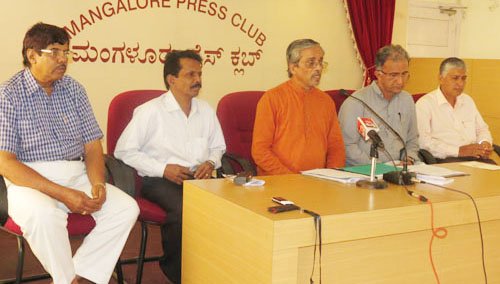
Mangalore, June 30: Jagotik Konkani Songhotton has condemned the move of Karnataka State Konkani Linguistic Minorities Institutions (KSKLMI), which had recently raised voice against considering Konkani works written in scripts other than 'Devanagari' for Central Sahitya Akademi awards.

Addressing a press meet here on Saturday, Eric Ozario, General Secretary, JKS, lamented that despite the fact that Devanagari is only the third most prolific script, after Kannada and Roman scripts, the Akademi has been squarely ignoring and neglecting Konkani literature in other scripts.

“Though Konkani is written in five different scripts, namely – Kannada, Roman, Devanagari, Perso-Arabic and Malayalam – the Sahitya Akademi (Central), since the very beginning, has been conferring Awards, Assignments and Projects only to the literature in the Devanagari script”, he said.
jks

Mr Ozario, said that he himself along with two others (Vally Vagga, Mysore and Marcel D'souza, Mangalore) on behalf of all Konkanis had approached High Court of Karnataka with a writ petition demanding the Court to issue a direction to the Sahitya Akademi to recognise all the five scripts of Konkani Language viz., Kannada, Roman (English), Devanagari, Arabic and Malayalam as eligible for grant of Awards, Research funding and all other incidental works, for which assistance is rendered by the Akademi.

He said while the High Court was considering this petition, the KSKLMI pleaded the same Court to consider 'only Devanagari for recognition'. Together, they have issued a press statement with false information. Their statements claim that 1) 'Devanagari is the official script of Konkani', 2) 'The Constitution has given prominence to the Devanagari script', 3)'Konkanis use only the Devanagari script and not Kannada or Malayalam', and 4) 'If any script other than Devanagari is recognised, it will be detrimental to Konkani Langauage'

Brushing aside all these four claims, Mr Ozario questioned how does Devanagari become the official script, just because the Devanagari lobby declares so? “Such a decision has to be taken in a democratic process, at an assembly of representatives of all scripts. Such an assembly has never been convened in Konkani, he said.

“Moreover, this is not a question of the 'Official script'. The Question is whether the Sahitya Akademi's mandate is to honour and support the 'literature' of a language or the 'script' of a language. If it is literature, then how can the Akademi pamper and patronize the literature in one script alone and completely ignore and disregard the literature in other scripts?” he questioned.

He also clarified that Constitution has never given prominence to Devanagari script over other scripts.

“In its reply to our petition the Sahitya Akademi itself has admitted to the Court that 'the mandate of the Akademi is fully to recognise and support the literary traditions of the given language. The literary traditions of Konkani being that it is in five scripts, the Akademi has no option but to recognize and support literature in all five scripts”, he said.

Stating that Konkanis are confined to Devanagari script, he said that the truth is – according to the 2001 Census, of the total Konkanis in India, 31.82% Konkanis live in Goa. 31.73% live in Karnataka. All Konkanis living in Karnataka read and write Konkani in the Kannada script. Goa is divided between Roman and Devanagari. A Study conducted in 2011 reveals that only 12.7% Konkanis in India use Devanagari script; the remaining 87.3% use other scripts. The use of Kannada script is the highest – 58%, he said.

However, Mr Ozario clarified that JKS is not fighting agaginst Devanagari. “We are not demanding that Devanagari be neglected. Our demand is that the other four scripts also be considered”, he said.

“Their attempt is to destroy all script variety in Konkani and impose their variety on everyone. This is detrimental to the unity and development of Konkani. We condemn this and seek legal remedies”, he said.

KK Utharan, Vice President (India) JKS, Dr. Pratapananda Naik, Linguist, Goa and Vally Vagga (Valerian Dsouza), writer, Mysore were also present in the press meet.

Comments

Add new comment

  • Coastaldigest.com reserves the right to delete or block any comments.
  • Coastaldigset.com is not responsible for its readers’ comments.
  • Comments that are abusive, incendiary or irrelevant are strictly prohibited.
  • Please use a genuine email ID and provide your name to avoid reject.
coastaldigest.com news network
February 5,2026

protestkerala.jpg

Mangaluru: The KSRTC Mangaluru division has rolled back the fare hike on buses operating on the Mangaluru–Kasaragod route following the suspension of toll collection at the Arikkady toll plaza near Kumbala in Kasaragod district.

The fare revision had been implemented after the National Highways Authority of India (NHAI) began toll collection at the Arikkady plaza on NH-66. As a result, fares for ordinary and Rajahamsa services were increased by ₹7 and ₹10, respectively, raising the bus fare from Mangaluru to Kasaragod from ₹81 to ₹88.

Senior Divisional Controller of KSRTC’s Mangaluru division, Rajesh Shetty, said the fares were reduced after toll collection at the Arikkady plaza was stopped. “The tollgate began operations on January 13, and the toll amount was deducted from the FASTag accounts of KSRTC buses operating on the route. Following an order from the central government to suspend toll collection, KSRTC has also withdrawn the additional fare with immediate effect,” he said.

At present, vehicles travelling on the Mangaluru–Kasaragod route pay toll only at the Talapady toll plaza. The toll for light motor vehicles (LMVs) at Talapady is ₹80 for a same-day return, while heavy vehicles, including buses, are charged ₹250. At Arikkady, the toll rates were ₹130 for LMVs (same-day return) and ₹450 for buses.

Protests against Arikkady toll plaza

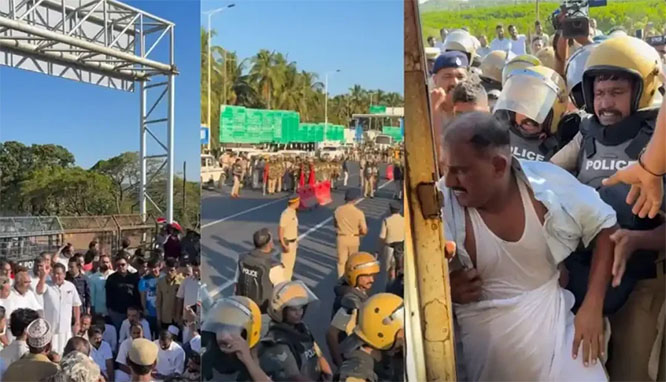
The Arikkady toll plaza witnessed widespread protests from January 12, the day toll collection commenced. On the second day, an action committee led by Manjeshwar MLA A K M Ashraf launched an indefinite protest at the site. Except for the BJP, leaders and workers of most major political parties participated in the agitation.

On the night of January 14, a large number of protesters gathered at the plaza and vandalised property, following which authorities temporarily suspended toll operations. The BJP later also expressed opposition to the toll plaza and criticised NHAI’s decision. 

Comments

Add new comment

  • Coastaldigest.com reserves the right to delete or block any comments.
  • Coastaldigset.com is not responsible for its readers’ comments.
  • Comments that are abusive, incendiary or irrelevant are strictly prohibited.
  • Please use a genuine email ID and provide your name to avoid reject.
News Network
February 5,2026

Bengaluru: As air quality continues to worsen across several parts of the city, hospitals in Bengaluru are reporting a steady rise in patients suffering from respiratory illnesses such as asthma, bronchitis and Chronic Obstructive Pulmonary Disease (COPD), health officials and doctors said.

Data from the Suvarna Arogya Suraksha Trust (SAST) shows that 3,891 patients received treatment for respiratory ailments between April and November 2024. The figure rose to 4,187 during the same period in 2025.

Private hospitals, too, are witnessing a 10–15 per cent year-on-year increase in such cases.

While doctors caution that the rise cannot be attributed solely to air pollution, a significant number of patients are non-smokers with no prior history of respiratory disease.

“Nearly 70 per cent of the patients we see are non-smokers with no previous respiratory issues. When other causes are ruled out, air pollution emerges as the most likely factor,” said Dr Manjunath PH, consultant interventional pulmonologist at a hospital in Kengeri.

Doctors noted that patient footfall spikes during the winter months and around Deepavali, when air quality typically worsens.

“There is a clear correlation between poor air quality and the rise in cases. People commonly present with persistent cough, breathlessness and irritation of the respiratory tract, indicating the impact of polluted air on their health,” said Dr Sheetal Chaurasia, consultant in pulmonary medicine at a private hospital in Whitefield.

Dr Chaurasia added that respiratory tract infections are also on the rise.

“Poor air quality leads to chronic airway inflammation, making the airways more vulnerable to infections. We are seeing an increase in both upper and lower respiratory tract infections,” she said.

Patients with pre-existing respiratory conditions remain the worst affected.

“For those already diagnosed with respiratory illnesses, deteriorating air quality significantly worsens the condition. Both the frequency and severity of attacks increase sharply,” said Dr Vandana P, a pulmonologist at a hospital on Bannerghatta Road.

Doctors also flagged a worrying trend of rising respiratory problems among younger adults and children.

To reduce exposure, they advised people to wear masks while travelling on two-wheelers or autos and ensure adequate ventilation at home to minimise indoor air pollution.

Comments

Add new comment

  • Coastaldigest.com reserves the right to delete or block any comments.
  • Coastaldigset.com is not responsible for its readers’ comments.
  • Comments that are abusive, incendiary or irrelevant are strictly prohibited.
  • Please use a genuine email ID and provide your name to avoid reject.
News Network
February 5,2026

In an era where digital distractions are the primary rival to academic excellence, the Karnataka Education Department is taking the fight directly to the living room. As the SSLC (Class 10) annual examinations loom, officials have launched a localized "digital strike" to ensure students aren't losing their competitive edge to scrolling or soap operas.

The 7-to-9 Lockdown

The department has issued a formal directive urging—and in some cases, enforcing via home visits—a total blackout of mobile phones and television sets between 7:00 PM and 9:00 PM. This two-hour window is being designated as "sacred study time" across the state until the examinations conclude on April 2.

Key Pillars of the Initiative:

•    Doorstep Advocacy: Teachers are transitioning from classrooms to living rooms, meeting parents to explain the psychological benefits of a distraction-free environment.

•    Parental Accountability: The campaign shifts the burden of discipline from the student to the household, asking parents to lead by example and switch off their own devices.

•    The Timeline: The focus remains sharp on the upcoming exam block, scheduled from March 18 to April 2.

"The objective is simple: uninterrupted focus. We are reclaiming the evening hours for the students, ensuring their environment is as prepared as their minds," stated a senior department official.

Student vs. Reality

While the student community has largely welcomed the "forced focus"—with many admitting they lack the willpower to ignore notifications—the move has sparked a debate on enforceability. Without a "TV Police," the success of this initiative rests entirely on the shoulders of parents and the persuasive power of visiting educators.

Comments

Add new comment

  • Coastaldigest.com reserves the right to delete or block any comments.
  • Coastaldigset.com is not responsible for its readers’ comments.
  • Comments that are abusive, incendiary or irrelevant are strictly prohibited.
  • Please use a genuine email ID and provide your name to avoid reject.