Dalits had access to learning in India even before British introduced education'

July 8, 2012

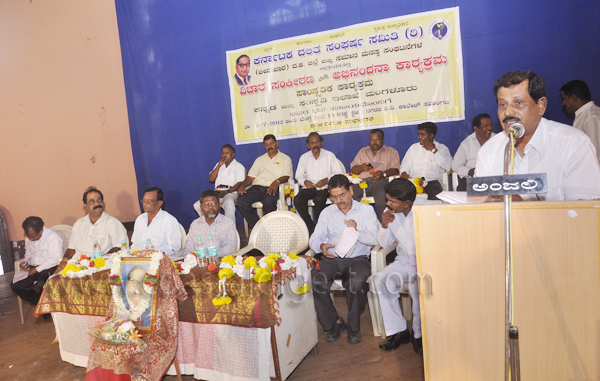
Mangalore, July 8: Atrocities against Dalits were in existence during the British Raj too, said Dr. Madhava Peraje, Lecturer, Hampi Kannada University.

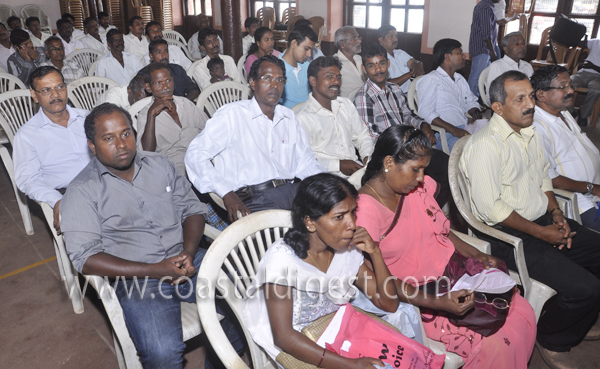
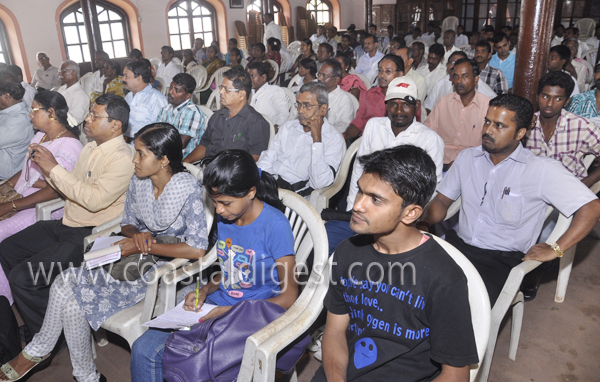
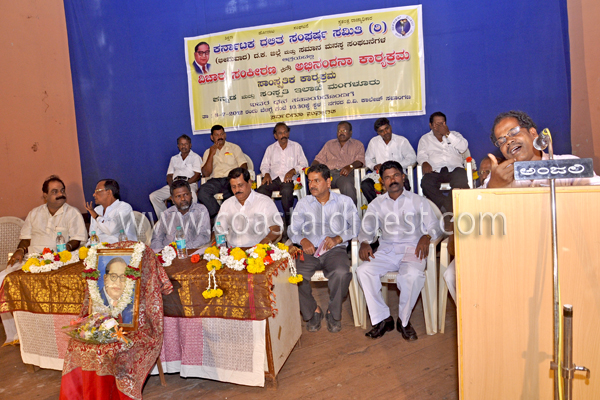
He was speaking at a seminar on 'Life of Dalits in Independent India', organized by Karnataka Dalitha Sangharsha Samithi (DSS Bhimavada) in Mangalore on Sunday.

Records mentioning British men carrying atrocities on Dalit women in 1700s are available, Dr. Peraje said.

In an inscription there is a mention of Dalits serving as army commanders in the 13th century. But during British rule, they were treated as slaves, he said.

Dr. Peraje also denied on the occasion that it was British who facilitated Dalits to get education by introducing common education. In the early 1700s, Dalits had access to education like upper caste people in India and there are records to prove it, he said.

Situation of Dalits same even after independence


Even after 64 years of independence, the situation of Dalits remains the same in India. Many Dalits have been deprived of government facilities due to lack of land rights documents, said Dharmanna Naik, Former Commissioner, Commercial Taxes Department, Mangalore.

Although it may appear that quite a few Dalits have got into government jobs, majority of Dalits continue to battle poverty and other problems. The educated members of the community must take intitatives in bringing the deprived lot to the mainstream, Mr. Naik said.

Shridhar Ullal, state award winning teacher and Krishnappa Derebail, District President, Mugera Samaja Seva Sangha, were felicitated on the occasion.

DL_PM_2

DL_PM_1

DL_PM_3

DL_PM_5

DL_PM_6

Comments

Add new comment

  • Coastaldigest.com reserves the right to delete or block any comments.
  • Coastaldigset.com is not responsible for its readers’ comments.
  • Comments that are abusive, incendiary or irrelevant are strictly prohibited.
  • Please use a genuine email ID and provide your name to avoid reject.
News Network
February 5,2026

In an era where digital distractions are the primary rival to academic excellence, the Karnataka Education Department is taking the fight directly to the living room. As the SSLC (Class 10) annual examinations loom, officials have launched a localized "digital strike" to ensure students aren't losing their competitive edge to scrolling or soap operas.

The 7-to-9 Lockdown

The department has issued a formal directive urging—and in some cases, enforcing via home visits—a total blackout of mobile phones and television sets between 7:00 PM and 9:00 PM. This two-hour window is being designated as "sacred study time" across the state until the examinations conclude on April 2.

Key Pillars of the Initiative:

•    Doorstep Advocacy: Teachers are transitioning from classrooms to living rooms, meeting parents to explain the psychological benefits of a distraction-free environment.

•    Parental Accountability: The campaign shifts the burden of discipline from the student to the household, asking parents to lead by example and switch off their own devices.

•    The Timeline: The focus remains sharp on the upcoming exam block, scheduled from March 18 to April 2.

"The objective is simple: uninterrupted focus. We are reclaiming the evening hours for the students, ensuring their environment is as prepared as their minds," stated a senior department official.

Student vs. Reality

While the student community has largely welcomed the "forced focus"—with many admitting they lack the willpower to ignore notifications—the move has sparked a debate on enforceability. Without a "TV Police," the success of this initiative rests entirely on the shoulders of parents and the persuasive power of visiting educators.

Comments

Add new comment

  • Coastaldigest.com reserves the right to delete or block any comments.
  • Coastaldigset.com is not responsible for its readers’ comments.
  • Comments that are abusive, incendiary or irrelevant are strictly prohibited.
  • Please use a genuine email ID and provide your name to avoid reject.
News Network
February 4,2026

Mangaluru: Urban local bodies and gram panchayats should make the use of Kannada on signboards mandatory while issuing trade licences to commercial establishments, Dakshina Kannada Deputy Commissioner Darshan HV said. He also called for regular inspections to ensure compliance.

Presiding over the District Kannada Awareness Committee meeting at the deputy commissioner’s office, Darshan said the city corporation would be directed to ensure that shops operating in malls prominently display their names in Kannada. “All commercial establishments, including shops, companies, offices and hotels, must mandatorily display their names in Kannada on signboards,” he said.

The deputy commissioner added that the National Highways Authority of India (NHAI) would be instructed to include Kannada on signboards along national highways. Banks, he said, would be directed through committee meetings to provide application forms in Kannada.

“Even if English-medium schools and colleges impart education in English, their signboards must display the institution’s name in Kannada. Steps will also be taken to ensure that private buses display place names in Kannada,” Darshan said.

During the meeting, committee members raised concerns over the closure of Kannada-medium schools in rural areas due to a shortage of teachers and stressed the need for immediate corrective measures. They also pointed out that several industries employ workers from other states while overlooking local candidates.

Members further demanded that nationalised banks provide deposit and withdrawal slips in Kannada. It was brought to the deputy commissioner’s notice that the presence of staff without knowledge of Kannada in rural branches of nationalised banks is causing hardship to local customers.

Meanwhile, MP Srinath, president of the District Kannada Sahitya Parishat, urged the district administration to allot land for the construction of a district Kannada Bhavana in Mangaluru.

Comments

Add new comment

  • Coastaldigest.com reserves the right to delete or block any comments.
  • Coastaldigset.com is not responsible for its readers’ comments.
  • Comments that are abusive, incendiary or irrelevant are strictly prohibited.
  • Please use a genuine email ID and provide your name to avoid reject.
News Network
February 5,2026

Bengaluru: As air quality continues to worsen across several parts of the city, hospitals in Bengaluru are reporting a steady rise in patients suffering from respiratory illnesses such as asthma, bronchitis and Chronic Obstructive Pulmonary Disease (COPD), health officials and doctors said.

Data from the Suvarna Arogya Suraksha Trust (SAST) shows that 3,891 patients received treatment for respiratory ailments between April and November 2024. The figure rose to 4,187 during the same period in 2025.

Private hospitals, too, are witnessing a 10–15 per cent year-on-year increase in such cases.

While doctors caution that the rise cannot be attributed solely to air pollution, a significant number of patients are non-smokers with no prior history of respiratory disease.

“Nearly 70 per cent of the patients we see are non-smokers with no previous respiratory issues. When other causes are ruled out, air pollution emerges as the most likely factor,” said Dr Manjunath PH, consultant interventional pulmonologist at a hospital in Kengeri.

Doctors noted that patient footfall spikes during the winter months and around Deepavali, when air quality typically worsens.

“There is a clear correlation between poor air quality and the rise in cases. People commonly present with persistent cough, breathlessness and irritation of the respiratory tract, indicating the impact of polluted air on their health,” said Dr Sheetal Chaurasia, consultant in pulmonary medicine at a private hospital in Whitefield.

Dr Chaurasia added that respiratory tract infections are also on the rise.

“Poor air quality leads to chronic airway inflammation, making the airways more vulnerable to infections. We are seeing an increase in both upper and lower respiratory tract infections,” she said.

Patients with pre-existing respiratory conditions remain the worst affected.

“For those already diagnosed with respiratory illnesses, deteriorating air quality significantly worsens the condition. Both the frequency and severity of attacks increase sharply,” said Dr Vandana P, a pulmonologist at a hospital on Bannerghatta Road.

Doctors also flagged a worrying trend of rising respiratory problems among younger adults and children.

To reduce exposure, they advised people to wear masks while travelling on two-wheelers or autos and ensure adequate ventilation at home to minimise indoor air pollution.

Comments

Add new comment

  • Coastaldigest.com reserves the right to delete or block any comments.
  • Coastaldigset.com is not responsible for its readers’ comments.
  • Comments that are abusive, incendiary or irrelevant are strictly prohibited.
  • Please use a genuine email ID and provide your name to avoid reject.