Two-day nationwide bank strike begins; banking services paralysed in DK, Udupi

[email protected] (CD Network)
August 22, 2012

bank1


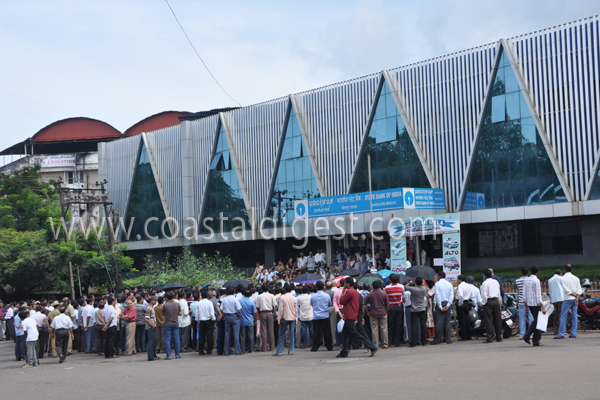
Mangalore, August 22: Employees of public sector banks across the coastal Karnataka have joined the two-day nationwide strike on Wednesday and Thursday opposing banking sector reforms and outsourcing of non-core activities.

The strike has affected banking services across Dakshina Kannada, Udupi and Uttara Kannada districts. However, a few private sector banks, foreign banks and ATMs, however, continued to operate normally.

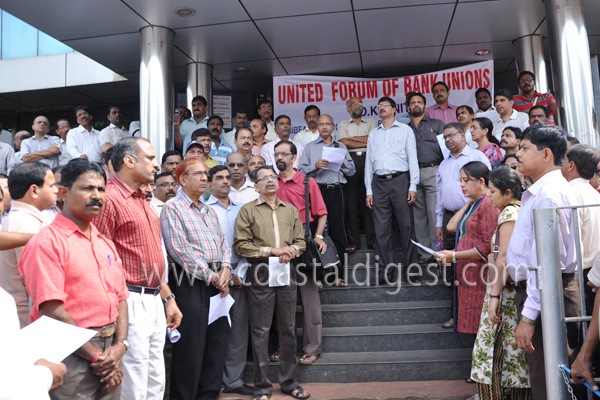
The strike call was given by the United Forum of Bank Unions (UFBU), an umbrella organisation of nine unions of employees and officers of PSU banks.

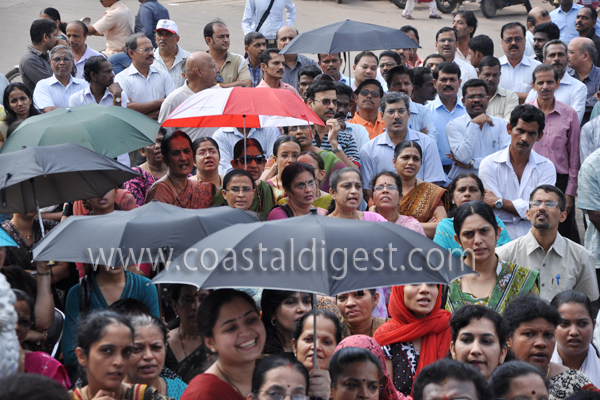
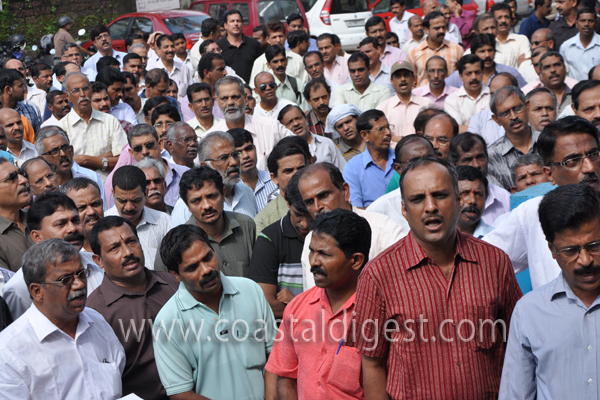
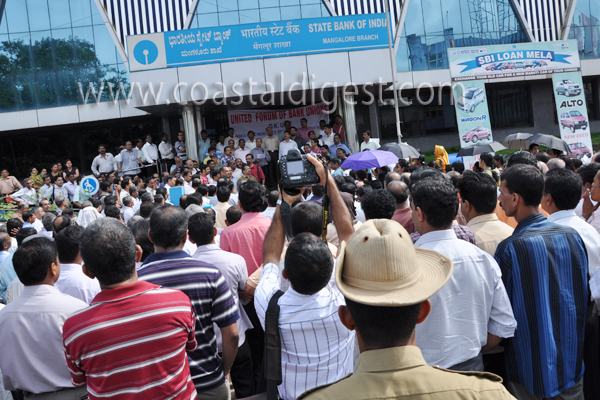
Under the aegis of Dakshina Kannada district unit of UFBU a demonstration was organized Wednesday morning in front of State Bank in the city, where protesters shouted slogans seeking the fulfillment of their demands.

They are protesting against banking sector reforms and unilateral implementation of the Khandelwal committee report on human resources management in PSU banks.

According to All India Bank Employees Association (AIBEA) General Secretary C H Venkatachalam nearly 10 lakh employees are participating in the two day strike across India. This includes 24 public- sector banks, 12 private banks and 6 foreign banks.

He also said that ATM machines will work until they have the cash and thereafter those services will also be impacted.

The strike has been called against government's policies of liberalisation, privatisation and globalisation.

Bank unions are demanding stringent and effective measures to recover bad loans.

There are about 87,000 branches of public sector banks, employing over 10 lakh people. The PSU banks, which operate 63,000 ATMs, control about 75 percent banking business in the country.

According to reports, operations like deposit, withdrawal as well as clearing are affected in public sector banks, including the largest lender State Bank of India, due to the strike.

However, in the private sector, operations were normal in ICICI Bank, HDFC Bank and Axis Bank and foreign banks.

Among other things, the trade unions are protesting against Banking Laws Amendment Bill which is pending in Parliament and implementation of the Khandelwal committee report.

The Amendment Bill, 2011 contains provisions such as raising of shareholders' voting rights from 10 percent to 26 percent in private banks and supersession of bank boards.

The Centre-appointed Khandelwal panel had suggested a slew of measures, including more outsourcing of non-core activities in a time-bound manner.

Also, the standard of recruitment, including methodology and content for testing, has to be raised. Testing of computer skills will be mandatory for both officers and clerks, the panel had recommended.

The Khandelwal committee had also suggested that the minimum qualification for clerks and sub-staff should be graduation and class 10, respectively.

The unions which had given the strike call include All India Bank Employees Association, All India Bank Officers Confederation, National Confederation of Bank Employees, All India Bank Officers Officers Association, Bank Employees Federation of India, India National Bank Employees Federation, Indian National Bank Officers Congress, National Organisation of Bank Workers and National Organisation of Bank Officers are part of the United Forum of Bank Union.
bank2

bank3

bank4

bank5


Comments

Add new comment

  • Coastaldigest.com reserves the right to delete or block any comments.
  • Coastaldigset.com is not responsible for its readers’ comments.
  • Comments that are abusive, incendiary or irrelevant are strictly prohibited.
  • Please use a genuine email ID and provide your name to avoid reject.
News Network
February 8,2026

Baraka1.jpg

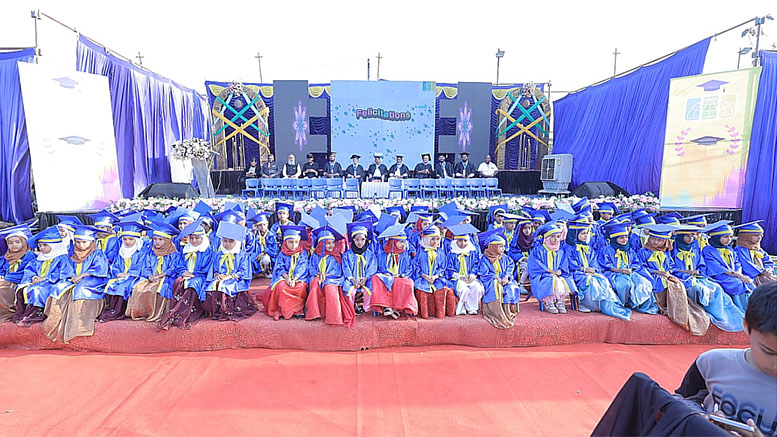
Mangaluru: Emphasising the importance of integrating cultural awareness with formal education, former Mangaluru North MLA and noted community leader Moidin Bawa said such an approach is vital for the holistic development of children and helps shape responsible, confident future citizens. He was speaking as the chief guest at the Prep Graduation Ceremony of Barakah International School and College.

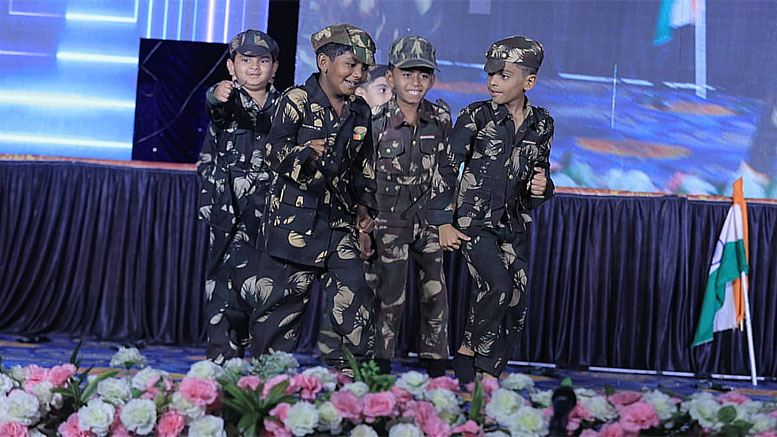
The young graduates enthralled the audience with a vibrant mix of performances, including skits, action songs, short plays, and other engaging cultural programmes that showcased the creativity and confidence nurtured by the institution.

The event was graced by several prominent personalities, including Abdul Naser “Lucky Star”, President of the Wakf Advisory Committee; Dr Mohammed Nohman, Orthopaedic Surgeon; S. A. Khaleel, Chairman of the Bolar Islamic Centre; Naufal Kokkada, President of the SKSM Youth Wing; Suhail Kandak, Chairman of the Make a Change Foundation; and Mohammad Ashraf Badriya, President of Muslim Aikyata Vedike, among others.

The programme began with a warm welcome by Principal Sharfuddin B.S., who highlighted Barakah’s distinctive educational philosophy that blends academic excellence with strong moral and cultural values.

Ayan Ashraf, Director of Barakah, conveyed the Chairman’s message and reaffirmed the institution’s commitment to value-based education.

The vote of thanks was proposed by Mohammed Haneef, Principal of Islamic Studies.

Barakah International School and College is a reputed educational institution in Mangaluru, offering quality education from nursery to degree level. The institution is known for its holistic education model that harmoniously integrates cultural values with academic excellence, ensuring the all-round development of students.

Baraka3.jpg

Baraka2.jpg

Comments

Add new comment

  • Coastaldigest.com reserves the right to delete or block any comments.
  • Coastaldigset.com is not responsible for its readers’ comments.
  • Comments that are abusive, incendiary or irrelevant are strictly prohibited.
  • Please use a genuine email ID and provide your name to avoid reject.
coastaldigest.com news network
February 5,2026

protestkerala.jpg

Mangaluru: The KSRTC Mangaluru division has rolled back the fare hike on buses operating on the Mangaluru–Kasaragod route following the suspension of toll collection at the Arikkady toll plaza near Kumbala in Kasaragod district.

The fare revision had been implemented after the National Highways Authority of India (NHAI) began toll collection at the Arikkady plaza on NH-66. As a result, fares for ordinary and Rajahamsa services were increased by ₹7 and ₹10, respectively, raising the bus fare from Mangaluru to Kasaragod from ₹81 to ₹88.

Senior Divisional Controller of KSRTC’s Mangaluru division, Rajesh Shetty, said the fares were reduced after toll collection at the Arikkady plaza was stopped. “The tollgate began operations on January 13, and the toll amount was deducted from the FASTag accounts of KSRTC buses operating on the route. Following an order from the central government to suspend toll collection, KSRTC has also withdrawn the additional fare with immediate effect,” he said.

At present, vehicles travelling on the Mangaluru–Kasaragod route pay toll only at the Talapady toll plaza. The toll for light motor vehicles (LMVs) at Talapady is ₹80 for a same-day return, while heavy vehicles, including buses, are charged ₹250. At Arikkady, the toll rates were ₹130 for LMVs (same-day return) and ₹450 for buses.

Protests against Arikkady toll plaza

The Arikkady toll plaza witnessed widespread protests from January 12, the day toll collection commenced. On the second day, an action committee led by Manjeshwar MLA A K M Ashraf launched an indefinite protest at the site. Except for the BJP, leaders and workers of most major political parties participated in the agitation.

On the night of January 14, a large number of protesters gathered at the plaza and vandalised property, following which authorities temporarily suspended toll operations. The BJP later also expressed opposition to the toll plaza and criticised NHAI’s decision. 

Comments

Add new comment

  • Coastaldigest.com reserves the right to delete or block any comments.
  • Coastaldigset.com is not responsible for its readers’ comments.
  • Comments that are abusive, incendiary or irrelevant are strictly prohibited.
  • Please use a genuine email ID and provide your name to avoid reject.
News Network
February 5,2026

In an era where digital distractions are the primary rival to academic excellence, the Karnataka Education Department is taking the fight directly to the living room. As the SSLC (Class 10) annual examinations loom, officials have launched a localized "digital strike" to ensure students aren't losing their competitive edge to scrolling or soap operas.

The 7-to-9 Lockdown

The department has issued a formal directive urging—and in some cases, enforcing via home visits—a total blackout of mobile phones and television sets between 7:00 PM and 9:00 PM. This two-hour window is being designated as "sacred study time" across the state until the examinations conclude on April 2.

Key Pillars of the Initiative:

•    Doorstep Advocacy: Teachers are transitioning from classrooms to living rooms, meeting parents to explain the psychological benefits of a distraction-free environment.

•    Parental Accountability: The campaign shifts the burden of discipline from the student to the household, asking parents to lead by example and switch off their own devices.

•    The Timeline: The focus remains sharp on the upcoming exam block, scheduled from March 18 to April 2.

"The objective is simple: uninterrupted focus. We are reclaiming the evening hours for the students, ensuring their environment is as prepared as their minds," stated a senior department official.

Student vs. Reality

While the student community has largely welcomed the "forced focus"—with many admitting they lack the willpower to ignore notifications—the move has sparked a debate on enforceability. Without a "TV Police," the success of this initiative rests entirely on the shoulders of parents and the persuasive power of visiting educators.

Comments

Add new comment

  • Coastaldigest.com reserves the right to delete or block any comments.
  • Coastaldigset.com is not responsible for its readers’ comments.
  • Comments that are abusive, incendiary or irrelevant are strictly prohibited.
  • Please use a genuine email ID and provide your name to avoid reject.