Feasibility report of 'Netrvathi Diversion project' infeasible'

September 2, 2012

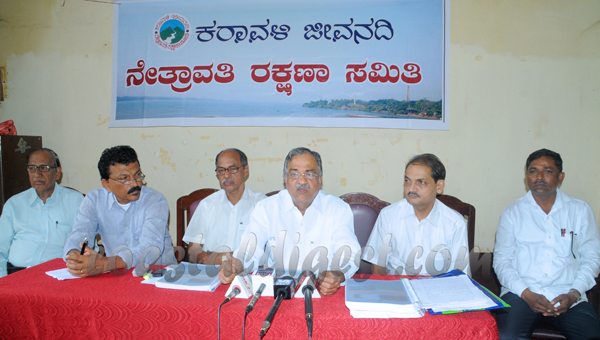
Mangalore, September 2: Strongly opposing the 'Yettinahole water diversion project' recently approved by the Government of Karnataka, Vijayakumar Shetty, President of Karavali Jeevanadi Netravathi Rakshana Samithi, said that it lacked a specific objective, and was a waste of Rs 8,600 crore estimated as the cost of the project.

Speaking at a press conference here on Sunday, the former MLA said that the feasibility report of the 'inter-basin water transfer' project obtained under RTI Act failed to mention basic areas of study such as the economic feasibility, damage to the environment and Western Ghats and the cost-benefit analysis of the proposed project. It also fails to mention the water needs of the riparian users, and is a deliberate attempt to deceive them, he said.

He said that the proposal which originally referred to diversion of 'Peak flow' from Yettinahole River, a tributary of Netravathi, was currently entitled 'Scheme for diversion of flood water from Sakleshpur (West) to Kolar/Chikkaballapur districts (East)'.

“While Sakleshpur was situated outside the Netravathi river basin, how could there be flood from that river or its tributaries? The term flood water is deliberately used to mislead the people. It is our moral duty to oppose the project,” he said and demanded that the Government withdraw it.

The proposal consists of 8 dams at different locations in the Western Ghats, and construction of huge pumps which required 370 MW of power, along with a high pressure pipeline in the forest region, which required the investment of Rs 8600 crore of tax-payer's money, he said.

Calling it a 'traitor project', he questioned the need for the creation of such huge infrastructure, which required such huge investment and caused irreparable damage to the environment and Western Ghats. Is it really going to solve the drinking problem of people of Kolar and Chikkaballapur, he questioned.

Terming the feasibility report as infeasible and misleading, Prof S G Mayya, Department of Applied Mechanics and Hydraulics, NIT-K Suratkal, said it did not contain any qualifications for feasibility. It contains a lot of wrong calculations and approximations regarding the available water at tapping points and amount of water proposed to be diverted. The rainfall data has been taken from unreliable sources instead of Indian Meteorological Department. While the basic average rainfall shows around 4500mm, the hydrological computations in the report are done with a figure of 6280mm. It has resulted in the over-estimation of available water by about 50 per cent, he said.

The report has also exaggerated the amount of water available at tapping points. The actual amount of water available at the proposed sites during the peak monsoons from June to November is only about 11TMC (thousand million cubic feet) and not 24TMC as envisioned in the report. None of the given facts have any clarity, he said.

The project can only be built with the approval of the donor river. I do not know how the Cabinet and Karnataka Niravary Nigama could approve the feasibility report. It is a just a money-making scheme by those in power, he alleged.

M G Hegde, leader of Janata Dal (Secular), P V Mohan, Congress leader, Vasudeva Boloor, and Hussain Kattipalla, were present at the press conference.

Vijaya

Comments

Add new comment

  • Coastaldigest.com reserves the right to delete or block any comments.
  • Coastaldigset.com is not responsible for its readers’ comments.
  • Comments that are abusive, incendiary or irrelevant are strictly prohibited.
  • Please use a genuine email ID and provide your name to avoid reject.
News Network
February 5,2026

In an era where digital distractions are the primary rival to academic excellence, the Karnataka Education Department is taking the fight directly to the living room. As the SSLC (Class 10) annual examinations loom, officials have launched a localized "digital strike" to ensure students aren't losing their competitive edge to scrolling or soap operas.

The 7-to-9 Lockdown

The department has issued a formal directive urging—and in some cases, enforcing via home visits—a total blackout of mobile phones and television sets between 7:00 PM and 9:00 PM. This two-hour window is being designated as "sacred study time" across the state until the examinations conclude on April 2.

Key Pillars of the Initiative:

•    Doorstep Advocacy: Teachers are transitioning from classrooms to living rooms, meeting parents to explain the psychological benefits of a distraction-free environment.

•    Parental Accountability: The campaign shifts the burden of discipline from the student to the household, asking parents to lead by example and switch off their own devices.

•    The Timeline: The focus remains sharp on the upcoming exam block, scheduled from March 18 to April 2.

"The objective is simple: uninterrupted focus. We are reclaiming the evening hours for the students, ensuring their environment is as prepared as their minds," stated a senior department official.

Student vs. Reality

While the student community has largely welcomed the "forced focus"—with many admitting they lack the willpower to ignore notifications—the move has sparked a debate on enforceability. Without a "TV Police," the success of this initiative rests entirely on the shoulders of parents and the persuasive power of visiting educators.

Comments

Add new comment

  • Coastaldigest.com reserves the right to delete or block any comments.
  • Coastaldigset.com is not responsible for its readers’ comments.
  • Comments that are abusive, incendiary or irrelevant are strictly prohibited.
  • Please use a genuine email ID and provide your name to avoid reject.
News Network
February 4,2026

Mangaluru: Urban local bodies and gram panchayats should make the use of Kannada on signboards mandatory while issuing trade licences to commercial establishments, Dakshina Kannada Deputy Commissioner Darshan HV said. He also called for regular inspections to ensure compliance.

Presiding over the District Kannada Awareness Committee meeting at the deputy commissioner’s office, Darshan said the city corporation would be directed to ensure that shops operating in malls prominently display their names in Kannada. “All commercial establishments, including shops, companies, offices and hotels, must mandatorily display their names in Kannada on signboards,” he said.

The deputy commissioner added that the National Highways Authority of India (NHAI) would be instructed to include Kannada on signboards along national highways. Banks, he said, would be directed through committee meetings to provide application forms in Kannada.

“Even if English-medium schools and colleges impart education in English, their signboards must display the institution’s name in Kannada. Steps will also be taken to ensure that private buses display place names in Kannada,” Darshan said.

During the meeting, committee members raised concerns over the closure of Kannada-medium schools in rural areas due to a shortage of teachers and stressed the need for immediate corrective measures. They also pointed out that several industries employ workers from other states while overlooking local candidates.

Members further demanded that nationalised banks provide deposit and withdrawal slips in Kannada. It was brought to the deputy commissioner’s notice that the presence of staff without knowledge of Kannada in rural branches of nationalised banks is causing hardship to local customers.

Meanwhile, MP Srinath, president of the District Kannada Sahitya Parishat, urged the district administration to allot land for the construction of a district Kannada Bhavana in Mangaluru.

Comments

Add new comment

  • Coastaldigest.com reserves the right to delete or block any comments.
  • Coastaldigset.com is not responsible for its readers’ comments.
  • Comments that are abusive, incendiary or irrelevant are strictly prohibited.
  • Please use a genuine email ID and provide your name to avoid reject.
News Network
February 4,2026

shettigar.jpg

An Indian resident who won the Dh20 million (approximately Rs 50 crore) jackpot in Abu Dhabi's Big Ticket draw has told of his joy at sharing his life-changing fortune with a friend.

Shanthanu Shettigar, a shop manager in Muscat, regularly buys tickets for the monthly grand prize draw with one of his closest friends – and the pair won on February 3.

Mr Shettigar, 33, who is from Udyavar in Udupi district of the southern state of Karnataka and has lived in the Omani capital for eight years, said he was left speechless after learning of his success.

“When I first moved to Muscat, many of my colleagues were purchasing Big Ticket, which encouraged me to give it a try,” he said.

“I started buying tickets on my own, and later began sharing tickets with a close friend. The ticket that brought me this win was one we purchased together.”

“Like most people, I receive a lot of spam calls, and I was fully absorbed in my work as well. I knew the live draw was taking place tonight, but I never imagined my name would be announced,” he said.

“When I realised it was real and that I had won, I was honestly speechless. It still hasn’t fully sunk in, but I’m extremely happy.”

Mr Shettigar is not sure how he will spend his share of the money, but encouraged others to take part.

“This win was completely unexpected, so I want to take some time to think things through before deciding what to do next,” he said.

“I would definitely encourage others to participate with Big Ticket, whether with family or friends – you never know when your moment might come.”

The Big Ticket was established in 1992 with an initial first prize of Dh1 million. It is one of the most popular monthly raffles in the UAE.

It has transformed the lives of many people across the Emirates and beyond.

Entry to the Big Ticket Millionaire is Dh500. Tickets can be bought online or at counters at Zayed International Airport and Al Ain Airport.

Comments

Add new comment

  • Coastaldigest.com reserves the right to delete or block any comments.
  • Coastaldigset.com is not responsible for its readers’ comments.
  • Comments that are abusive, incendiary or irrelevant are strictly prohibited.
  • Please use a genuine email ID and provide your name to avoid reject.