



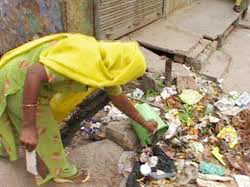
State govt. alleged of harassing scavengers by denying salaries'

[email protected] (CD Network)
September 11, 2012

scaveng

Mangalore, September 11: Two women working as 'scavengers' in Udupi for the last 42 years in Udupi are being harassed by the state government, Dr. Ravindranath Shanbhag, President, Human Rights Protection Foundation, Udupi, alleged.

Addressing media persons at Press Club in Mangalore on Tuesday, Mr. Shanbhag said that Akku and Leela have been working as scavengers for last 42 years in Government Women Teachers' Training Institute at Udupi (Karnataka) for a meager basic salary 15/- per month all the way.

From 1971, these two women were repeatedly requesting the higher authorities in the Department of Education to sanction minimum wages given to scavengers /sweepers. In 1999, they approached the Human Rights Protection Foundation, an NGO, for guidance and support. Even after two years of systematic correspondence from the NGO, there was no result. In 2001, they were guided and helped to file a petition with the Karnataka Administrative Tribunal at Bangalore. Soon after filing the case, the Education Department stopped even the meagre salary they have been paying. But the two ladies continued to work without salary in the hope of getting justice from the Law courts. On 25-7-2003, The Karnataka Administrative Tribunal (KAT) ordered for the regularization of services of the complainants in 90 days (copy enclosed). But still, nothing happened for fourteen months in spite of repeated representations from these ladies, Mr. Shanbhag said.

On 6-9-2004, the ladies filed contempt proceedings against the government. Immediately, the education department filed an appeal to the Karnataka High Court against the order of KAT. On 4-10-2004, Karnataka High court dismissed the appeal by the government after hearing and ordered the Government to pay the salaries (copy enclosed). Notices were issued for contempt of courts when salaries were not paid. Instead of paying their salaries, in 2005, Karnataka Govt preferred special leave petition before the Supreme Court of India (SLP No: 533/05) challenging the order of Karnataka High Court. On 22 -1-2010, Supreme Court of India passed the judgment ( Civil Appeal NO: 860-861 of 2010, copy enclosed) directing the Karnataka Government to consider the complainants' claim for regularization of employment with the principles laid down by Constitution Bench in State of Karnataka & others Vs Uma Devi & others.

But the scavengers have not received their wages even after two and a half years of the Supreme Court verdict. Now the authorities are saying that the women are not employable because they have reached the retirement age. However, the key point here is that they were indeed below the retirement age when the verdict was pronounced by the Supreme Court, Mr. Shanbhag said

The hapless illiterate women are asking whether there any other court above the Supreme Court of India so that they can get their hard earned salaries, Mr. Shanbhag lamented.


Comments

Add new comment

  • Coastaldigest.com reserves the right to delete or block any comments.
  • Coastaldigset.com is not responsible for its readers’ comments.
  • Comments that are abusive, incendiary or irrelevant are strictly prohibited.
  • Please use a genuine email ID and provide your name to avoid reject.
News Network
February 3,2026

wind.jpg

Dakshina Kannada MP Capt Brijesh Chowta has urged the Centre to give high priority to offshore wind energy generation along the Mangaluru coast, citing its strategic importance to India’s green energy and port-led development goals.

Raising the issue in the Lok Sabha under Rule 377, Chowta said studies by the National Institute of Oceanography have identified the Mangaluru coastline as part of India’s promising offshore wind ‘Zone-2’, covering nearly 6,490 sq km. He noted that the region’s relatively low exposure to cyclones and earthquakes makes it suitable for long-term offshore wind projects and called for its development as a dedicated offshore wind energy zone.

Highlighting the role of New Mangalore Port, Chowta said its modern infrastructure, multiple berths and heavy cargo-handling capacity position it well as a logistics hub for transporting and assembling large wind energy equipment.

He also pointed to the presence of major industrial units such as MRPL, OMPL, UPCL and the Mangaluru SEZ, which could serve as direct buyers of green power through power purchase agreements, improving project viability and speeding up execution.

With Karnataka’s peak power demand crossing 18,000 MW in early 2025, Chowta stressed the need to diversify renewable energy sources. He added that offshore wind projects in the Arabian Sea are strategically safer compared to the cyclone-prone Bay of Bengal.

Calling the project vital to India’s target of 500 GW of renewable energy by 2030, Chowta urged the Ministry of New and Renewable Energy to initiate resource assessments, pilot projects and stakeholder consultations at the earliest.

Comments

Add new comment

  • Coastaldigest.com reserves the right to delete or block any comments.
  • Coastaldigset.com is not responsible for its readers’ comments.
  • Comments that are abusive, incendiary or irrelevant are strictly prohibited.
  • Please use a genuine email ID and provide your name to avoid reject.
News Network
February 5,2026

In an era where digital distractions are the primary rival to academic excellence, the Karnataka Education Department is taking the fight directly to the living room. As the SSLC (Class 10) annual examinations loom, officials have launched a localized "digital strike" to ensure students aren't losing their competitive edge to scrolling or soap operas.

The 7-to-9 Lockdown

The department has issued a formal directive urging—and in some cases, enforcing via home visits—a total blackout of mobile phones and television sets between 7:00 PM and 9:00 PM. This two-hour window is being designated as "sacred study time" across the state until the examinations conclude on April 2.

Key Pillars of the Initiative:

•    Doorstep Advocacy: Teachers are transitioning from classrooms to living rooms, meeting parents to explain the psychological benefits of a distraction-free environment.

•    Parental Accountability: The campaign shifts the burden of discipline from the student to the household, asking parents to lead by example and switch off their own devices.

•    The Timeline: The focus remains sharp on the upcoming exam block, scheduled from March 18 to April 2.

"The objective is simple: uninterrupted focus. We are reclaiming the evening hours for the students, ensuring their environment is as prepared as their minds," stated a senior department official.

Student vs. Reality

While the student community has largely welcomed the "forced focus"—with many admitting they lack the willpower to ignore notifications—the move has sparked a debate on enforceability. Without a "TV Police," the success of this initiative rests entirely on the shoulders of parents and the persuasive power of visiting educators.

Comments

Add new comment

  • Coastaldigest.com reserves the right to delete or block any comments.
  • Coastaldigset.com is not responsible for its readers’ comments.
  • Comments that are abusive, incendiary or irrelevant are strictly prohibited.
  • Please use a genuine email ID and provide your name to avoid reject.
News Network
February 1,2026

Bengaluru: Karnataka Deputy Chief Minister D K Shivakumar on Sunday criticised the Union Budget presented by Finance Minister Nirmala Sitharaman, claiming it offered no tangible benefit to the state.

Though he said he was yet to study the budget in detail, Shivakumar asserted that Karnataka had gained little from it. “There is no benefit for our state from the central budget. I was observing it. They have now named a programme after Mahatma Gandhi, after repealing the MGNREGA Act that was named after him,” he said.

Speaking to reporters here, the Deputy Chief Minister demanded the restoration of MGNREGA, and made it clear that the newly enacted rural employment scheme — VB-G RAM G — which proposes a 60:40 fund-sharing formula between the Centre and the states, would not be implemented in Karnataka.

“I don’t see any major share for our state in this budget,” he added.

Shivakumar, who also holds charge of Bengaluru development, said there were high expectations for the city from the Union Budget. “The Prime Minister calls Bengaluru a ‘global city’, but what has the Centre done for it?” he asked.

He also drew attention to the problems faced by sugar factories, particularly those in the cooperative sector, alleging a lack of timely decisions and support from the central government.

Noting that the Centre has the authority to fix the minimum support price (MSP) for agricultural produce, Shivakumar said the Union government must take concrete steps to protect farmers’ interests.

Comments

Add new comment

  • Coastaldigest.com reserves the right to delete or block any comments.
  • Coastaldigset.com is not responsible for its readers’ comments.
  • Comments that are abusive, incendiary or irrelevant are strictly prohibited.
  • Please use a genuine email ID and provide your name to avoid reject.