Cyber-crime is a challenge amidst changing technology'

[email protected] (CD Network)
September 14, 2012

roshni_nilaya_8


Mangalore, September 14: One of the biggest challenges of cyber-crime is that it is transnational. It is not limited by boundaries, making it difficult for intelligence agencies to check and solve such crime, said Inspector General of Police (Western Range) Pratap Reddy.


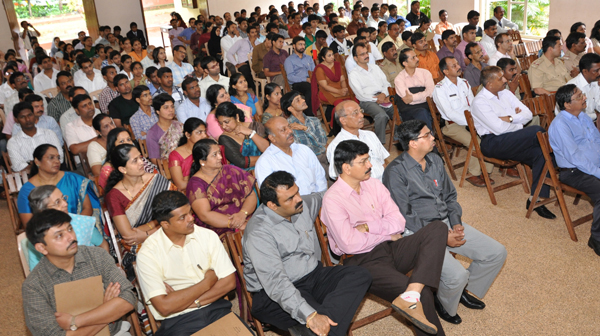
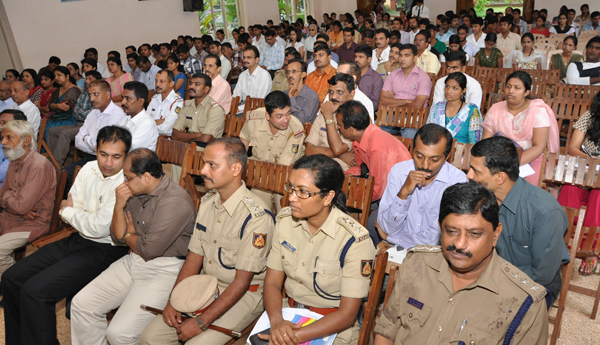
He was delivering the key-note address at the inaugural session of a state-level seminar on 'Cyber Crime' organised by Department of Criminology and Forensic Sciences and Secretarial Practices of Roshni Nilaya School of Social Work in collaboration with Western Range Police, Mangalore, on Friday.


He said that in cases of cyber-crime, the perpetrator did not have to be near a person to commit a crime. It is difficult to investigate cases where criminals are transnational as laws protect seamless sharing of evidence even in friendly countries. It is a challenge for experts to handle such cases, he said.


Talking about the legal challenges involved, he said that the IT Act of India (2000) had been amended in 2008 within a short period of eight years, as the law had to be up-to-date with the technology. “But the difficulty for police officers was coping with changing technology, which becomes difficult for the local and local police who are given this task. The law enforcement has to keep specialising in this field. We create specialised centres and agencies where they try to focus on developing expertise and handling sophisticated cases,” he said.


Another difficulty in investigating cyber-crime was the reliability of external experts in the field, as there was a lack of full-fledged in-house experts, he said.


Talking about the present scenario, he said that among 1000 million mobile connections in India, the problem was the lax personal attention of the users regarding the gadgets they used for surfing. He said that it was becoming easy for a mischief-monger to get his hands on personal details of any individual. “There have been occasions where Facebook accounts have been used to gather information to commit crimes. Hence it is essential to fundamentally understand the security concerns of cyber-crime and how to protect ourselves from it,” he said.


Delivering the presidential address, Principal of Roshni Nilaya Dr Sophia N Fernandes said that the internet had tremendously changed the world. While the advantages of information technology outweigh the disadvantages, it is high time we look at the negative aspects of it. A secure cyber space and information domain has become the need of the hour, she said.


She said that crime was a misdirected energy which needed to be directed towards right channels.


Dr Jacinta D'Souza, former principal of the College, said that it was vital that awareness be created on the importance of criminology and forensic science. Due to cyber-crime, there had been a loss of Rs 42,000 crore in the last year, and every minute, there were 8 victims who were duped, she said.


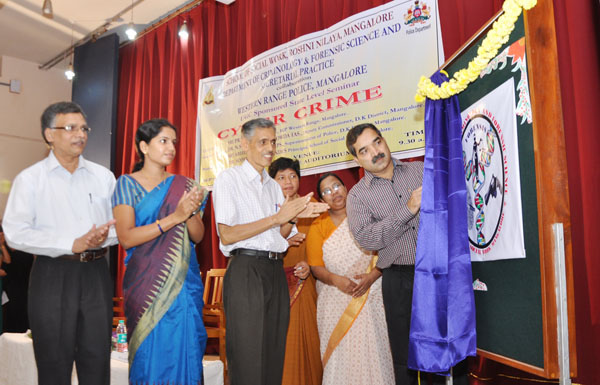
On the occasion, Pratap Reddy unveiled the new logo of the Department of Criminology and Forensic Science of the college.


Dr B Ashok delivered the introductory speech on the seminar.
roshni_nilaya_6

roshni_nilaya_1


Comments

Add new comment

  • Coastaldigest.com reserves the right to delete or block any comments.
  • Coastaldigset.com is not responsible for its readers’ comments.
  • Comments that are abusive, incendiary or irrelevant are strictly prohibited.
  • Please use a genuine email ID and provide your name to avoid reject.
News Network
February 5,2026

In an era where digital distractions are the primary rival to academic excellence, the Karnataka Education Department is taking the fight directly to the living room. As the SSLC (Class 10) annual examinations loom, officials have launched a localized "digital strike" to ensure students aren't losing their competitive edge to scrolling or soap operas.

The 7-to-9 Lockdown

The department has issued a formal directive urging—and in some cases, enforcing via home visits—a total blackout of mobile phones and television sets between 7:00 PM and 9:00 PM. This two-hour window is being designated as "sacred study time" across the state until the examinations conclude on April 2.

Key Pillars of the Initiative:

•    Doorstep Advocacy: Teachers are transitioning from classrooms to living rooms, meeting parents to explain the psychological benefits of a distraction-free environment.

•    Parental Accountability: The campaign shifts the burden of discipline from the student to the household, asking parents to lead by example and switch off their own devices.

•    The Timeline: The focus remains sharp on the upcoming exam block, scheduled from March 18 to April 2.

"The objective is simple: uninterrupted focus. We are reclaiming the evening hours for the students, ensuring their environment is as prepared as their minds," stated a senior department official.

Student vs. Reality

While the student community has largely welcomed the "forced focus"—with many admitting they lack the willpower to ignore notifications—the move has sparked a debate on enforceability. Without a "TV Police," the success of this initiative rests entirely on the shoulders of parents and the persuasive power of visiting educators.

Comments

Add new comment

  • Coastaldigest.com reserves the right to delete or block any comments.
  • Coastaldigset.com is not responsible for its readers’ comments.
  • Comments that are abusive, incendiary or irrelevant are strictly prohibited.
  • Please use a genuine email ID and provide your name to avoid reject.
coastaldigest.com news network
February 5,2026

protestkerala.jpg

Mangaluru: The KSRTC Mangaluru division has rolled back the fare hike on buses operating on the Mangaluru–Kasaragod route following the suspension of toll collection at the Arikkady toll plaza near Kumbala in Kasaragod district.

The fare revision had been implemented after the National Highways Authority of India (NHAI) began toll collection at the Arikkady plaza on NH-66. As a result, fares for ordinary and Rajahamsa services were increased by ₹7 and ₹10, respectively, raising the bus fare from Mangaluru to Kasaragod from ₹81 to ₹88.

Senior Divisional Controller of KSRTC’s Mangaluru division, Rajesh Shetty, said the fares were reduced after toll collection at the Arikkady plaza was stopped. “The tollgate began operations on January 13, and the toll amount was deducted from the FASTag accounts of KSRTC buses operating on the route. Following an order from the central government to suspend toll collection, KSRTC has also withdrawn the additional fare with immediate effect,” he said.

At present, vehicles travelling on the Mangaluru–Kasaragod route pay toll only at the Talapady toll plaza. The toll for light motor vehicles (LMVs) at Talapady is ₹80 for a same-day return, while heavy vehicles, including buses, are charged ₹250. At Arikkady, the toll rates were ₹130 for LMVs (same-day return) and ₹450 for buses.

Protests against Arikkady toll plaza

The Arikkady toll plaza witnessed widespread protests from January 12, the day toll collection commenced. On the second day, an action committee led by Manjeshwar MLA A K M Ashraf launched an indefinite protest at the site. Except for the BJP, leaders and workers of most major political parties participated in the agitation.

On the night of January 14, a large number of protesters gathered at the plaza and vandalised property, following which authorities temporarily suspended toll operations. The BJP later also expressed opposition to the toll plaza and criticised NHAI’s decision. 

Comments

Add new comment

  • Coastaldigest.com reserves the right to delete or block any comments.
  • Coastaldigset.com is not responsible for its readers’ comments.
  • Comments that are abusive, incendiary or irrelevant are strictly prohibited.
  • Please use a genuine email ID and provide your name to avoid reject.
News Network
February 1,2026

Golf.jpg

The coastal city of Mangaluru is gearing up for a major sporting milestone with the launch of a Golf Excellence Academy at the Pilikula Golf Club (PGC), scheduled to open on May 31. The initiative aims to position Mangaluru firmly on India’s national golfing map.

Speaking to reporters on Saturday during PGC’s first-ever floodlit Pro-Am tournament, club captain Manoj Kumar Shetty said the project is being funded by UAE-based philanthropist Michael D’Souza and is currently in the design phase. Experts from leading golf academies across the country are expected to visit Mangaluru to help shape the training programme and infrastructure.

The academy will train 20 young golfers at a time, with a long-term vision of producing national-level players from the region. Until now, PGC relied on an in-house coach, but the recent renovation of the course and the introduction of floodlights have opened new possibilities for expanding the sport.

Shetty said discussions are underway with two reputed coaching academies, whose heads are expected to visit PGC shortly. “A dormitory for trainers is already under construction. We are inviting academies to assess the facilities and suggest changes so we can build a truly world-class Golf Excellence Academy,” he said.

Professional golfer Aryan Roopa Anand noted that the floodlit course would be a game-changer for young players. “Students can now practise after school hours, even up to 8 or 9 pm, without compromising on academics,” he said.

Comments

Add new comment

  • Coastaldigest.com reserves the right to delete or block any comments.
  • Coastaldigset.com is not responsible for its readers’ comments.
  • Comments that are abusive, incendiary or irrelevant are strictly prohibited.
  • Please use a genuine email ID and provide your name to avoid reject.