RSS Supremo’s public relations exercise: What to believe in — Words or deeds?

Ram Puniyani
October 6, 2018

Do organizations say what they intend to do? Not necessarily. This came out clearly from the three long lectures by RSS Sarsanghchalak Mohan Bhagwat. The event was supposed to be a dialogue, but the maximum of dialogue one could see was his answering few questions at the end of lectures. This normal practice of answering the questions was underlined strongly, as probably this must have been novel thing for this organization.

What did Bhagwat say which was new? He did say that Hindutva includes Muslims, RSS respects Constitution, RSS is not opposed to reservations, RSS is not dictatorial-there is a place for opinions of others apart from that of Shri Bhagwat also, RSS respects the diversity of this Hindu nation etc. It became clear the gentleman was answering to the criticism of his organization by its critics, and there are plenty of them. What appeared novel was the change in the language of RSS from its major ideologue Guru Golwalkar to Mr. Bhagwat, the current chief? While Golwalkar bluntly appreciated the Nazi methods of exterminating the minorities, Bhagwat sounded to be accepting the existence of religious minorities. While Guru was announcing the Muslims, Christians and Communists are internal threat to Hindu nation, Bhagwat went on to say that they don’t fully agree with Guruji so his book, ‘Bunch of Thoughts’, has been republished by omitting such sentences which are threatening to minorities and asserting the Hindu nationalism in a blunt way.

So has RSS changed? In case of most of the organizations, they should be judged by their actions, or by the outcome of activities and the programs of the organizations which come into being due to RSS ideology. That’s what will tell us the true character, real agenda of RSS and help us assess why a pleasant face is being presented now?

The core activity of RSS is structured around Shakhas (Branches). In these shakhas young boys are given the physical training, one component of training is wielding lathis (batons). This is what is the most visible part of its activities. Running parallel to this is the ideological training, the bauddhiks (intellectual) sessions. This is where the real agenda of RSS gets itself manifested. In these shakha bauddhiks, which are backed up by long training camps leading to three year training program, the outcome of which are the Swamyamsevak/Pracharak, who is ready to take on the mantle of RSS programs in an independent way.

These bauddhiks indoctrinate the young boys in to believing that, India has been a Hindu nation from times immemorial. Roughly RSS training module, as gleaned from various sources, follows these lines. ‘We’ were having a great society, all castes were equal, women had honorable place in the society. The society was attacked by foreigners, the Muslims, leading to inequality of castes and degeneration of status of women. The Muslim kings destroyed our temples, and imposed Islam by force. The Muslim kings were very cruel, Mohammad Gazani (destroying Somnath) Mohammad Ghori (Betraying Prithivraj Chowhan). Hindu kings like Maharana Pratap and Shivaji saved the Hindu society. During freedom movement, while Savarkar put forward Hindu nationalism, the likes of Gandhi-Nehru and their followers regarded people of foreign religions also belonging to this land. Gandhi appeased the Muslims due to which Muslims got emboldened and demanded Pakistan; it’s due to faulty policies of Nehru that Kashmir, the integral part of India, has become a problem and so on and so forth.

The prachraks/swaymsevaks after this training go in to different segments of society, or into directly floated organizations, Bhartiya Jansangh, ABVP, BJP, VHP, Vanvasi kalian Ashram, Seva Bharati to name the few. Technically these are all independent organizations, but they are run and controlled by the trained prachraks of RSS. So RSS does not have to act as remote control as its ideology runs into the DNA of these organizations. The RSS module of indoctrination has created hatred in the society, hatred against Muslims and partly against Christians and those upholding secular values-liberals. One manifestation of this Hatred was the murder of Gandhi by Godse, who was the trained Pracharak of RSS. Sardar Patel must have been the first one to articulate this and see beyond the murder of Gandhi. He could see that the core reason of Gandhi’s murder was spread of Hatred in society by RSS.

While RSS has volunteers dressed in RSS uniform doing relief work, those taking up arms to indulge in violence are the one, who are guided by this hate against religious minorities. The violence prevalent in the society has been the outcome of issues, which are related to emotions brought into the service of Hindu nationalism of RSS. The communal violence went up in the wake of Ram Temple issue. If the country belongs to all, all religions are respected, why the crime of demolishing a five hundred year old mosque? Why marshalling of communal view of history to polarize the society? On similar lines why Holy cow is the political issue, while swami Vivekanand did say beef was eaten during Vedic times and Gandhi posited that state should not take up banning of cow slaughter or banning of beef?

One must say that RSS, as it has got renewed confidence during last four years is now trying to spread its net by mouthing liberal language. This velvet glow is the contribution of Mr. Bhagwat to the deepening divide created in the society due to the all round work of the progeny of RSS, which while sounding independent is totally loyal to the trainings it got while attending shakha baudhhiks. So we know that when the Jansangh component of Janata Party was asked to severe its links with RSS, they preferred to break the party and reemerge as BJP. So the late Prime Minister Vajpayee in Staten Island, while talking in front of NRI Indians reaffirmed his primary loyalty to RSS. Its respect of Indian Constitution is a sham as; for Indian Constitution; we are a secular democratic India, in contrast to Hindu nation, the soul of RSS agenda.

Comments

Add new comment

  • Coastaldigest.com reserves the right to delete or block any comments.
  • Coastaldigset.com is not responsible for its readers’ comments.
  • Comments that are abusive, incendiary or irrelevant are strictly prohibited.
  • Please use a genuine email ID and provide your name to avoid reject.
News Network
January 14,2026

phone.jpg

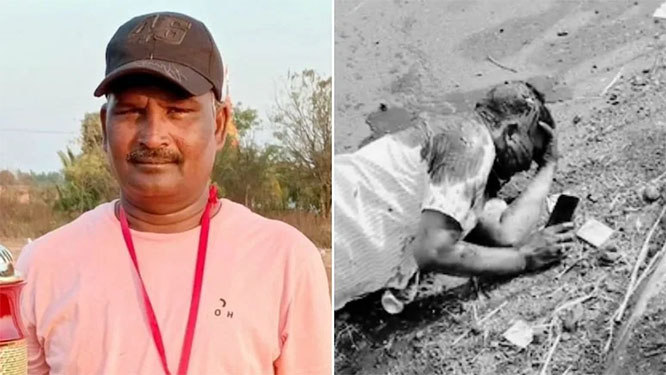
Bidar (Karnataka): A routine ride turned fatal when a nylon kite string slit the throat of a 48-year-old motorcyclist in Karnataka’s Bidar district, claiming his life in a chilling reminder of the deadly threat posed by banned kite-flying materials.

The victim, identified as Sanjukumar Hosamani, was riding near the Talamadagi Bridge when a taut kite string stretched across the road cut deep into his neck, causing profuse bleeding. Critically injured, Hosamani collapsed from his motorcycle but managed to place a final phone call to his daughter.

A disturbing video circulating on social media shows Hosamani drenched in blood, struggling to dial his daughter’s number as life ebbed away.

A passerby attempted to help by pressing a cloth against the wound to stop the bleeding. Locals said an ambulance was called immediately, but it arrived too late. Hosamani succumbed to his injuries before he could be taken to a hospital.

Family members have blamed the delay in emergency response for his death, alleging that timely medical assistance could have saved his life.

Following the incident, Hosamani’s relatives and local residents staged a protest at the accident spot, demanding strict action against the use of nylon kite strings and urgent improvements in emergency medical services.

Police have registered a case at Manna Ekhelli Police Station and said an investigation is underway.

Kite flying during Makar Sankranti is a long-standing tradition across many parts of India. While cotton strings coated with powdered glass were once common, they have increasingly been replaced by cheaper and more durable nylon strings. This durability, however, has proven lethal, as nylon can slice through skin with ease.

Commonly referred to as Chinese manjha, these strings pose a grave danger to two-wheeler riders, who often fail to notice the nearly invisible lines stretched across roads and flyovers.

The Karnataka incident is the latest in a series of such deaths reported across the country. Just this week, a 45-year-old man in Indore died after a kite string slit his throat. Delhi has witnessed multiple fatalities in recent years, including the deaths of a 22-year-old businessman in 2025, a biker in 2022, and a seven-year-old child in 2023.

Despite periodic raids and seizures by authorities, the recurring deaths underline serious gaps in enforcement, raising questions about whether current measures are sufficient to prevent further loss of life.

Comments

Add new comment

  • Coastaldigest.com reserves the right to delete or block any comments.
  • Coastaldigset.com is not responsible for its readers’ comments.
  • Comments that are abusive, incendiary or irrelevant are strictly prohibited.
  • Please use a genuine email ID and provide your name to avoid reject.
coastaldigest.com news network
January 10,2026

Mangaluru: In a strong pitch for redefining the economic future of coastal Karnataka, Deputy Chief Minister D K Shivakumar on Saturday lamented that the region’s vast natural wealth and tourism potential remain largely underutilised, forcing thousands of coastal youth to migrate outside the state and even abroad in search of opportunities.

Speaking in Mangaluru, Shivakumar said the coastal belt—stretching from Mangaluru to Karwar—continues to be one of Karnataka’s most scenic and resource-rich zones, yet local communities are not benefiting proportionately.

“Our beaches, backwaters, forests and culture are unmatched. But people from Mangaluru and other coastal districts continue to move out because we have not capitalised on what we already have,” he said.

Emphasising the talent of the younger generation, he noted that youth from coastal Karnataka are excelling in countries across the world. “They are brilliant, skilled and globally competitive. Our priority must be to create conditions where they can build their future here, not somewhere else. Our identity should shine on our own soil,” he asserted.

Shivakumar revealed that the state government has finalised a new tourism policy aimed at transforming Karnataka—particularly the coast—into a major tourism hub.

As part of the rollout, meetings will be held with investors, builders, tourism operators, entrepreneurs and local business communities.

“The government will extend full support to tourism development. Before implementing the policy, we will take inputs from stakeholders across Karnataka, especially from the coastal belt. Locals should be the prime beneficiaries of tourism growth,” he said.

He stressed that development must be driven by local capability, local enterprise and local initiative, ensuring that economic gains stay within the region rather than drifting outward.

Shivakumar added that Chief Minister Siddaramaiah is scheduled to visit later in the evening, urging those with concerns or suggestions regarding coastal tourism and youth opportunities to raise them directly during the visit.

Comments

Add new comment

  • Coastaldigest.com reserves the right to delete or block any comments.
  • Coastaldigset.com is not responsible for its readers’ comments.
  • Comments that are abusive, incendiary or irrelevant are strictly prohibited.
  • Please use a genuine email ID and provide your name to avoid reject.
News Network
January 6,2026

sharmila.jpg

Bengaluru A 34-year-old software engineer from Mangaluru lost her life due to asphyxiation after a fire broke out in her apartment in Ramamurthy Nagar late on Saturday night.

The deceased has been identified as Sharmila, a native of Kavoor in Mangaluru. She had relocated to Bengaluru about a year ago in search of better career prospects and was residing in an apartment complex at Subramanya Layout.

The incident occurred around 11 pm when Sharmila was alone in the flat, as her roommate had travelled out of town for the weekend. Preliminary investigations suggest that the fire may have been triggered by a short circuit in one of the rooms. Within a short span, the apartment was filled with dense, toxic smoke.

As the flames spread, the power supply to the building was cut off, plunging the flat into darkness. Police believe that Sharmila, trapped inside the smoke-filled apartment and unable to find an exit or a source of ventilation, succumbed to smoke inhalation.

The fire caused extensive damage to household items, with beds, curtains and other furniture completely gutted. Personnel from the Ramamurthy Nagar police shifted the body for post-mortem examination, which has since been completed. The mortal remains were later handed over to her family.

A case has been registered, and the police have launched a detailed investigation to determine the exact cause of the suspected electrical failure.

Comments

Add new comment

  • Coastaldigest.com reserves the right to delete or block any comments.
  • Coastaldigset.com is not responsible for its readers’ comments.
  • Comments that are abusive, incendiary or irrelevant are strictly prohibited.
  • Please use a genuine email ID and provide your name to avoid reject.