



Coronavirus was made in Wuhan lab, claims Chinese virologist Li-Meng Yan

Agencies
September 14, 2020

New Delhi, Sept 14: In a stunning revelation, a Chinese virologist has claimed that the coronavirus was created in a government-controlled laboratory in Wuhan, the original epicentre of the outbreak and offered scientific evidence to back her claims.

In an exclusive conversation with 'Loose Women', a British talk show, Dr Li-Meng Yan, the scientist said she was assigned to investigate "new pneumonia" in Wuhan. She said that she discovered a cover-up operation regarding coronavirus during her investigation.

Dr Li-Meng, who specialised in virology and immunology at the Hong Kong School of Public Health, said she conducted two researches on new pneumonia in China first between December and early January and the second one in mid-January, before fleeing to the US from Hong Kong.

"I decided to report this development to my supervisor, who is also a World Health Organisation (WHO) consultant. There was no response from the WHO and my supervisor. Everyone warned me that do not cross the right line and keep silence or else I would be made to disappear," she said.

The virologist said she had expected her supervisor to "do the right thing on behalf of the Chinese government and WHO".

Several countries, including the US, have criticised both China and WHO for covering-up the severity of the coronavirus outbreak.

Dr Li-Meng revealed she had contacted a famous Chinese YouTuber in the US. The expose, which was in Chinese, said that the Chinese Communist Party was covering up the COVID-19 crisis and there was a human-to-human transmission of the virus.

She also said that coronavirus is a "high-mutant virus" which will become an outbreak soon and the seafood market in Wuhan and the virus's intermediate hosts were just a "smokescreen".

The doctor then made the stunning revelation that the "virus is not from nature" and it was from a "laboratory controlled by the Chinese government in Wuhan".

"This is based on the China Military Institute that discovered and owned some bad coronavirus named CC45 and ZXC41. Based on that, after lab modification becomes a novel virus," she said.

Asked if she had scientific proof about the revelation, Dr Li-Meng said she has intelligence from the Chinese Center for Disease Control and Prevention (CDC), local doctors and other people across China. "These are the truths and all other things were covered up," she added.

The virologist said she is working on a scientific report with a small group of top scientists across the world and will be published soon.

"There are two reports. The first one will come in several days and it will tell the people all the evidence," she said, adding that the coronavirus is a highly contagious and a dangerous virus.

Asked whether she was worried about her safety after fleeing Hong Kong, the doctor remarked she wanted to deliver the message as soon as possible to the world.

"It was very scary at that time. But I had to do it because I am a doctor and I cannot see it happen. If I do not tell the truth to the world, I will be regretful. So, this foundation which is based in New York helped me to secretly leave Hong Kong. They help people who are against the Chinese government," she added.

Giving an insight into her unpublished scientific report, Dr Li-Meng said anyone, even those who do not have knowledge of biology, can read it.

"The genome sequence is like our human fingerprint. So, based on this you can recognise and identify this thing. 
So, I used the evidence existing in the genome sequence of Sars-CoV-2 to tell people why this came from China and why they are the only ones who made it," she stated.

She further said, "You can check, identify and verify it by yourself. It is a critical thing for us to know the origins of the virus. If not, it will be life-threatening for everyone."

Comments

Add new comment

  • Coastaldigest.com reserves the right to delete or block any comments.
  • Coastaldigset.com is not responsible for its readers’ comments.
  • Comments that are abusive, incendiary or irrelevant are strictly prohibited.
  • Please use a genuine email ID and provide your name to avoid reject.
News Network
February 3,2026

Bengaluru: Following reports of fresh Nipah virus (NiV) cases in West Bengal and heightened vigilance across parts of Southeast Asia, the Karnataka Health Department has placed the state on high alert and activated emergency preparedness protocols.

Health officials said enhanced surveillance measures have been initiated after two healthcare workers in Barasat, West Bengal, tested positive for the virus earlier this month. While no cases have been reported in Karnataka so far, authorities said the state’s past exposure to Nipah outbreaks and high inter-state mobility warranted preventive action.

Officials have directed district health teams to intensify monitoring, particularly at hospitals and points of entry, and to ensure early detection and isolation of suspected cases.

High Mortality Virus with Multiple Transmission Routes

Nipah virus is a zoonotic disease that can spread from animals to humans and has a reported fatality rate ranging between 60 and 75 per cent. Fruit bats, also known as flying foxes, are the natural reservoirs of the virus and can transmit it by contaminating food sources with saliva or urine.

Known modes of transmission include:

•    Contaminated food: Consumption of fruits partially eaten by bats or raw date-palm sap
•    Animal contact: Exposure to infected pigs or other animals
•    Human-to-human transmission: Close contact with body fluids of infected persons, particularly in healthcare settings

Symptoms and Disease Progression

The incubation period typically ranges from 4 to 14 days, though delayed onset has also been reported. Early symptoms often resemble common viral infections, making prompt clinical suspicion critical.

•    Initial symptoms: Fever, headache, body aches, fatigue, sore throat
•    Progressive symptoms: Drowsiness, disorientation, altered mental state
•    Severe stage: Seizures, neck stiffness and acute encephalitis, which can rapidly progress to coma

Public Health Advisory

The Health Department has issued precautionary guidelines urging the public to adopt risk-avoidance practices to prevent any local spillover.

Do’s
•    Wash fruits thoroughly before consumption
•    Drink boiled and cooled water
•    Use protective equipment while handling livestock
•    Maintain strict hand hygiene

Don’ts
•    Avoid fruits found on the ground or showing bite marks
•    Do not consume beverages made from raw tree sap, including toddy
•    Avoid areas with dense bat populations
•    Do not handle sick or dead animals

Preparedness Measures

Officials confirmed that isolation wards are being readied in major government hospitals and that medical staff are being sensitised to identify early warning signs.

“There is no cause for panic, but there is a need for heightened vigilance,” a senior health official said, adding that there is currently no approved vaccine or specific antiviral treatment for Nipah, and care remains largely supportive.

Comments

Add new comment

  • Coastaldigest.com reserves the right to delete or block any comments.
  • Coastaldigset.com is not responsible for its readers’ comments.
  • Comments that are abusive, incendiary or irrelevant are strictly prohibited.
  • Please use a genuine email ID and provide your name to avoid reject.
News Network
February 4,2026

Mangaluru: Urban local bodies and gram panchayats should make the use of Kannada on signboards mandatory while issuing trade licences to commercial establishments, Dakshina Kannada Deputy Commissioner Darshan HV said. He also called for regular inspections to ensure compliance.

Presiding over the District Kannada Awareness Committee meeting at the deputy commissioner’s office, Darshan said the city corporation would be directed to ensure that shops operating in malls prominently display their names in Kannada. “All commercial establishments, including shops, companies, offices and hotels, must mandatorily display their names in Kannada on signboards,” he said.

The deputy commissioner added that the National Highways Authority of India (NHAI) would be instructed to include Kannada on signboards along national highways. Banks, he said, would be directed through committee meetings to provide application forms in Kannada.

“Even if English-medium schools and colleges impart education in English, their signboards must display the institution’s name in Kannada. Steps will also be taken to ensure that private buses display place names in Kannada,” Darshan said.

During the meeting, committee members raised concerns over the closure of Kannada-medium schools in rural areas due to a shortage of teachers and stressed the need for immediate corrective measures. They also pointed out that several industries employ workers from other states while overlooking local candidates.

Members further demanded that nationalised banks provide deposit and withdrawal slips in Kannada. It was brought to the deputy commissioner’s notice that the presence of staff without knowledge of Kannada in rural branches of nationalised banks is causing hardship to local customers.

Meanwhile, MP Srinath, president of the District Kannada Sahitya Parishat, urged the district administration to allot land for the construction of a district Kannada Bhavana in Mangaluru.

Comments

Add new comment

  • Coastaldigest.com reserves the right to delete or block any comments.
  • Coastaldigset.com is not responsible for its readers’ comments.
  • Comments that are abusive, incendiary or irrelevant are strictly prohibited.
  • Please use a genuine email ID and provide your name to avoid reject.
coastaldigest.com news network
February 5,2026

protestkerala.jpg

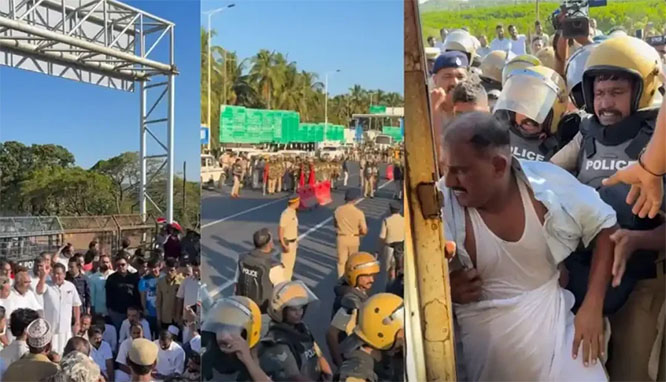
Mangaluru: The KSRTC Mangaluru division has rolled back the fare hike on buses operating on the Mangaluru–Kasaragod route following the suspension of toll collection at the Arikkady toll plaza near Kumbala in Kasaragod district.

The fare revision had been implemented after the National Highways Authority of India (NHAI) began toll collection at the Arikkady plaza on NH-66. As a result, fares for ordinary and Rajahamsa services were increased by ₹7 and ₹10, respectively, raising the bus fare from Mangaluru to Kasaragod from ₹81 to ₹88.

Senior Divisional Controller of KSRTC’s Mangaluru division, Rajesh Shetty, said the fares were reduced after toll collection at the Arikkady plaza was stopped. “The tollgate began operations on January 13, and the toll amount was deducted from the FASTag accounts of KSRTC buses operating on the route. Following an order from the central government to suspend toll collection, KSRTC has also withdrawn the additional fare with immediate effect,” he said.

At present, vehicles travelling on the Mangaluru–Kasaragod route pay toll only at the Talapady toll plaza. The toll for light motor vehicles (LMVs) at Talapady is ₹80 for a same-day return, while heavy vehicles, including buses, are charged ₹250. At Arikkady, the toll rates were ₹130 for LMVs (same-day return) and ₹450 for buses.

Protests against Arikkady toll plaza

The Arikkady toll plaza witnessed widespread protests from January 12, the day toll collection commenced. On the second day, an action committee led by Manjeshwar MLA A K M Ashraf launched an indefinite protest at the site. Except for the BJP, leaders and workers of most major political parties participated in the agitation.

On the night of January 14, a large number of protesters gathered at the plaza and vandalised property, following which authorities temporarily suspended toll operations. The BJP later also expressed opposition to the toll plaza and criticised NHAI’s decision. 

Comments

Add new comment

  • Coastaldigest.com reserves the right to delete or block any comments.
  • Coastaldigset.com is not responsible for its readers’ comments.
  • Comments that are abusive, incendiary or irrelevant are strictly prohibited.
  • Please use a genuine email ID and provide your name to avoid reject.