



Why the world cares so much about Malala Yousufzai

October 11, 2012
Malala_Yousufzai

Islamabad, October 11: A 14-year-old Pakistani schoolgirl campaigner shot by the Taliban had defied threats for years, believing the good work she was doing for her community was her best protection, her father said on Wednesday.

Malala Yousufzai was shot and seriously wounded on Tuesday as she was leaving her school in her hometown in the Swat valley, northwest of the capital, Islamabad.

The Taliban claimed responsibility saying her promotion of education for girls was pro-Western and she had opposed them.

The shooting has outraged people in a country seemingly inured to extreme violence since a surge in Islamist militancy began after the September 11, 2001, attacks on the United States.

"She is candle of peace that they have tried to blow out," said one Pakistani man, Abdul Majid Mehsud, 45, from the violence plagued South Waziristan region.

In the Swat valley, a one-time tourist spot infiltrated by militants from Afghan border bases more than five years ago, her family and community are praying for her survival.

Her father, Ziauddin Yousufzai, who ran a girls' school, said his daughter had wanted to go into politics.

He said that of all the things he loved about her, it was her fairness - her democratic ideals - that he loved the most.

Malala, then a dimpled 11-year-old with dark eyes, shot to fame when she wrote a blog under a pen name for the BBC about living under the rule of the Pakistani Taliban.

The militants, led by a firebrand young preacher, took over her valley through a mixture of violence, intimidation and the failure of the authorities to stand up to them.

Even after the military finally went into action with an offensive in 2009 that swept most of the militants from the valley, it remained a dangerous place.

Malala didn't keep quiet. She campaigned for education for girls and later received Pakistan's highest civilian prize.

Her prominence came at a cost.

"We were being threatened. A couple of times, letters were thrown in our house, that Malala should stop doing what she is doing or the outcome will be very bad," her father, sounding drained and despondent, said by telephone.

But despite the threats, he said he had turned down offers of protection from the security forces.

"We stayed away from that because she is a young female. The tradition here does not allow a female to have men close by," he said.

"NEVER FEARFUL"

Malala had spent many sleepless nights kept awake by gunfire, had been forced to flee her home with her two younger brothers and walked past the headless bodies of those who defied the Taliban.

Her parents also wanted her to have some chance of a normal childhood, her father said. Security in Swat had improved after the army had pushed back the Taliban in 2009.

"We did not want her to be carrying her school books surrounded by bodyguards. She would not have been able to receive education freely," he said.

Her parents thought she would be safe among their neighbours in the town of Mingora, nestled among the snow-capped mountains that earned Swat the nickname of the Switzerland of Pakistan.

"I never imagined that this could happen because Malala is a young innocent girl," her father said. "Whenever there were threats, relatives and friends would tell Malala to take care but Malala was never fearful."

"She would frequently say 'I am satisfied. I am doing good work for my people so nobody can do anything to me'."

Recently, Malala had started to organise a fund to make sure poor girls could go to school, said Ahmed Shah, a family friend and chairman of the Swat Private Schools Association.

"She had planned on making the Malala Education Foundation in Swat," Shah said, adding that the Taliban even used to print threats against her in the newspaper.

On Tuesday, a gunman arrived at her school, asking for her by name. He opened fire on her and two classmates on a bus.

Now her father is waiting for her to regain consciousness as she lies swathed in white bandages in a military hospital.

"Doctors are hopeful," he said. "I appeal to the country to pray for her survival."

Ziauddin Yousufzai said the shooting would stop neither him nor his daughter from their work.

He echoed many people who said that the shooting was against Islamic law and against the culture of the ethnic Pashtun region, which forbids the targeting of women.

"We will focus even more on our work with more strength," he said. "If all of us die fighting, we will still not leave this work."


Comments

Add new comment

  • Coastaldigest.com reserves the right to delete or block any comments.
  • Coastaldigset.com is not responsible for its readers’ comments.
  • Comments that are abusive, incendiary or irrelevant are strictly prohibited.
  • Please use a genuine email ID and provide your name to avoid reject.
News Network
January 19,2026

trump.jpg

Donald Trump has linked his repeated threats to seize Greenland to his failure to win the Nobel Peace Prize, in a letter to Norwegian Prime Minister Jonas Gahr Støre.

The authenticity of the letter, in which Trump says he no longer feels obligated to “think purely of peace,” was confirmed by Støre to the Norwegian newspaper VG.

“Considering your country decided not to give me the Nobel Peace Prize for having stopped eight wars plus, I no longer feel an obligation to think purely of peace,” Trump wrote, adding he can now “think about what is good and proper for the United States.”

Støre said Trump’s letter was in response to a short message he had sent earlier, on behalf of himself and Finland’s President Alexander Stubb.

Trump has escalated rhetoric toward Greenland, a self-governing Danish territory, insisting the US will take control “one way or the other.” Over the weekend, he tweeted: “Now it is time, and it will be done!!!”

On Saturday, Trump threatened a 10% tariff on imports from Denmark, Norway, Sweden, France, Germany, the UK, the Netherlands, and Finland from 1 February until the US is allowed to purchase the island. EU diplomats met for emergency talks on possible retaliatory tariffs and sanctions.

In his letter, Trump argued Denmark “cannot protect” Greenland from Russia or China, questioning Danish ownership: “There are no written documents; it’s only that a boat landed there hundreds of years ago.” He added that NATO should support the US, claiming the world is “not secure unless we have complete and total control of Greenland.”

Trump’s stance has unsettled the EU and NATO, as he refused to rule out military action to take control of the mineral-rich island.

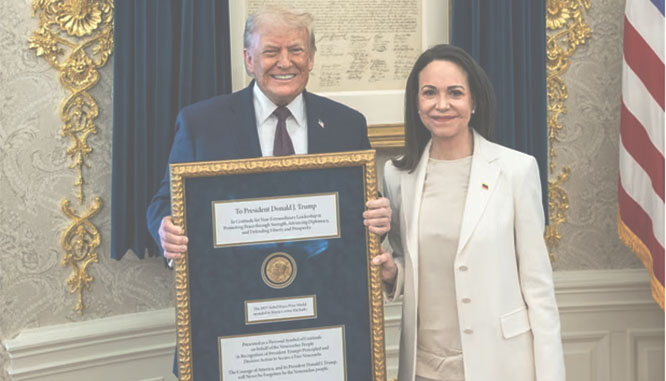
The Nobel Peace Prize is awarded by the independent Norwegian Nobel Committee, not the government. Trump had campaigned for last year’s prize, which went to Venezuelan opposition leader María Corina Machado, who dedicated her award to him.

Støre reiterated that the Nobel Prize decision rests solely with the committee.

Comments

Add new comment

  • Coastaldigest.com reserves the right to delete or block any comments.
  • Coastaldigset.com is not responsible for its readers’ comments.
  • Comments that are abusive, incendiary or irrelevant are strictly prohibited.
  • Please use a genuine email ID and provide your name to avoid reject.
News Network
January 10,2026

greenland.jpg

US officials have discussed sending lump sum payments to Greenlanders as part of a bid to convince them to secede from Denmark and potentially join the United States, according to four sources familiar with the matter.

While the exact dollar figure and logistics of any payment are unclear, US officials, including White House aides, have discussed figures ranging from $10,000 to $100,000 per person, said two of the sources, who requested anonymity to discuss internal deliberations.

The idea of directly paying residents of Greenland, an overseas territory of Denmark, offers one explanation of how the US might attempt to "buy" the island of 57,000 people, despite authorities' insistence in Copenhagen and Nuuk that Greenland is not for sale.

The tactic ⁠is among various plans being discussed by the White House for acquiring Greenland, including potential use of the U.S. military. But it risks coming off as overly transactional and even degrading to a population that has long debated its own independence and its economic dependence on Denmark. "Enough is enough ... No more fantasies about annexation," Greenland's Prime Minister Jens-Frederik Nielsen wrote in a Facebook post on Sunday after U.S. President Donald Trump again told reporters the U.S. needed to acquire the island.

European leaders say decision for Greenland, Denmark

Leaders in Copenhagen and throughout Europe have reacted to comments by Trump and other White House officials asserting their right to Greenland in recent days with disdain, particularly given that the U.S. and Denmark are NATO allies bound by a mutual defense agreement. On Tuesday, France, Germany, Italy, Poland, Spain, Britain and Denmark issued a joint statement, saying only Greenland and Denmark can decide matters regarding their relations.

Asked for comment about discussions to purchase the island, including the possibility of direct payments to Greenlanders, the White House referred Reuters to remarks by press secretary Karoline Leavitt and Secretary of State Marco Rubio on Wednesday.

During a press briefing, Leavitt acknowledged that Trump and his national security aides were "looking at what a potential purchase would look like." Rubio said he would meet his Danish counterpart next week in Washington to discuss Greenland.

The Danish embassy declined to comment, and Greenland's representative office in Washington did not ⁠respond to a request for comment.

Greenland discussions increasingly serious

Trump has long argued that the US needs to acquire Greenland on several grounds, including that it is rich in minerals needed for advanced military applications. He has also said the Western Hemisphere broadly needs to be under the geopolitical influence of Washington.

While internal deliberations regarding how to seize Greenland have occurred among Trump's aides since before he took office a year ago, there has been renewed urgency ⁠after his government captured Venezuelan leader Nicolas Maduro in a daring snatch-and-grab operation over the weekend, according to sources familiar with internal deliberations.

One source ⁠said White House aides were eager to carry over the momentum from the Maduro operation toward accomplishing Trump's other long-standing geopolitical goals.

"We need Greenland from the standpoint of national security, and Denmark isn't going to be able to do it," Trump told reporters on Air Force One on Sunday. "It's so strategic."

One of the sources familiar with White House deliberations said the internal discussions regarding lump sum payments were not necessarily new. However, that person said, they had gotten more serious in recent days, and aides were entertaining higher values, with a $100,000-per-person payment - which would result in a total payment of almost $6 billion - a real possibility.

Many details of any potential payments were unclear, such as when and how they would be doled out if the Trump administration pursued that route or what exactly would be expected of the Greenlanders in exchange. The White House has said military intervention is possible, though officials have also said the U.S. prefers buying the island or otherwise acquiring it through diplomatic means.

Free association agreement one option

Among the possibilities being floated by Trump's aides, a White House official said on Tuesday, is trying to enter into a type of agreement with the island called a Compact of Free Association.

The precise details of COFA agreements - which have only ever been extended to the small island nations of Micronesia, the Marshall Islands and Palau - vary depending on the signatory. But the US government typically provides many essential services, such as mail delivery and military protection. In exchange, the US military operates freely in COFA countries, and trade with the US is largely duty-free.

COFA agreements have previously been inked with independent countries, and Greenland would likely need to separate from Denmark for such a plan to proceed. In theory, payments could be used to induce Greenlanders to vote for their independence, or to sign onto a COFA after such a vote.

While polls show an overwhelming majority of Greenlanders want independence, concerns about the economic costs of separating from Denmark - among other issues - have kept most Greenlandic legislators from calling for an independence referendum.

Surveys also show most Greenlanders, while open to separating from Denmark, do not want to be part of the US.

Comments

Add new comment

  • Coastaldigest.com reserves the right to delete or block any comments.
  • Coastaldigset.com is not responsible for its readers’ comments.
  • Comments that are abusive, incendiary or irrelevant are strictly prohibited.
  • Please use a genuine email ID and provide your name to avoid reject.