



Bulandshahr: Unraveling the anatomy of a riot

Ram Puniyani
December 21, 2018

The scene of violence in the name of emotive issues has been continuously throwing new patterns of instigating and orchestrating violence. In recent times we saw the major violence following the demolition of Babri Mosque (1992), Godhra train burning (Gujarat carnage 2002), murder of a Swami (Kandhamal 2008), on the pretext of love Jihad (Muzzafarnanger 2013) among others. The gross pattern seems to be to spread hatred against sections of society and unleash the hate, which gets converted in to violence. In last couple of years, what has dominated the scene of violence has been the accusations related to slaughter of cows, beginning with horrifying murder of Mohammad Akhlaq down to the killing of Junaid, Cow-beef have been used as a ‘weapon of hate’. In this very series follows the Bulandshahr killings of two men, one of them being a Hindu police officer.

This tragedy goes on to show the underbelly of communal violence, which in due course brings into its orbit not only the religious minorities but people from the majority religion also. As such the violence does not involve much killing of majority community, though they also suffer in small number. In this case, in Bulandshahr, we see the major victim is not only a Hindu but an officer of the state police. While full details are yet to come out with SIT probing, whatever can be gleaned from the media reports is frightening enough.

In beginning of December 2018 a large congregation of Muslims, Ijtema, took place in Bulandshahar. The congregation had participation of Muslims, by rough count of around fifty lakhs. These religious congregations do keep taking place in different parts of the country. Nearly seventy Kilometers away from the place of this congregation, in village Siyana of Bulandshahar, this incidence came to notice. It seems someone had thrown the remains of a slaughtered cow in an agricultural filed. The villagers noticed carcass, reported it to police, which planned to initiate the action as per law. As the carcass was being taken away in the tractor, some 40-50 youth from outside descended on the village and took charge of tractor. As per some reports the beef was thrown in the field by those belonging to Bharatiya Janta Morcha andBajrang dal. Reports by some journalists, report (video) shows that the whole incident was orchestrated by outsiders.

The youth took the tractor to the police station, lodged the FIR and created ruckus. Yogesh Raj, local Chief of Bajrang Dal, who lodged the FIR, was booked as the prime accused in the incident. Various versions are in the air. What followed led to the death of Inspector Subodh Singh in a brutal manner. Sudarshan TV’s, Suresh Chavanhke, the right wing channel close to RSS, tried to link up the violence to the Muslims-Itjema. As per Chavanke’s tweet the violence was indulged in by the Muslims participating in Itjema. This was countered by the police authorities who tweeted that the incident had nothing whatsoever to do with the Itjema, which was at a place far away and was a peaceful event.

Many other theories also started being thrown up. One being that one Jitendra Malik, who is part of Rashtriya Rifles posted in Kashmir, was present on the spot and was the culprit of the violence. His elder brother denied the charge and promised to prove the innocence of his brother. Malik was brought back from his duty in Kashmir, but nothing much seems to have been proven about his complicity. The usual question is who did it? Before that let’s see the very revealing facts related to the Inspector, SHO, who as per his sister was killed in a planned manner. Subodh Singh was the one who had investigated the Mohammad Akhlaq case leading to arrest of many culprits. It is said that it was he “who always took the right stand especially on Hindu-Muslim issues”. Probably he was not letting Hindutva groups to have their divisive ways. The local unit of BJP related organizations had written to the officials demanding transfer of Singh. The other highlights related to the incident are mixed, disturbing and appreciable both types. One is that many of those who had come to attend Ijtema were sheltered in the Shiva Temple. SHO Singh’s teenager son appealed for peace and harmony in the area. He said "I would appeal to the entire country, please stop Hindu-Muslim violence. People get violent at the slightest provocation. People should understand and think that they are bound by the law." In response the DSP in a moving face book post stated “I salute Abhishek who even after losing his father is not speaking the language of hatred and violence,”

 On the other side the Chief minister of UP, Mr. Adityanath, in the aftermath of this tragedy commented that incidents related to Cow slaughter are increasing and need to be curbed. This ‘Cow-Primacy’ got reflected in the statement of BJP MP who advised the investigating team to examine whether SHO came under attack as he failed to check the cow slaughters and cow smuggling! The murder of Singh a serving police official is relegated to second place in Yogi-BJP scheme of things. These are disturbing signs of times where the politics is being dictated by Modi-Yogi, in which emotive issues are taking precedence over human lives, which does not disturb them so far as these serve their political agenda of polarization!

Meanwhile the sense of insecurity is reigning supreme in the village, where the incident took place. The villagers who repeatedly affirmed that their village had braved all the communal incidents like Babri Demolition violence Muzzafarnagar violence, etc. is now fearing for their safety, feeling insecure in the places where they have been living in peace in decades.

In the trajectory of patterns of violence, Bulanshahr is yet another pattern of probably a planned violence, where the major victim can be from majority community itself; yet another victim of cow politics!

Comments

Add new comment

  • Coastaldigest.com reserves the right to delete or block any comments.
  • Coastaldigset.com is not responsible for its readers’ comments.
  • Comments that are abusive, incendiary or irrelevant are strictly prohibited.
  • Please use a genuine email ID and provide your name to avoid reject.
News Network
January 14,2026

phone.jpg

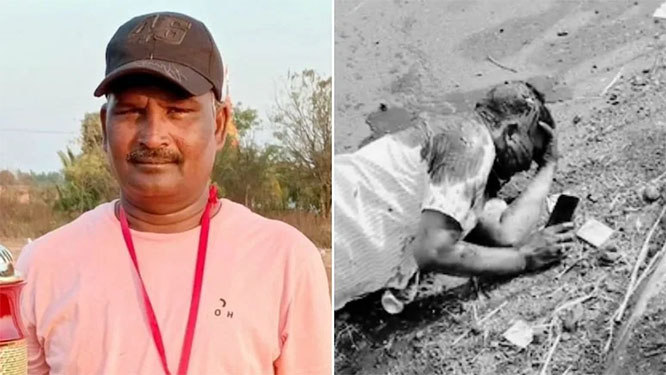
Bidar (Karnataka): A routine ride turned fatal when a nylon kite string slit the throat of a 48-year-old motorcyclist in Karnataka’s Bidar district, claiming his life in a chilling reminder of the deadly threat posed by banned kite-flying materials.

The victim, identified as Sanjukumar Hosamani, was riding near the Talamadagi Bridge when a taut kite string stretched across the road cut deep into his neck, causing profuse bleeding. Critically injured, Hosamani collapsed from his motorcycle but managed to place a final phone call to his daughter.

A disturbing video circulating on social media shows Hosamani drenched in blood, struggling to dial his daughter’s number as life ebbed away.

A passerby attempted to help by pressing a cloth against the wound to stop the bleeding. Locals said an ambulance was called immediately, but it arrived too late. Hosamani succumbed to his injuries before he could be taken to a hospital.

Family members have blamed the delay in emergency response for his death, alleging that timely medical assistance could have saved his life.

Following the incident, Hosamani’s relatives and local residents staged a protest at the accident spot, demanding strict action against the use of nylon kite strings and urgent improvements in emergency medical services.

Police have registered a case at Manna Ekhelli Police Station and said an investigation is underway.

Kite flying during Makar Sankranti is a long-standing tradition across many parts of India. While cotton strings coated with powdered glass were once common, they have increasingly been replaced by cheaper and more durable nylon strings. This durability, however, has proven lethal, as nylon can slice through skin with ease.

Commonly referred to as Chinese manjha, these strings pose a grave danger to two-wheeler riders, who often fail to notice the nearly invisible lines stretched across roads and flyovers.

The Karnataka incident is the latest in a series of such deaths reported across the country. Just this week, a 45-year-old man in Indore died after a kite string slit his throat. Delhi has witnessed multiple fatalities in recent years, including the deaths of a 22-year-old businessman in 2025, a biker in 2022, and a seven-year-old child in 2023.

Despite periodic raids and seizures by authorities, the recurring deaths underline serious gaps in enforcement, raising questions about whether current measures are sufficient to prevent further loss of life.

Comments

Add new comment

  • Coastaldigest.com reserves the right to delete or block any comments.
  • Coastaldigset.com is not responsible for its readers’ comments.
  • Comments that are abusive, incendiary or irrelevant are strictly prohibited.
  • Please use a genuine email ID and provide your name to avoid reject.
News Network
January 8,2026

bird.jpg

Mangaluru: The pristine landscapes of Pilikula Nisargadhama are set to become a haven for avian enthusiasts as the 12th edition of the Karnataka Bird Festival (popularly known as Hakki Habba) kicks off this Friday. Organized by the Karnataka Eco-Tourism Development Board in collaboration with the Forest Department, the three-day event (January 9–11) aims to pivot the state’s tourism narrative from "tiger-centric" to a more inclusive appreciation of its diverse winged inhabitants.

A Majestic Mascot for Coastal Conservation

This year, the spotlight shines brightly on the White-bellied Sea Eagle, a formidable raptor of the coastal skies, which has been designated as the festival’s official mascot. Board Chairperson Shalet Pinto emphasized that the choice highlights the region's unique maritime biodiversity and the urgent need for environmental protection through sustainable eco-tourism.

Global Knowledge, Local Roots

The festival will be officially inaugurated by Eshwar B. Khandre, Minister for Forest, Ecology, and Environment. Beyond the spectacle, the event serves as a critical bridge between seasoned naturalists and the next generation.

Anthony Mariappa, DCF of the Mangaluru Division, noted that the festival is designed as an "outreach and knowledge-sharing powerhouse." More than 180 students from six prestigious colleges, including St. Aloysius and Mangalore University, will trade their classrooms for the field, gaining hands-on experience in bird spotting and documentation.

The "Big Twelve": Habitats Under the Lens

Ornithologists and participants will fan out across twelve strategically identified locations representing four distinct ecosystems:

•    Wetlands: Kenjar, Kavoor, Polali, and Jokatte.
•    Forest Patches: Pilikula and Mangalore University campus.
•    Shorelines: Mukka and Sasihitlu.
•    Estuaries: Bettampady.

With over 420 species recorded in the Dakshina Kannada district—including 40 migratory visitors—this edition of the Bird Festival promises to be a milestone in documenting India's western flyway. 

Comments

Add new comment

  • Coastaldigest.com reserves the right to delete or block any comments.
  • Coastaldigset.com is not responsible for its readers’ comments.
  • Comments that are abusive, incendiary or irrelevant are strictly prohibited.
  • Please use a genuine email ID and provide your name to avoid reject.
News Network
January 7,2026

BCCI1.jpg

Mangaluru: In a decisive move aimed at reshaping the economic future of the Beary community, the Bearys Chamber of Commerce and Industry (BCCI) formally launched its Youth Wing at a well-attended ceremony held at Ocean Pearl Hotel, Mangaluru on January 6. Bringing together business leaders, professionals, policymakers, and young aspirants, the event highlighted a shared resolve to build the community through entrepreneurship.

Delivering the keynote address, BCCI General Secretary Mohammed Imthiyaz outlined the motivation behind the formation of the chamber and its newly launched Youth Wing. He candidly spoke about the structural and mindset gaps that have historically held back the Beary community as a business force when compared to other established trading communities in India. These shortcomings, he said, can only be addressed through focused mentoring, collective effort, and by encouraging the younger generation to think beyond conventional boundaries.

“The future lies in empowering our youth to lead from the front and position the Beary community among India’s strongest business communities,” he said.

Guest speaker Yezdani Feroze delivered a thought-provoking address, asserting that the Beary community has the potential to lead Indian Muslims through trade and entrepreneurship. He stressed that success is not merely a reward for hard work, but for clear thinking, describing entrepreneurs as “professional thinkers.”

“The ummah cannot afford to produce more job seekers,” he said. “We need job creators, innovators, and history makers.”

Highlighting the power of ideas, Feroze reminded the audience that every invention—from mobile phones to everyday furniture—was once just an idea someone chose not to abandon. He called for the establishment of idea forums to nurture young entrepreneurs and help transform concepts into viable enterprises.

The programme also featured the felicitation of M A Gafoor, newly appointed Chairman of the Coastal Development Authority, and Shahid Thekkil, Chairman of the Karnataka Minimum Wage Board Commission. Thanking the organisers, Gafoor reaffirmed his commitment to the development of coastal Karnataka, with a special focus on boosting tourism. Shahid Thekkil expressed confidence that BCCI would play a pivotal role in producing a new generation of entrepreneurs from the community.

Presiding over the event, S M Rashid Haji officially announced the inauguration of the Youth Wing and emphasised that the initiative goes far beyond symbolic launches or routine meetings.

“This is about building entrepreneurs and investing in long-term community development,” he said.

Four coordinators were appointed to lead the Youth Wing: Zeeshan Ramlan (CEO, Talentzy), Ashhar Abdul Razak (Hajjaj Group), Ayaan Haris, and Muhammed Shahbaz.

The event brought together prominent business leaders, professionals, policymakers, and young aspirants, underscoring a shared vision of entrepreneurship-led community growth. 

Earlier, the programme included the recitation of the Holy Quran by Badruddin Panambur. Nissar Fakeer Mohammed, Secretary of BCCI, welcomed the gathering and served as the Master of Ceremony. The event concluded with a vote of thanks by BCCI Treasurer Mansoor Ahmed.

BCCI6.jpg

BCCI5.jpg

BCCI4.jpg

BCCI3.jpg

BCCI2.jpg

Comments

Add new comment

  • Coastaldigest.com reserves the right to delete or block any comments.
  • Coastaldigset.com is not responsible for its readers’ comments.
  • Comments that are abusive, incendiary or irrelevant are strictly prohibited.
  • Please use a genuine email ID and provide your name to avoid reject.