



From Disha Ravi to Arundhati Roy, SC sedition law stay to impact several high-profile cases

News Network
May 11, 2022

arundhatroy.jpg

New Delhi, May 11: In the wake of the Supreme Court order staying the registration of FIRs, ongoing probes and coercive measures under the sedition law, all eyes will be on the fate of several high-profile cases registered under the draconian British-era law.

According to a National Crime Records Bureau (NCRB) report, a total of 356 cases of sedition -- as defined under section 124A of the IPC -- were registered and 548 people arrested between 2015 and 2020, out of which only six were convicted.

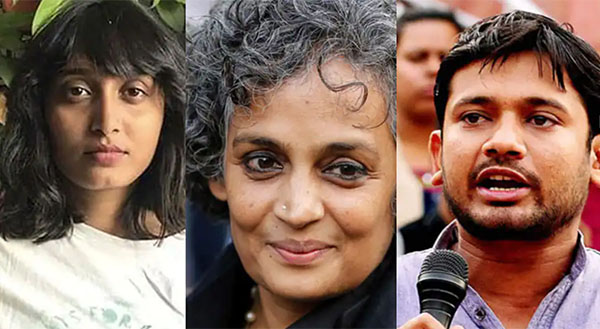
A 21-year-old Bengaluru-based environment activist, Disha Ravi, was arrested by the Delhi Police on February 14, 2021 for allegedly creating and disseminating a "toolkit" on the farmers' protests against farm laws brought by the BJP government at the Centre.

The toolkit was tweeted by Swedish environment activist Greta Thunberg on February 3, 2021.

The Delhi Police registered an FIR against Ravi, who was working at a vegan store in Bengaluru and fighting for environment issues since her student days, under IPC sections 124A (sedition), 120-B (criminal conspiracy) and 153A (promoting enmity between different groups).

Ravi was granted bail on February 23, 2021 by a Delhi court, which stated that "the offence of sedition cannot be invoked to minister to the wounded vanity of the governments".

Additional sessions judge Dharmender Rana said citizens are "conscience keepers" of the government in any democratic nation, and they cannot be put behind the bars simply because they choose to disagree with State policies.

In 2016, a group of students from the prestigious Jawaharlal Nehru University had held a poetry session to mark the third anniversary of the hanging of 2001 Parliament attack case convict Afzal Guru. The Delhi Police later charged the then JNU student union president Kanhaiya Kumar, along with other students and union leaders, including Umar Khalid and Anirban Bhattacharya, under section 124A and other provisions of the Indian Penal Code (IPC).

Three Kashmiri students, who were enrolled in the RBS Engineering College, Agra under the PM Special Scholarship Scheme for the students of Jammu and Kashmir, were arrested on October 28 last year for allegedly posting a WhatsApp status praising Pakistani players after their victory against India in a T20 cricket match.

They were languishing in prison till April 26 this year even after securing bail on March 30 from the Allahabad High Court due to the non-availability of local guarantors, a high-security amount and police verification.

Some noted journalists like late Vinod Dua had to face the wrath of the draconian law for views expressed by them on social media.

Dua, in his programme on Youtube on March 30, 2020, made remarks against the government's handling of the Covid crisis, following which an FIR was registered against him by the Himachal Pradesh Police under the sedition law and other charges on a complaint by a BJP leader in Shimla.

The sedition charges were quashed by the Supreme Court which held that journalists are entitled to protection in sedition cases so long as they do not incite people to violence against the government established by law or with the intention of creating public disorder.

Kerala-based journalist Siddique Kappan was arrested by the Uttar Pradesh Police while he was on his way to report the rape case of a Dalit woman in Hathras on October 5, 2020.

The FIR against him claimed that he was going to Hathras with the intention "to breach the peace" as part of a "conspiracy".

The Special Task Force of Uttar Pradesh, in its charge sheet filed in April last year, charged eight people linked to the Popular Front of India, including its students' wing leader K A Rauf Sherif and Kappan, for sedition, criminal conspiracy, funding of terror activities and other offences.

Booker Prize winner writer and activist Arundhati Roy was booked under the sedition law, along with Hurriyat leader Late Syed Ali Shah Geelani and others, in 2010 for their alleged "anti-India" speech at a seminar.

Roy and others were charged under sections 124A, 153A (promoting enmity between classes), 153B (imputations, assertions prejudicial to national integration), 504 (insult intended to provoke breach of peace) and 505 (false statement, rumour circulated with intent to cause mutiny or offence against public peace.

Student leader from JNU and IIT passout Sharjeel Imam is facing charges under the sedition law for making alleged inflammatory speeches during the protests against the Citizenship Amendment Act (CAA) and the National Register of Citizens (NRC) in 2019.

A court has framed charges against Imam, who is in judicial custody since 2020, under sections 124A, 153A (promoting enmity between different groups on grounds of religion), 153B (imputations, assertions prejudicial to national integration), 505 (statements conducing to public mischief) of the IPC, and section 13 (punishment for unlawful activities) of the Unlawful Activities (Prevention) Activities (UAPA).

As per the prosecution, Imam had allegedly made speeches at Jamia Millia Islamia on December 13, 2019, and at Aligarh Muslim University on December 16, 2019, where he threatened to cut off Assam and the rest of the northeast from India. In his defence, Imam had earlier told the court that he is not a terrorist and his prosecution is a whip of a monarch rather than a government established by law.

Comments

Add new comment

  • Coastaldigest.com reserves the right to delete or block any comments.
  • Coastaldigset.com is not responsible for its readers’ comments.
  • Comments that are abusive, incendiary or irrelevant are strictly prohibited.
  • Please use a genuine email ID and provide your name to avoid reject.
News Network
November 22,2025

The Karnataka government has announced a 50% rebate on pending traffic and transport fines. The discount is available from November 21 to December 12.

The rebate applies to all traffic e-challans and violation cases booked by the RTO between 1991–92 and 2019–20. Officials clarified that the offer is not applicable to pending tax dues and is restricted only to traffic-violation fines.

Across Karnataka, more than 4 lakh RTO cases remain pending, including those involving transport vehicles. While thousands of vehicle owners have already cleared their dues, the department expects to generate substantial revenue through this limited-period rebate.

How to Pay and Avail the Discount

There are three ways to check and pay your pending fines:

1. Through Mobile Apps
Available on both Play Store and App Store:
•    Karnataka State Police (KSP) app
•    KarnatakaOne app
•    ASTraM app

Steps:
•    Enter your vehicle number in any of the above apps
•    Verify the photo/details of your vehicle
•    Pay the fine with the 50% discount applied

2. Visit a Traffic Police Station

You can pay your pending fine at any nearby traffic police station.

3. Visit the Traffic Management Centre (TMC)

•    Location: First Floor, Infantry Road, near Indian Express, Bengaluru

Transport Commissioner Yogeesh A M said, “We don't issue e-challans, so there's no online payment system.”

The department estimates ₹52 crore in pending RTO fines up to March 2020. “With the 50% rebate, we expect to collect around ₹25 crore if all dues are cleared,” he added.

Comments

Add new comment

  • Coastaldigest.com reserves the right to delete or block any comments.
  • Coastaldigset.com is not responsible for its readers’ comments.
  • Comments that are abusive, incendiary or irrelevant are strictly prohibited.
  • Please use a genuine email ID and provide your name to avoid reject.
News Network
November 26,2025

Mangaluru, Nov 26: Assembly Speaker and local MLA U.T. Khader has initiated a high-level push to resolve one of Mangaluru’s longest-standing traffic headaches: the narrow, high-density stretch of National Highway-66 between Nanthoor and Talapady.

He announced on Tuesday that a formal proposal has been submitted to the Union Ministry of Road Transport and Highways (MoRTH) seeking approval to prepare a Detailed Project Report (DPR) for the widening of this crucial corridor.

The plan specifically aims to expand the existing 45-meter road width to a full 60 meters, coupled with the construction of dedicated service roads. Khader highlighted that land for a 60-meter highway was originally acquired during the initial four-laning project, but only 45 meters were developed, leading to a perpetual bottleneck.

"With vehicle density rising sharply, the expansion has become unavoidable," Khader stated, stressing that the upgrade is essential for ensuring smoother traffic flow and improving safety at the city's main entry and exit points.

The stretch between Nanthoor and Talapady is a vital link on the busy Kochi-Panvel coastal highway and connects to major city junctions. The move to utilize the previously acquired land for the full 60-meter width is seen as a necessary measure to catch up with the region's rapid vehicular growth and prevent further traffic gridlocks.

Comments

Add new comment

  • Coastaldigest.com reserves the right to delete or block any comments.
  • Coastaldigset.com is not responsible for its readers’ comments.
  • Comments that are abusive, incendiary or irrelevant are strictly prohibited.
  • Please use a genuine email ID and provide your name to avoid reject.
News Network
November 21,2025

Bengaluru, Nov 21: The Karnataka government is facing pressure to overhaul its employment system after a high-level Cabinet sub-committee recommended the complete phase-out of job outsourcing in government offices, boards, and corporations by March 2028. The move is aimed at tackling a systemic issue that has led to the potential violation of constitutional reservation policies and the exploitation of workers.

The Call for Systemic Change

With over three lakh vacant posts currently being filled through private agencies on an outsource, insource, or daily wage basis, the sub-committee highlighted a significant lapse. "As a result, reservations are not being followed as per the Constitution and state laws. It’s an urgent need to take serious steps to change the system. It has been recommended to completely stop the system of outsourcing by March 2028," the panel stated in a document.

The practice of outsourcing involves private companies hiring workers to perform duties for a government agency. Critics argue this model results in lesser salaries, a lack of social security benefits (otherwise available to permanent government employees), and a failure to adhere to the provisions of Articles 14 and 15 of the Constitution, which guarantee equality before the law and prohibit discrimination.

The 'Bidar Model' as a Stop-Gap Solution

To regulate the current mode of employment and reduce worker exploitation until the 2028 deadline, the government plans to establish workers’ services multi-purpose cooperative societies across all districts, following the successful "Bidar Model."

The Bidar District Services of Labour Multi-purpose Cooperative Society Ltd., which operates under the District Commissioner, is cited as a successful example of providing a measure of social security to outsourced staff. Labour Department officials argue this society ensures workers receive their due wages and statutory facilities like ESI (Employees' State Insurance) and PF (Provident Fund), in exchange for a 1% service fee collected from the employees.

legislative push and Priority Insourcing

The recommendations, led by the sub-committee headed by Law and Parliamentary Affairs Minister H K Patil, are set to be discussed at the next Cabinet meeting. The committee has proposed the introduction of the Karnataka Outsourced Employees (Regulation, Placement and Welfare) Bill 2025.

In a move addressing immediate concerns, Labour Minister Santosh Lad, a member of the sub-committee, has reportedly assured that steps will be taken over the next 2-3 years to insource workers in "life-threatening services" on a priority basis. This includes essential personnel like pourakarmikas (sanitation workers), drivers, electrical staff in the Energy Department, and Health Department staff handling contagious diseases. The transition aims to grant these workers the long-term security and benefits they currently lack under the outsourcing system. 

Comments

Add new comment

  • Coastaldigest.com reserves the right to delete or block any comments.
  • Coastaldigset.com is not responsible for its readers’ comments.
  • Comments that are abusive, incendiary or irrelevant are strictly prohibited.
  • Please use a genuine email ID and provide your name to avoid reject.