Authentic survey to be carried out prior to issue of PR cards: Ponnuraj

September 3, 2012

PR_1

Mangalore, September 3: The Property Cards (PR Cards) which would be given to owners of properties as part of the implementation of the Urban Property Ownership Records (UPOR) project, would act as a 'mirror' which would reflect the true property status in the city, said V Ponnuraj, Commisioner, Survey Settlement and land records and head of Urban Property Ownership records project.

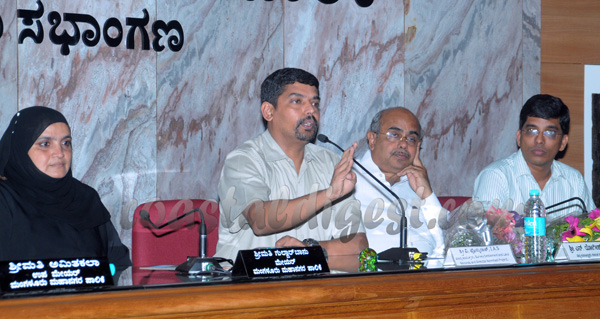
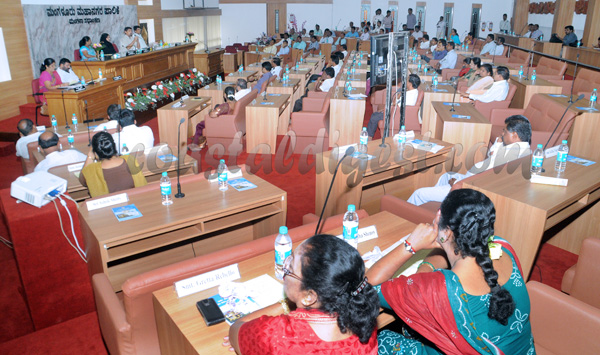
Addressing corporators at a meeting convened at the Mangalore City Corporation to clarify doubts concerning the UPOR project on Monday, Mr. Ponnuraj said that the PR Card would reflect the spatial reality of the property besides explaining its legal status.

The project implementation work has advanced at a good pace at Mysore and Shimoga cities but there were hitches as far as Mangalore was concerned since the work carried out by the private partnering agency was not satisfactory. A different agency has been entrusted with the job of conducting survey and helping in the implementation of the project in the city, Mr. Ponnuraj said. In Mysore and Shimoga, survey work has seen 100% completion, he said, stating that now issuance of PR cards is in the process there. In Hubli-Dharwad, one third of survey work is still pending while Bellary and Mangalore cities are also yet to see completion of survey work, he said.

During the survey, the space dimensions, past record of the property in terms of RTC, municipal documents and other records etc are ascertained and only after a complete information gathering is a property card granted to the owner of the property, Mr. Ponnuraj said. Factors such as lease, loans, river flow over the concerned property etc are also taken into consideration, he reveald. Markings are made after informing the owner of the property as well the owners of the neighbouring properties, he said. A duration of 30 days is allotted to the concerned parties to place before the UPOR authorities any complaints with regard to the survey and after the completion of the said duration, the card is finalled, he said. However, Mr. Ponnuraj added that even after granting a PR card, there is scope for people to challenge its issuance and disprove the survey details false by taking the matter to court, within 3 years of issuance of the card.

Responding to the query of one of the corporators with regard to the fees people would have to pay to get the PR cards, Mr. Ponnuraj said that no money is charged from people for UPOR processes up till the issuance of the card. To obtain the cards, property owners would have to pay charges based on the category that they belong to. Charges would also be determined depending on the size of the concerned property, he said. For the poor and lower middle class, and the minimum plot (about 600 sq. ft) charges would range from Rs. 300-500, he said, while property owners of commercial as well as residential properties measuring more than 1 acre would have to shell out around Rs. 4,500-5,000. The payments would be one-time payments.

When asked about irregularities in the already existing RTC and other records, Mr. Ponuraj said that adjacent lands would also be surveyed and an honest attempt at ascertaining whether some portion of the property had been wrongly encroached would be made before entering data into the Property card. If adjacent land records are also found to be correct, then the existing land record details would be considered for the concerned property, he said.

In case of the land or property being disputed and being sub-judice, a survey would be conducted nevertheless and name of the owner would be mentioned as mentioned in the records but it would be recorded in the PR Card that the matter is in the court of law, he said.

In case of divisions of property, new property numbers would be given and separate cards would be made, Mr. Ponnuraj said. A UPOR Cell would come into existence in the region which would keep track of such updates and developments, he informed. In case of a property being in the name of a person who is no more, it would be seen if his children are willing to divide the property. If they do not, then the PR card for the property will be issued in the name of all children, he said.

About two and a half lakh properties exist in Mangalore and each one has to be given a PR card, he said. The PR card will serve as a legal document for registration and statutory purposes. There is no scope for cheating with PR card, he added, stating that voter ID cards and UID cards would be linked to the PR card.

The project is being implemented on a Public Private Partnership (PPP) basis, Mr. Ponnuraj said, stating that 66% of the funding is being done by the government while 33% of the investement has to come from private agency. The private party has been made to invest so that the quality of work is maintained and that its output is linked to the investment, he said.

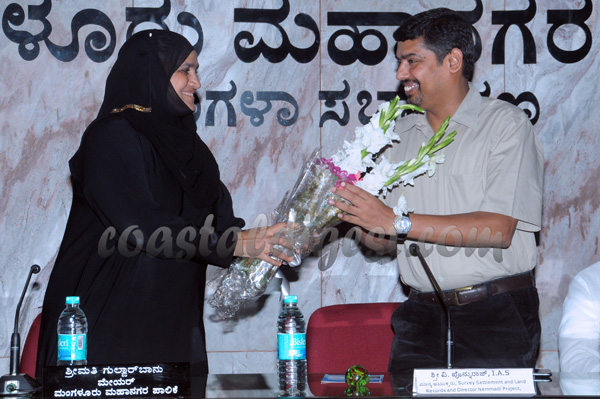
N Yogish Bhat, Deputy Speaker, Karnataka Legislative Assembly, Gulzar Banu, Mayor, Amitha Kala, Deputy Mayor and Dr. Harish Kumar, Commissioner, MCC, were also present.
PR_2

PR_3

Comments

Add new comment

  • Coastaldigest.com reserves the right to delete or block any comments.
  • Coastaldigset.com is not responsible for its readers’ comments.
  • Comments that are abusive, incendiary or irrelevant are strictly prohibited.
  • Please use a genuine email ID and provide your name to avoid reject.
News Network
February 8,2026

Baraka1.jpg

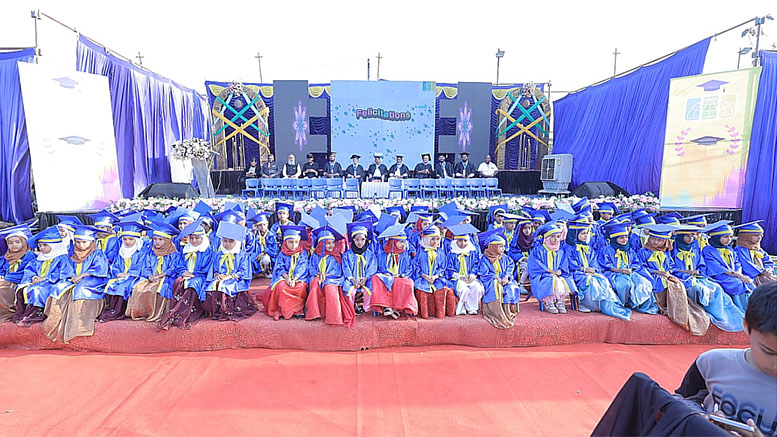
Mangaluru: Emphasising the importance of integrating cultural awareness with formal education, former Mangaluru North MLA and noted community leader Moidin Bawa said such an approach is vital for the holistic development of children and helps shape responsible, confident future citizens. He was speaking as the chief guest at the Prep Graduation Ceremony of Barakah International School and College.

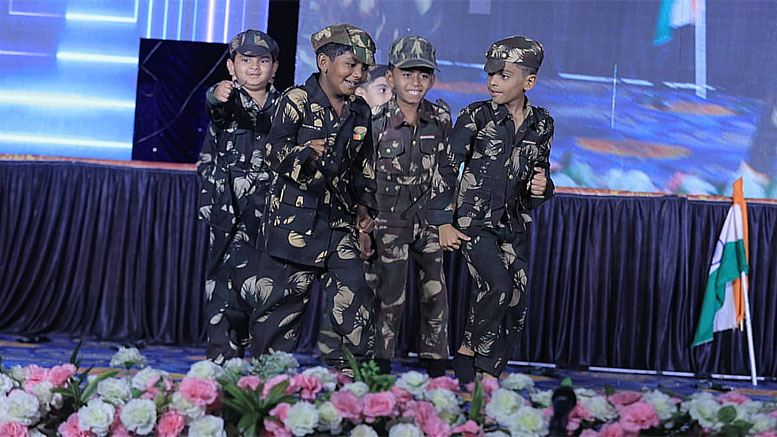
The young graduates enthralled the audience with a vibrant mix of performances, including skits, action songs, short plays, and other engaging cultural programmes that showcased the creativity and confidence nurtured by the institution.

The event was graced by several prominent personalities, including Abdul Naser “Lucky Star”, President of the Wakf Advisory Committee; Dr Mohammed Nohman, Orthopaedic Surgeon; S. A. Khaleel, Chairman of the Bolar Islamic Centre; Naufal Kokkada, President of the SKSM Youth Wing; Suhail Kandak, Chairman of the Make a Change Foundation; and Mohammad Ashraf Badriya, President of Muslim Aikyata Vedike, among others.

The programme began with a warm welcome by Principal Sharfuddin B.S., who highlighted Barakah’s distinctive educational philosophy that blends academic excellence with strong moral and cultural values.

Ayan Ashraf, Director of Barakah, conveyed the Chairman’s message and reaffirmed the institution’s commitment to value-based education.

The vote of thanks was proposed by Mohammed Haneef, Principal of Islamic Studies.

Barakah International School and College is a reputed educational institution in Mangaluru, offering quality education from nursery to degree level. The institution is known for its holistic education model that harmoniously integrates cultural values with academic excellence, ensuring the all-round development of students.

Baraka3.jpg

Baraka2.jpg

Comments

Add new comment

  • Coastaldigest.com reserves the right to delete or block any comments.
  • Coastaldigset.com is not responsible for its readers’ comments.
  • Comments that are abusive, incendiary or irrelevant are strictly prohibited.
  • Please use a genuine email ID and provide your name to avoid reject.
News Network
February 1,2026

Golf.jpg

The coastal city of Mangaluru is gearing up for a major sporting milestone with the launch of a Golf Excellence Academy at the Pilikula Golf Club (PGC), scheduled to open on May 31. The initiative aims to position Mangaluru firmly on India’s national golfing map.

Speaking to reporters on Saturday during PGC’s first-ever floodlit Pro-Am tournament, club captain Manoj Kumar Shetty said the project is being funded by UAE-based philanthropist Michael D’Souza and is currently in the design phase. Experts from leading golf academies across the country are expected to visit Mangaluru to help shape the training programme and infrastructure.

The academy will train 20 young golfers at a time, with a long-term vision of producing national-level players from the region. Until now, PGC relied on an in-house coach, but the recent renovation of the course and the introduction of floodlights have opened new possibilities for expanding the sport.

Shetty said discussions are underway with two reputed coaching academies, whose heads are expected to visit PGC shortly. “A dormitory for trainers is already under construction. We are inviting academies to assess the facilities and suggest changes so we can build a truly world-class Golf Excellence Academy,” he said.

Professional golfer Aryan Roopa Anand noted that the floodlit course would be a game-changer for young players. “Students can now practise after school hours, even up to 8 or 9 pm, without compromising on academics,” he said.

Comments

Add new comment

  • Coastaldigest.com reserves the right to delete or block any comments.
  • Coastaldigset.com is not responsible for its readers’ comments.
  • Comments that are abusive, incendiary or irrelevant are strictly prohibited.
  • Please use a genuine email ID and provide your name to avoid reject.
News Network
February 5,2026

In an era where digital distractions are the primary rival to academic excellence, the Karnataka Education Department is taking the fight directly to the living room. As the SSLC (Class 10) annual examinations loom, officials have launched a localized "digital strike" to ensure students aren't losing their competitive edge to scrolling or soap operas.

The 7-to-9 Lockdown

The department has issued a formal directive urging—and in some cases, enforcing via home visits—a total blackout of mobile phones and television sets between 7:00 PM and 9:00 PM. This two-hour window is being designated as "sacred study time" across the state until the examinations conclude on April 2.

Key Pillars of the Initiative:

•    Doorstep Advocacy: Teachers are transitioning from classrooms to living rooms, meeting parents to explain the psychological benefits of a distraction-free environment.

•    Parental Accountability: The campaign shifts the burden of discipline from the student to the household, asking parents to lead by example and switch off their own devices.

•    The Timeline: The focus remains sharp on the upcoming exam block, scheduled from March 18 to April 2.

"The objective is simple: uninterrupted focus. We are reclaiming the evening hours for the students, ensuring their environment is as prepared as their minds," stated a senior department official.

Student vs. Reality

While the student community has largely welcomed the "forced focus"—with many admitting they lack the willpower to ignore notifications—the move has sparked a debate on enforceability. Without a "TV Police," the success of this initiative rests entirely on the shoulders of parents and the persuasive power of visiting educators.

Comments

Add new comment

  • Coastaldigest.com reserves the right to delete or block any comments.
  • Coastaldigset.com is not responsible for its readers’ comments.
  • Comments that are abusive, incendiary or irrelevant are strictly prohibited.
  • Please use a genuine email ID and provide your name to avoid reject.